
Free Position Description (Leading Hand) Template
Clearly define the roles and safety duties of a Leading Hand with our free Position Description template. Aligned with Australian WHS practices. Download today.
Free Position Description (Leading Hand) Template
DOCX • 135 KB + PDF
Updated Oct 2026
No signup required
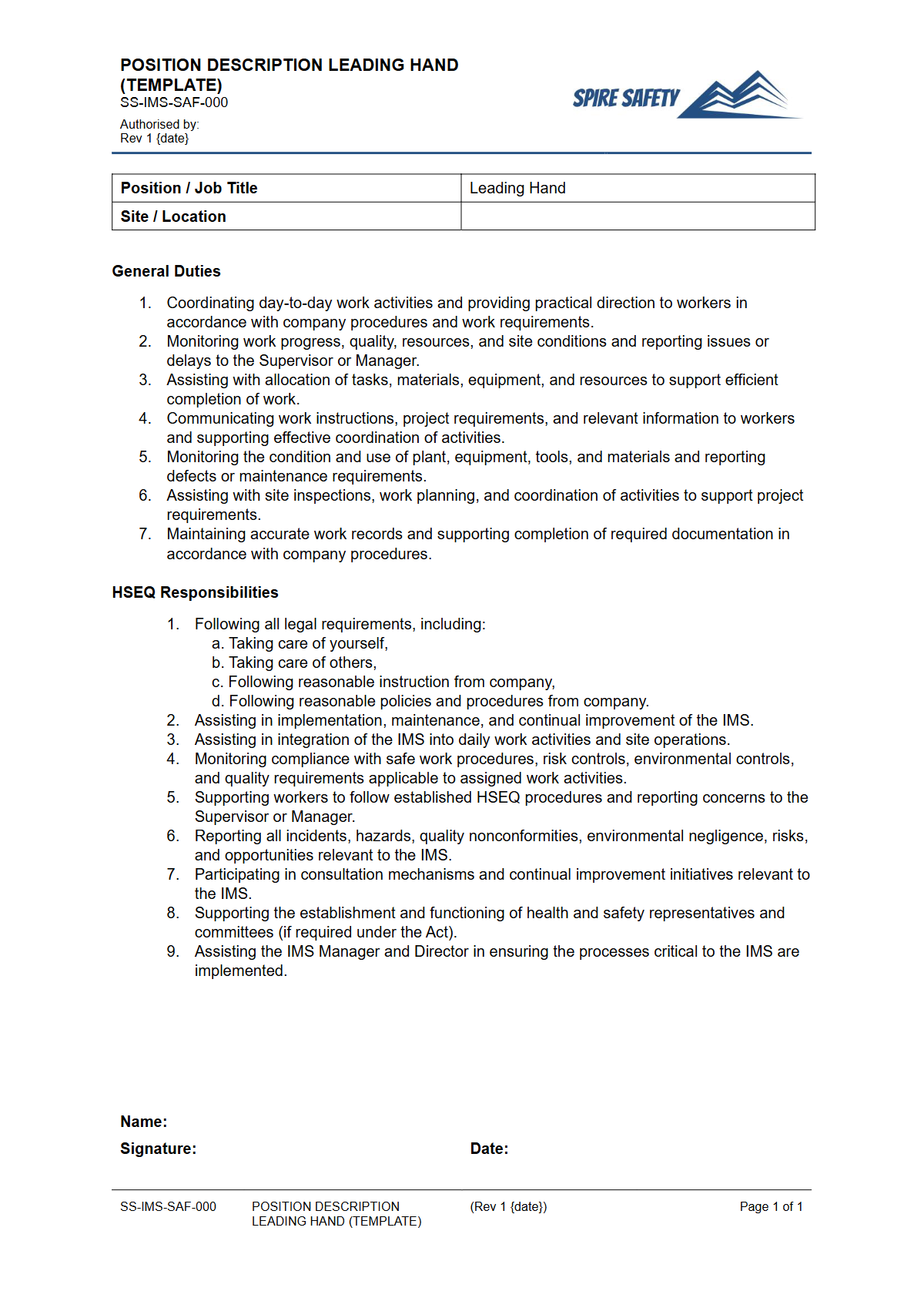
Purpose of the Free Position Description (Leading Hand) Template
A Leading Hand is a critical link between management and the workforce, playing a vital hands-on role in daily operations and site safety. This Free Position Description (Leading Hand) Template provides a structured framework for formally defining their responsibilities, authority, and, most importantly, their WHS duties.
A well-drafted Position Description (PD) ensures clarity, sets clear performance expectations, and helps integrate safety leadership into the ground level of your organisation. By outlining specific WHS accountabilities, you empower your Leading Hands to effectively supervise tasks, promote safe work behaviours, and contribute to a positive safety culture.
Using a formalised PD helps ensure that these key personnel understand their obligations to consult with workers, identify hazards, and implement risk controls. It forms a foundational document within your broader safety framework and is a key component of effective WHS management systems. This template helps you articulate the key competencies, qualifications, and reporting lines necessary for the role, reducing ambiguity and improving operational efficiency.
How to use the Free Position Description (Leading Hand) Template
This template is provided in both DOCX and PDF formats for your convenience. The DOCX file is fully editable, allowing you to tailor the content to your specific business needs. We recommend following these steps:
- Download the DOCX version of the template.
- Review each section and replace the placeholder text with information relevant to your organisation, industry, and the specific team the Leading Hand will manage.
- Pay close attention to the “Key Responsibilities” and “WHS Responsibilities” sections. These must be detailed and accurate. For instance, specify if the role includes duties like conducting pre-start checks, leading toolbox talks, or contributing to the development of key safety documents like our Free Hand Tools SWMS Template.
- Consult with key stakeholders, such as the relevant manager, WHS personnel, and even experienced team members, to ensure the PD is practical and comprehensive.
- Once finalised, have the document approved by management and provide a copy to the employee upon hiring or as part of a role review.
Important: It is critical that you customise this document for your specific workplace, equipment, and operational context. We have provided a structured starting point, but you must ensure the final document accurately reflects the specific duties and legal obligations at your site.
For complex operations, seeking external advice from a WHS consulting firm can provide valuable assurance.
When to use it
A Leading Hand Position Description is a versatile document that should be used at several key points in the employment lifecycle. It is essential during the recruitment and selection process to attract suitable candidates and provide them with a clear understanding of the role's expectations.
It should be given to a new employee as part of their induction and onboarding process. The PD also serves as a valuable tool during performance reviews, providing a benchmark against which an employee's performance, including their safety leadership, can be measured.
It can also be used to clarify roles and responsibilities within a growing or restructuring team.
Who should use it
This template is designed for use by anyone responsible for managing personnel and ensuring workplace safety. This typically includes:
- Business Owners and Directors
- Operations Managers
- Human Resources (HR) Managers
- WHS and Safety Managers
- Site Supervisors and Foremen
It is particularly useful for organisations in industries such as construction, manufacturing, warehousing, logistics, and maintenance, where frontline leadership is crucial for managing safety risks. Implementing clear role definitions is also a key part of preparing for or maintaining system certifications, which can be verified through WHS compliance auditing. Training is another area where PDs are vital; for example, ensuring Leading Hands are equipped to deliver important safety messages, such as those found in a Vibration Toolbox Talk Template, is a key responsibility that should be captured.
We encourage you to explore our complete free WHS resources library for more templates to support your management system.
Common mistakes
Common mistakes to avoid
- Using a generic template without customising it to the specific workplace and tasks.
- Failing to clearly define and separate WHS duties from general operational responsibilities.
- Neglecting to involve current Leading Hands or team members in the drafting process.
- Forgetting to review and update the Position Description as roles, equipment, or processes change.
Legal references
Legal considerations
The following legal requirements may be relevant to this type of work.
- Work Health and Safety Act (Harmonised) — Provides the primary duties for protecting workers and other people from work health and safety risks.
- Work Health and Safety Regulations (Harmonised) — Sets out requirements supporting the management of workplace hazards and risks.
The following codes may be relevant to this type of work.
- Managing WHS Risks Code of Practice — Provides practical guidance on identifying hazards, assessing risks and applying effective controls.
- Work Health and Safety Consultation, Cooperation and Coordination Code of Practice — Provides practical guidance on consulting workers and coordinating with other duty holders.
- Managing the Work Environment and Facilities Code of Practice — Provides practical guidance on safe work environments, workplace facilities and related controls.
Did you know
A Worker with Influence
In WHS law, a person's title is less important than their function. A Leading Hand who directs and influences the work of others has a significant responsibility to ensure safety, regardless of whether their title is 'Supervisor' or not.
Frontline Leadership Impact
Studies consistently show that the safety behaviour and attitude of frontline leaders like Leading Hands have the most direct impact on the safety culture and performance of their teams.
FAQ
Frequently asked questions
01What is the difference between a Leading Hand and a Supervisor?
02Does a Leading Hand have legal WHS responsibilities in Australia?
03How detailed should a Leading Hand's Position Description be?
04Can this template be used for industries other than construction?
Share this resource
Free Position Description (Leading Hand) Template
Browse Categories
How To Use It
- 1Download and open in Word or PDF.
- 2Replace the placeholders with your business details.
- 3Get it reviewed by a WHS specialist before rollout.
Need it customised?
Our WHS consultants can adapt this template to your site, run a gap analysis, or audit what you already have in place.
Book a Free Consultation WHS consulting servicesor call 1300 156 382
Related templates
- Free Position Description (Logistics Coordinator) Template
- Free Position Description (Maintenance Manager) Template
- Free Position Description (Maintenance Technician) Template
- Free Position Description (Managing Director or CEO) Template
- Free Position Description (Office Manager) Template
- Free Position Description (Operations Manager) Template