
Free Position Description (Managing Director or CEO) Template
Clearly define WHS responsibilities for top leadership. Our free Position Description (Managing Director or CEO) template sets clear safety expectations.
Free Position Description (Managing Director or CEO) Template
DOCX • 138 KB + PDF
Updated Oct 2026
No signup required
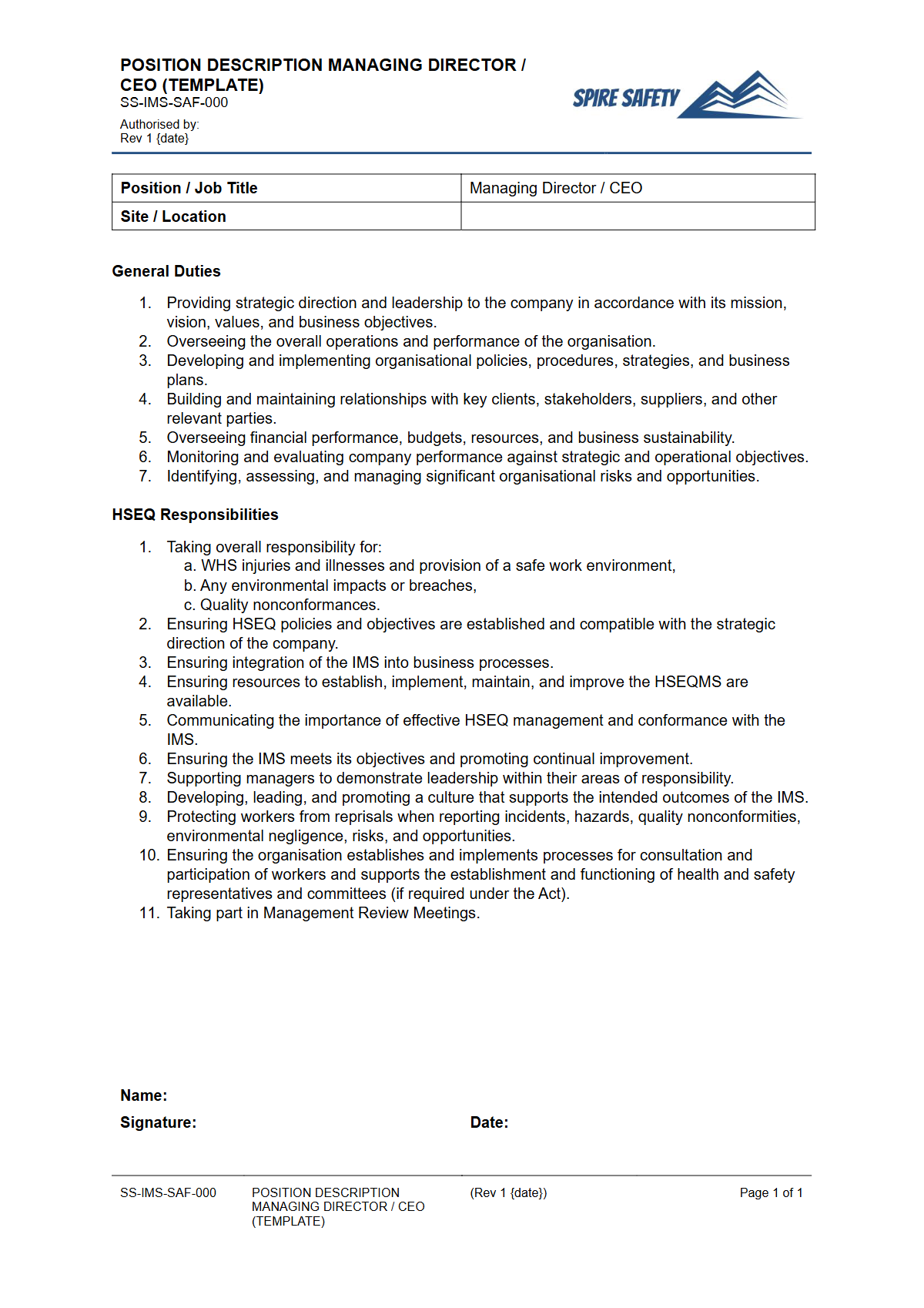
Purpose of the Free Position Description (Managing Director or CEO) Template
A well-defined Position Description for a Managing Director (MD) or Chief Executive Officer (CEO) is a cornerstone of good governance and effective safety leadership. This document goes beyond typical role descriptions by embedding specific Work Health and Safety (WHS) accountabilities at the highest level of your organisation.
Using a structured template ensures that the duty of care and due diligence obligations required of 'officers' under Australian WHS law are clearly articulated and formally recognised. This free Position Description (Managing Director or CEO) Template provides a structured starting point for defining the responsibilities, authorities, and key performance indicators for your most senior executive, ensuring their role is explicitly linked to the success of your WHS management system.
This template helps formalise the expectation that safety leadership starts at the top. It outlines the MD or CEO’s responsibility to drive a positive safety culture, ensure resources are allocated for safety initiatives, monitor organisational WHS performance, and lead compliance with all relevant legislation and standards.
By clarifying these duties, the organisation demonstrates a proactive commitment to health and safety from the board down.
How to use the Free Position Description (Managing Director or CEO) Template
This downloadable template is provided in both DOCX and PDF formats. The DOCX version is fully editable, allowing you to tailor it to your organisation's specific needs, industry, and risk profile.
To use it effectively, work through each section and adapt the content to align with your corporate structure, strategic objectives, and legal obligations.
Important: This document is a template and not a finished product. It must be customised to your specific workplace.
We recommend a thorough review by your board, HR department, or legal counsel to ensure it accurately reflects the intended role and your organisation's unique operational context. For example, you may need to add specific responsibilities related to company policies, such as the oversight of a corporate Travel Policy, especially if the role involves frequent domestic or international travel.
Successful implementation involves integrating the Position Description into your existing HR and governance frameworks. It should be used during the recruitment and onboarding process, referenced in performance reviews, and updated in response to significant changes in the business or regulatory landscape.
The goal is to create a live document that genuinely guides the actions and priorities of your top leader.
When to use it
A formal Position Description for an MD or CEO should be considered a critical business document. It is essential during several key phases of the business lifecycle:
- Recruitment and Appointment: Use it to attract candidates with a demonstrated commitment to safety leadership and to form a clear basis for the employment contract.
- Performance Management: Integrate the WHS responsibilities into the CEO's annual performance review process to measure and reward safety leadership.
- Organisational Restructuring: When roles and responsibilities are changing, updating the PD ensures clarity and continuity of WHS governance.
- Audits and Reviews: This document serves as key evidence during a WHS compliance audit, demonstrating how officer duties are defined and assigned at the executive level.
Ultimately, this document helps ensure the person with the most influence in the company has a clear mandate to lead on safety. This strategic direction ensures that all high-risk work within the business is properly managed, which includes providing adequate resources for creating tools like a Safe Work Method Statement for EWP operation where required.
Who should use it
This template is designed for those responsible for organisational governance and executive management. This includes:
- Company Directors and Board Members: For defining the role they are seeking to fill and for holding the appointed CEO accountable.
- Business Owners: In small to medium enterprises (SMEs), the owner may also be the Managing Director, and using this template helps formalise their own WHS duties.
- Human Resources (HR) Managers: To ensure recruitment, onboarding, and performance management processes for executive roles are aligned with WHS obligations.
- Recruitment Professionals: To develop accurate job advertisements and interview criteria for senior executive positions.
Clarifying these top-level accountabilities ensures that safety responsibilities cascade effectively throughout the organisation. While the CEO has ultimate accountability, their leadership supports the systems needed for safe operations everywhere, from the office to the field where workers might be using a SWMS for backhoe loader operation. For organisations needing assistance in defining these roles and structures, engaging specialist WHS consulting services can provide valuable external expertise. If you're looking for other documents, you can browse our full library of free WHS resources.
Common mistakes
Common mistakes to avoid
- Using a generic, operations-focused PD that omits strategic WHS leadership and due diligence duties.
- Failing to align the PD with the organisation's specific high-level risks and strategic safety objectives.
- Treating the document as a one-off for recruitment and not integrating it into performance management.
- Not explicitly referencing the personal 'duty of due diligence' required of officers under WHS legislation.
Legal references
Legal considerations
The following legal requirements may be relevant to this type of work.
- Work Health and Safety Act (Harmonised) — Provides the primary duties for protecting workers and other people from work health and safety risks.
- Work Health and Safety Regulations (Harmonised) — Sets out requirements supporting the management of workplace hazards and risks.
The following codes may be relevant to this type of work.
- Managing WHS Risks Code of Practice — Provides practical guidance on identifying hazards, assessing risks and applying effective controls.
- Work Health and Safety Consultation, Cooperation and Coordination Code of Practice — Provides practical guidance on consulting workers and coordinating with other duty holders.
- Managing the Work Environment and Facilities Code of Practice — Provides practical guidance on safe work environments, workplace facilities and related controls.
Did you know
Personal Duty of Care
Under Australia's model WHS laws, the 'duty of due diligence' for officers is a personal one. This means a CEO or Director cannot delegate this duty and can be held personally liable for failures.
Leadership's Impact
Studies consistently show that visible and active safety leadership from senior executives is the single greatest predictor of a positive safety culture and improved WHS performance in an organisation.
FAQ
Frequently asked questions
01Why is a specific WHS section needed in a CEO's Position Description?
02What are the 'officer duties' under Australian WHS law?
03Can this template be used for other senior leadership roles?
04How often should a Managing Director's Position Description be reviewed?
Share this resource
Free Position Description (Managing Director or CEO) Template
Browse Categories
How To Use It
- 1Download and open in Word or PDF.
- 2Replace the placeholders with your business details.
- 3Get it reviewed by a WHS specialist before rollout.
Need it customised?
Our WHS consultants can adapt this template to your site, run a gap analysis, or audit what you already have in place.
Book a Free Consultation WHS consulting servicesor call 1300 156 382