
Free Position Description (Painter) Template
Download our free Painter Position Description template for Australian workplaces. Clearly define roles, responsibilities, and safety duties. Get your DOCX.
Free Position Description (Painter) Template
DOCX • 135 KB + PDF
Updated Oct 2026
No signup required
Purpose of the Free Position Description (Painter) Template
A well-drafted position description is a foundational tool for any organisation. For a role like a painter, which involves specific hazards and technical skills, it is absolutely essential.
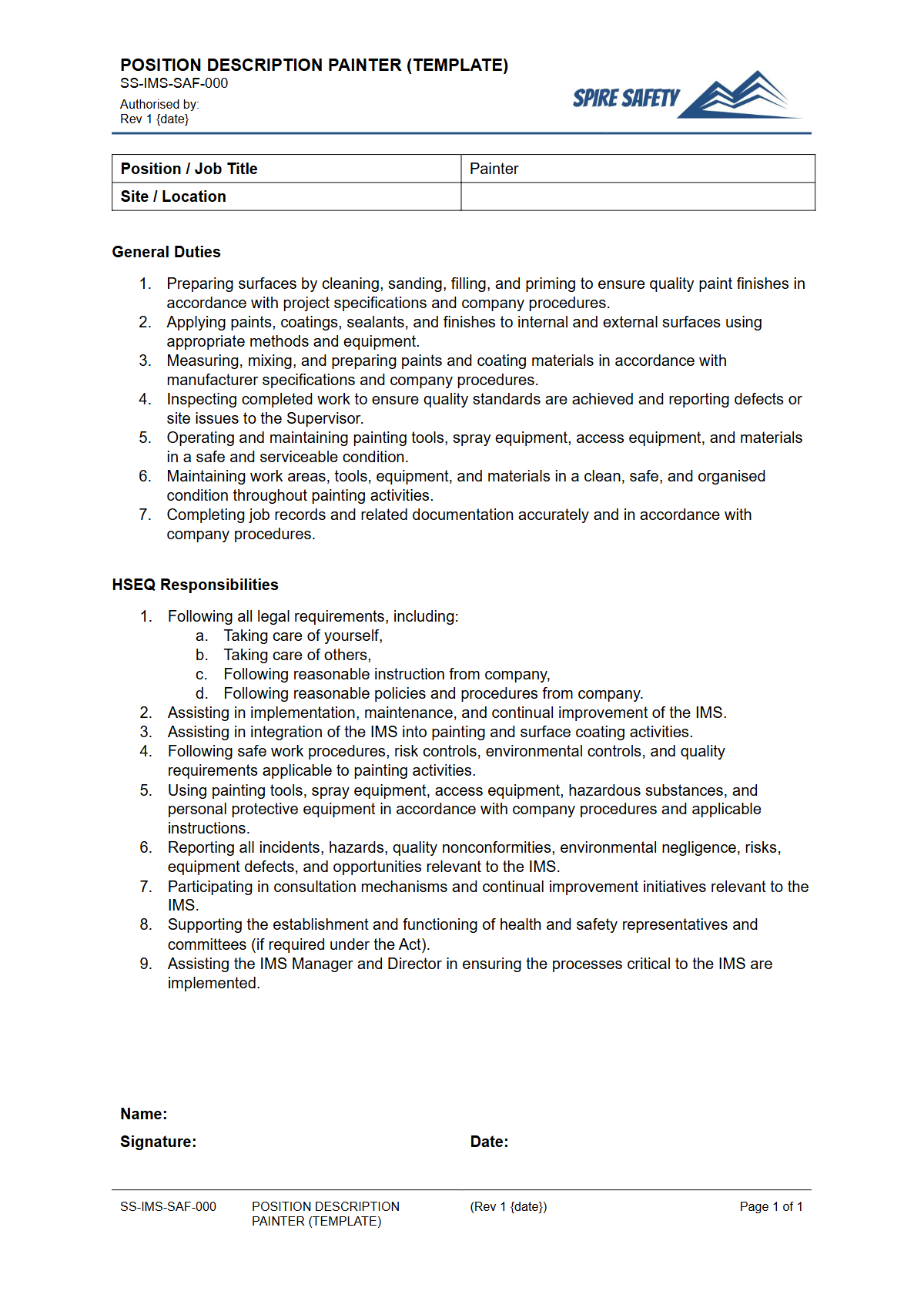
This Free Position Description (Painter) Template provides a structured starting point for clearly defining a painter's role, responsibilities, qualifications, and key performance indicators. It goes beyond a simple list of tasks to integrate critical work health and safety (WHS) obligations, ensuring that safety is recognised as a core component of the job from day one.
Using this template helps establish clear expectations for both the employee and management. It outlines the specific duties related to paint preparation, application, finishing, and cleanup, while also embedding safety responsibilities such as hazard identification, use of personal protective equipment (PPE), and adherence to safe work method statements (SWMS).
By documenting these requirements, you create a formal basis for performance management, training needs analysis, and demonstrating due diligence. This document is a key component in building robust and effective WHS management systems that integrate safety into every role.
How to use the Free Position Description (Painter) Template
This resource is available for download in both DOCX format for easy editing and PDF for straightforward printing and sharing. To get the most value, you should use the DOCX version and tailor it to your specific operational needs and the unique hazards present in your workplace.
A painter's role can vary significantly, from residential repaints to industrial coatings on major infrastructure, so customisation is vital.
When customising, consider the specific tasks the painter will perform. Will they be working at heights, in confined spaces, or with hazardous substances like two-pack paints or solvents?
Ensure these specific duties and the associated safety controls are explicitly mentioned. List the required qualifications, such as a Certificate III in Painting and Decorating, and any high-risk work licences needed (e.g., for operating an elevating work platform).
Important: This template is a guide and must be customised to your specific business and legal obligations. We recommend a thorough review to ensure it aligns with your site-specific risks, control measures, and state or territory WHS laws.
If you are unsure how to tailor this document to meet your duties, engaging professional WHS consulting services can provide clarity and expert guidance.
Defining Key Responsibilities
Use the provided sections to detail the painter's primary duties. This includes:
- Preparation: Scraping, sanding, filling, and cleaning surfaces. Responsibilities may include identifying and managing risks associated with lead paint or asbestos-containing materials.
- Application: Proficiency with brushes, rollers, and spray equipment. Specify the types of coatings they will work with, from standard latex paints to specialised epoxies or polyurethanes.
- Safety Compliance: Adherence to all safety policies and procedures, including reading Safety Data Sheets (SDS), participating in toolbox talks, and reporting all hazards and incidents.
- Quality Control: Inspecting work to ensure it meets quality standards and client specifications.
When to use it
A position description is a versatile document used throughout the employment lifecycle. Its primary use is during the recruitment and hiring process to attract suitable candidates and form the basis of the employment contract.
It should also be used during employee onboarding to clearly communicate expectations from the start. Beyond recruitment, it serves as a critical tool for performance reviews, helping managers and employees discuss performance against documented responsibilities.
It is also essential when planning for promotions, identifying training gaps, or restructuring roles within a team. Regular reviews of position descriptions should be part of your safety management schedule, similar to how you might conduct periodic WHS compliance auditing to check the health of your overall system.
Who should use it
This template is designed for use by anyone involved in managing personnel and WHS within an organisation. This typically includes:
- Business Owners and Directors: Especially in smaller businesses where they are directly involved in hiring and managing staff.
- HR Managers: For creating standardised, role-specific documents as part of a structured human resources framework.
- Hiring Managers and Supervisors: To ensure they have a clear, agreed-upon set of criteria for evaluating candidates and managing their team members.
- WHS Managers and Coordinators: To ensure that safety responsibilities are properly defined and integrated into every role across the business, a core principle of frameworks like ISO 45001. Expert ISO 45001 consulting can help formally embed these practices at a system level.
By utilising this template, you help ensure that every painter in your organisation understands not just what they do, but how to do it safely. You can find more templates and tools like this in our free WHS resources library.
Common mistakes
Common mistakes to avoid
- Using a generic template without customising it for specific site hazards and paint systems.
- Failing to list key safety-critical tasks and required competencies or licences.
- Forgetting to include responsibilities for using and maintaining Personal Protective Equipment (PPE).
- Not reviewing and updating the position description after an incident or when job roles change.
Legal references
Legal considerations
The following legal requirements may be relevant to this type of work.
- Work Health and Safety Act (Harmonised) — Provides the primary duties for protecting workers and other people from work health and safety risks.
- Work Health and Safety Regulations (Harmonised) — Sets out requirements supporting the management of workplace hazards and risks.
The following codes may be relevant to this type of work.
- Managing WHS Risks Code of Practice — Provides practical guidance on identifying hazards, assessing risks and applying effective controls.
- Work Health and Safety Consultation, Cooperation and Coordination Code of Practice — Provides practical guidance on consulting workers and coordinating with other duty holders.
- Managing the Work Environment and Facilities Code of Practice — Provides practical guidance on safe work environments, workplace facilities and related controls.
Did you know
Painter's Asthma
Occupational asthma is a significant risk for painters, often caused by exposure to isocyanates found in two-pack polyurethane paints and coatings, which can cause sensitisation.
Lead Paint Hazard
In Australia, houses built before 1970 are likely to contain lead-based paint, posing a serious health risk during surface preparation and removal if not managed with appropriate controls.
FAQ
Frequently asked questions
01What WHS responsibilities should be included in a painter's position description?
02Is this position description template suitable for commercial and residential painters?
03How does a detailed position description improve safety?
04Can I use this template for an apprentice painter?
Share this resource
Free Position Description (Painter) Template
Browse Categories
How To Use It
- 1Download and open in Word or PDF.
- 2Replace the placeholders with your business details.
- 3Get it reviewed by a WHS specialist before rollout.
Need it customised?
Our WHS consultants can adapt this template to your site, run a gap analysis, or audit what you already have in place.
Book a Free Consultation WHS consulting servicesor call 1300 156 382
Related templates
- Free Position Description (Plasterer) Template
- Free Position Description (Plumber) Template
- Free Position Description (Procurement Officer) Template
- Free Position Description (Project Engineer) Template
- Free Position Description (Project Manager) Template
- Free Position Description (Quality Assurance Officer) Template