
Free Safe Operating Procedure (Concrete Moisture Test) Template
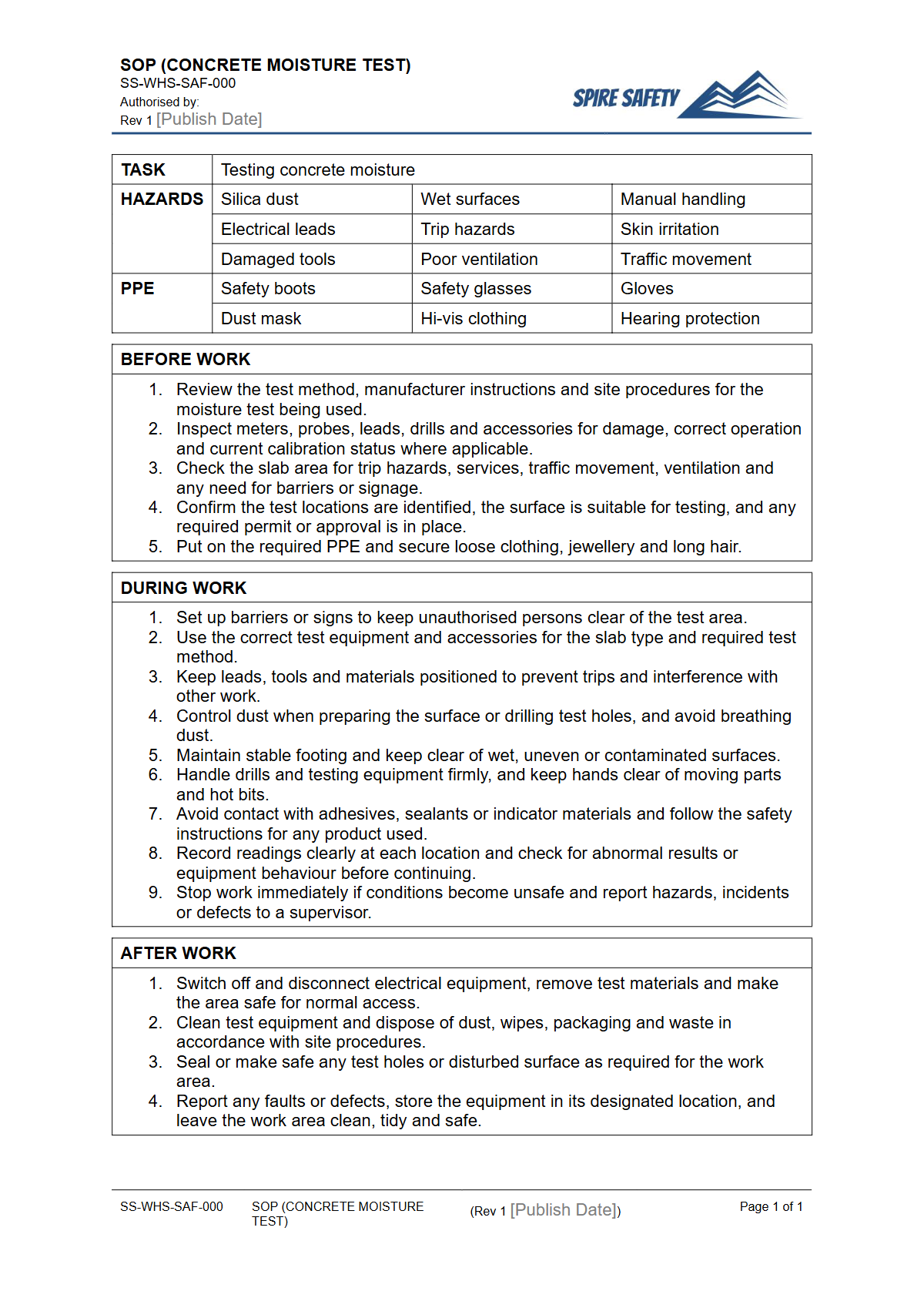
Download our free Safe Operating Procedure (Concrete Moisture Test) template. This customisable DOCX & PDF helps document safe work practices.
Free Safe Operating Procedure (Concrete Moisture Test) Template
DOCX • 126 KB + PDF
Updated Oct 2026
No signup required
Purpose of the Free Safe Operating Procedure (Concrete Moisture Test) Template
This Free Safe Operating Procedure (Concrete Moisture Test) template provides a structured framework for businesses to document the required steps for safely and accurately testing moisture content in concrete slabs. Properly testing for moisture is critical before installing flooring systems, coatings, or finishes to prevent costly failures like delamination, blistering, or microbial growth.
This document helps you formalise a safe system of work, outlining potential hazards, necessary personal protective equipment (PPE), and emergency procedures. It serves as a vital component within your overall WHS management system, demonstrating a commitment to proactive risk management.
The SOP template is designed to be adapted to your specific site conditions, equipment (such as calcium chloride tests or in-situ RH probes), and organisational requirements. It acts as a clear guide for workers, ensuring consistency and safety every time the task is performed.
Video walkthrough
How to use the Free Safe Operating Procedure (Concrete Moisture Test) Template
To effectively use this template, you must customise it to reflect your workplace's unique environment and processes. Download the DOCX file and systematically work through each section, adding, editing, and removing content to match your specific moisture testing equipment and procedures.
This includes detailing the exact make and model of the meter used, the specific PPE required for handling any chemicals (if applicable), and site-specific emergency contacts.
Important Note: This is a template, not a finished document. It is your responsibility to ensure the final SOP is accurate and relevant to your operations.
We recommend a competent person reviews the customised document before implementation. Similar to how you would detail specific operational steps in our free Boom Pump SOP, this document requires precise, task-specific information to be effective.
When to use a Concrete Moisture Test SOP
A Safe Operating Procedure for concrete moisture testing should be used whenever a worker is required to assess the moisture vapour emission rate (MVER) or relative humidity (RH) of a concrete slab. This is a standard and necessary step in many construction and flooring projects. Key scenarios include:
- Before the installation of vinyl, timber, carpet, epoxy, or any other type of floor covering.
- As part of a quality assurance process for new concrete pours.
- During diagnostic work to determine the cause of existing flooring failures.
- When specified by an architect, engineer, or flooring manufacturer's warranty requirements.
Integrating this SOP into your project workflow ensures the task is not overlooked and is performed according to a pre-approved, safe method. This systematic approach is also crucial for tasks like cutting materials on site, where a free Circular Saw SOP would define the required safety protocols.
Who Should Use This SOP
This Safe Operating Procedure is intended for use by various personnel within a construction, flooring, or building maintenance organisation. This includes:
- Workers and Technicians: Individuals who physically perform the concrete moisture tests.
- Site Supervisors and Foremen: Those responsible for overseeing the work, ensuring procedures are followed, and providing necessary resources.
- Project Managers: To ensure that quality and safety standards are met and documented correctly as part of the project's milestones.
- WHS Officers and Managers: For integrating the procedure into the company's safety framework and for use during training and inductions.
Furthermore, the finalised SOP serves as a key piece of evidence during safety reviews. An effective procedure, properly implemented, demonstrates proactive risk control, a critical focus area for any professional WHS compliance auditing process.
Enhancing Site Safety with Consistent Procedures
Implementing standardised procedures like this SOP for concrete moisture testing helps reduce variability and improve safety outcomes. When every worker follows the same approved steps, it minimises the risk of errors, equipment damage, or personal injury.
It also simplifies worker training and competency assessments. This principle of standardisation applies to all high-risk tasks on a worksite, whether you are operating heavy machinery detailed in a free Trencher SOP or using basic access equipment.
By documenting and enforcing these procedures, you create a workplace culture where safety is not an afterthought but a core part of every task. For broader support in developing a comprehensive safety framework, our WHS consulting services can provide expert guidance.
You can also explore our full free WHS resources library for more templates and guides to support your safety initiatives.
Common mistakes
Common mistakes to avoid
- Testing on a concrete slab that is not at service temperature or has not acclimated.
- Using moisture testing equipment that has not been recently calibrated.
- Drilling test holes to the incorrect depth for in-situ RH probe testing.
- Failing to properly document test locations, conditions, and results for future reference.
Legal references
Legal considerations
The following legal requirements may be relevant to this type of work.
- Work Health and Safety Act (Harmonised) — Provides the primary duties for protecting workers and other people from work health and safety risks.
- Work Health and Safety Regulations (Harmonised) — Sets out requirements supporting the management of workplace hazards and risks.
The following codes may be relevant to this type of work.
- Managing WHS Risks Code of Practice — Provides practical guidance on identifying hazards, assessing risks and applying effective controls.
- Work Health and Safety Consultation, Cooperation and Coordination Code of Practice — Provides practical guidance on consulting workers and coordinating with other duty holders.
- Managing the Work Environment and Facilities Code of Practice — Provides practical guidance on safe work environments, workplace facilities and related controls.
Did you know
Leading Cause of Failure
Excess moisture in concrete is the most common reason for floor covering system failures, leading to significant financial losses in damage and replacement costs annually.
RH vs. MVER
While both are common, In-situ Relative Humidity (RH) testing is often considered more reliable than Calcium Chloride (MVER) testing as it measures moisture conditions within the slab itself.
FAQ
Frequently asked questions
01What is a concrete moisture test SOP for?
02Is this template suitable for all types of moisture meters?
03How often should a Safe Operating Procedure be reviewed?
04Who is responsible for implementing an SOP on-site?
Share this resource
Free Safe Operating Procedure (Concrete Moisture Test) Template
Browse Categories
How To Use It
- 1Download and open in Word or PDF.
- 2Replace the placeholders with your business details.
- 3Get it reviewed by a WHS specialist before rollout.
Need it customised?
Our WHS consultants can adapt this template to your site, run a gap analysis, or audit what you already have in place.
Book a Free Consultation WHS consulting servicesor call 1300 156 382
Related templates
- Free Safe Operating Procedure (Concrete Pile Cutter) Template
- Free Safe Operating Procedure (Concrete Planer) Template
- Free Safe Operating Procedure (Concrete Pump Hose) Template
- Free Safe Operating Procedure (Concrete Scarifier) Template
- Free Safe Operating Procedure (Concrete Screed) Template
- Free Safe Operating Procedure (Condensate Drain Flush) Template