
Free Safe Operating Procedure (Concrete Planer) Template
Download our free Safe Operating Procedure (Concrete Planer) template. This customisable DOCX & PDF helps you outline safety controls for concrete planing.
Free Safe Operating Procedure (Concrete Planer) Template
DOCX • 126 KB + PDF
Updated Oct 2026
No signup required
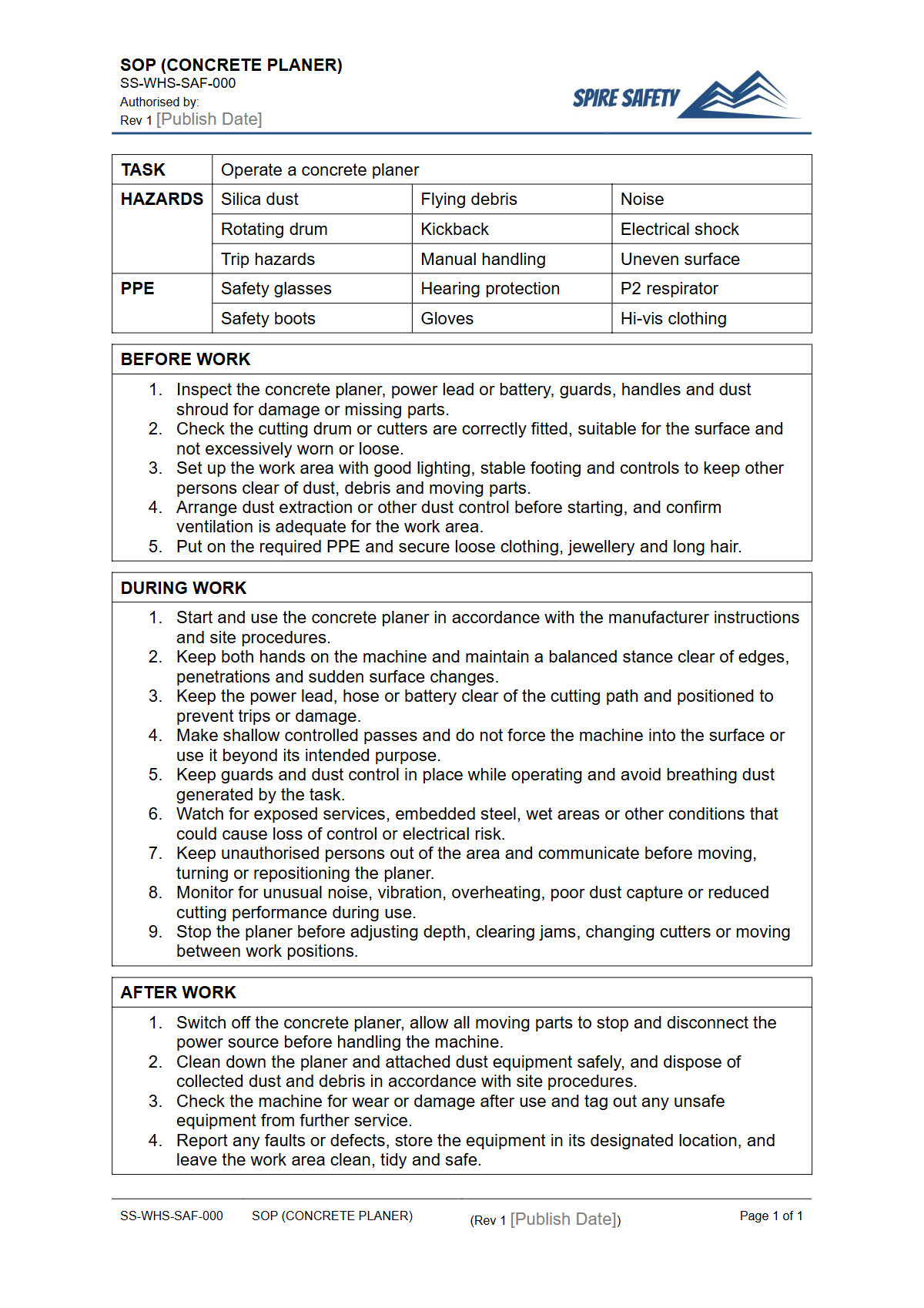
Purpose of the Free Safe Operating Procedure (Concrete Planer) Template
Operating a concrete planer involves significant risks, including exposure to respirable crystalline silica (RCS), high noise levels, hand-arm vibration, and electrical hazards. This free Safe Operating Procedure (Concrete Planer) template provides a structured framework for documenting a safe system of work to manage these risks effectively.
It helps your organisation detail the step-by-step processes required to operate the equipment safely, from pre-start checks to clean-up and maintenance. Implementing robust SOPs is a critical component of effective WHS management systems, demonstrating a commitment to worker health and safety.
Video walkthrough
How to use the Free Safe Operating Procedure (Concrete Planer) Template
This document is a template and must be customised to your specific workplace. Download the DOCX or PDF and consult with your team, including operators and supervisors, to adapt it.
You should detail the exact make and model of the concrete planer in use, the specific site conditions, and your organisation's emergency procedures. We recommend you edit the document to include details on required PPE (e.g., P2/P3 respirators, hearing protection), dust control measures (e.g., on-tool extraction, water suppression), and safe handling techniques. A well-developed SOP for one tool can inform the development of others, such as our FREE Circular Saw SOP (Safe Operating Procedure) Template.
Key Sections to Customise
- Hazard Identification: List all potential hazards specific to your tasks, such as silica dust, manual handling, noise, vibration, and electrical risks from cords or power sources.
- Risk Control Measures: Document the specific controls you will implement. This is the most critical section and should detail measures like using an M or H-class vacuum for dust extraction, implementing job rotation to limit vibration exposure, and ensuring regular equipment maintenance.
- Personal Protective Equipment (PPE): Specify the exact PPE required for the task. Be specific about the type of respiratory protection (e.g., P2/P3 half-face respirator with appropriate filters), eye protection, and hearing protection needed.
- Step-by-Step Procedure: Break down the task into a logical sequence, including pre-operational checks, starting the planer, operating the machine, and shutdown procedures.
- Emergency Procedures: Outline the steps to take in case of an incident, such as equipment failure, electrical shock, or injury.
When to use a Concrete Planer SOP
A Safe Operating Procedure for a concrete planer should be developed and implemented before any worker first uses the equipment. It serves as a vital tool for worker training and induction, ensuring everyone understands the risks and control measures.
The SOP should also be used as a reference for pre-task risk assessments (like a Take 5 or JSA) and for ongoing supervision to ensure the documented safe work method is being followed. Just as you would plan for groundwork with a FREE Trencher SOP (Safe Operating Procedure) Template, you must plan for finishing tasks with equal diligence.
Who should use it
This SOP should be used by several key personnel within an organisation. Operators must be trained on the SOP and follow its procedures during their work.
Supervisors and managers are responsible for implementing the SOP, providing adequate training, and ensuring compliance on-site. WHS managers or advisors will typically lead the development and review of the document, ensuring it aligns with legislative requirements and best practice. Regular reviews and updates are essential, and the effectiveness of your SOPs can be verified through formal WHS compliance auditing.
By thoroughly documenting safety procedures, you create a safer work environment and a clear standard for performance and training. You can find more templates and checklists in our complete free WHS resources library to support your safety management system.
Common mistakes
Common mistakes to avoid
- Neglecting to use on-tool dust extraction (M or H-class vacuum) or water suppression.
- Using a simple dust mask instead of a properly fitted P2/P3 respirator.
- Failing to inspect grinding discs for cracks or damage before starting work.
- Not managing electrical cords properly, creating trip or electrical shock hazards.
Legal references
Legal considerations
The following legal requirements may be relevant to this type of work.
- Work Health and Safety Act (Harmonised) — Provides the primary duties for protecting workers and other people from work health and safety risks.
- Work Health and Safety Regulations (Harmonised) — Sets out requirements supporting the management of workplace hazards and risks.
The following codes may be relevant to this type of work.
- Managing WHS Risks Code of Practice — Provides practical guidance on identifying hazards, assessing risks and applying effective controls.
- Work Health and Safety Consultation, Cooperation and Coordination Code of Practice — Provides practical guidance on consulting workers and coordinating with other duty holders.
- Managing the Work Environment and Facilities Code of Practice — Provides practical guidance on safe work environments, workplace facilities and related controls.
Did you know
Silica Dust Hazard
Concrete dust can contain high levels of respirable crystalline silica (RCS). Long-term, unprotected exposure to RCS can lead to serious and irreversible lung diseases like silicosis, lung cancer, and chronic obstructive pulmonary disease.
Vibration Risk
Prolonged use of high-vibration tools like concrete planers can cause Hand-Arm Vibration Syndrome (HAVS), a painful condition that damages nerves and blood vessels in the hands and arms, leading to loss of grip and sensation.
FAQ
Frequently asked questions
01What are the main hazards associated with using a concrete planer?
02Is a Safe Operating Procedure legally required for a concrete planer in Australia?
03How often should a concrete planer SOP be reviewed?
04What Personal Protective Equipment (PPE) is required for operating a concrete planer?
Share this resource
Free Safe Operating Procedure (Concrete Planer) Template
Browse Categories
How To Use It
- 1Download and open in Word or PDF.
- 2Replace the placeholders with your business details.
- 3Get it reviewed by a WHS specialist before rollout.
Need it customised?
Our WHS consultants can adapt this template to your site, run a gap analysis, or audit what you already have in place.
Book a Free Consultation WHS consulting servicesor call 1300 156 382
Related templates
- Free Safe Operating Procedure (Concrete Pump Hose) Template
- Free Safe Operating Procedure (Concrete Scarifier) Template
- Free Safe Operating Procedure (Concrete Screed) Template
- Free Safe Operating Procedure (Condensate Drain Flush) Template
- Free Safe Operating Procedure (Condiment Bottle Filling) Template
- Free Safe Operating Procedure (Condiment Station Clean) Template