
Free Safe Operating Procedure (Condiment Station Clean) Template
Download our free Safe Operating Procedure (Condiment Station Clean) template.
Free Safe Operating Procedure (Condiment Station Clean) Template
DOCX • 126 KB + PDF
Updated Oct 2026
No signup required
Purpose of the Free Safe Operating Procedure (Condiment Station Clean) Template
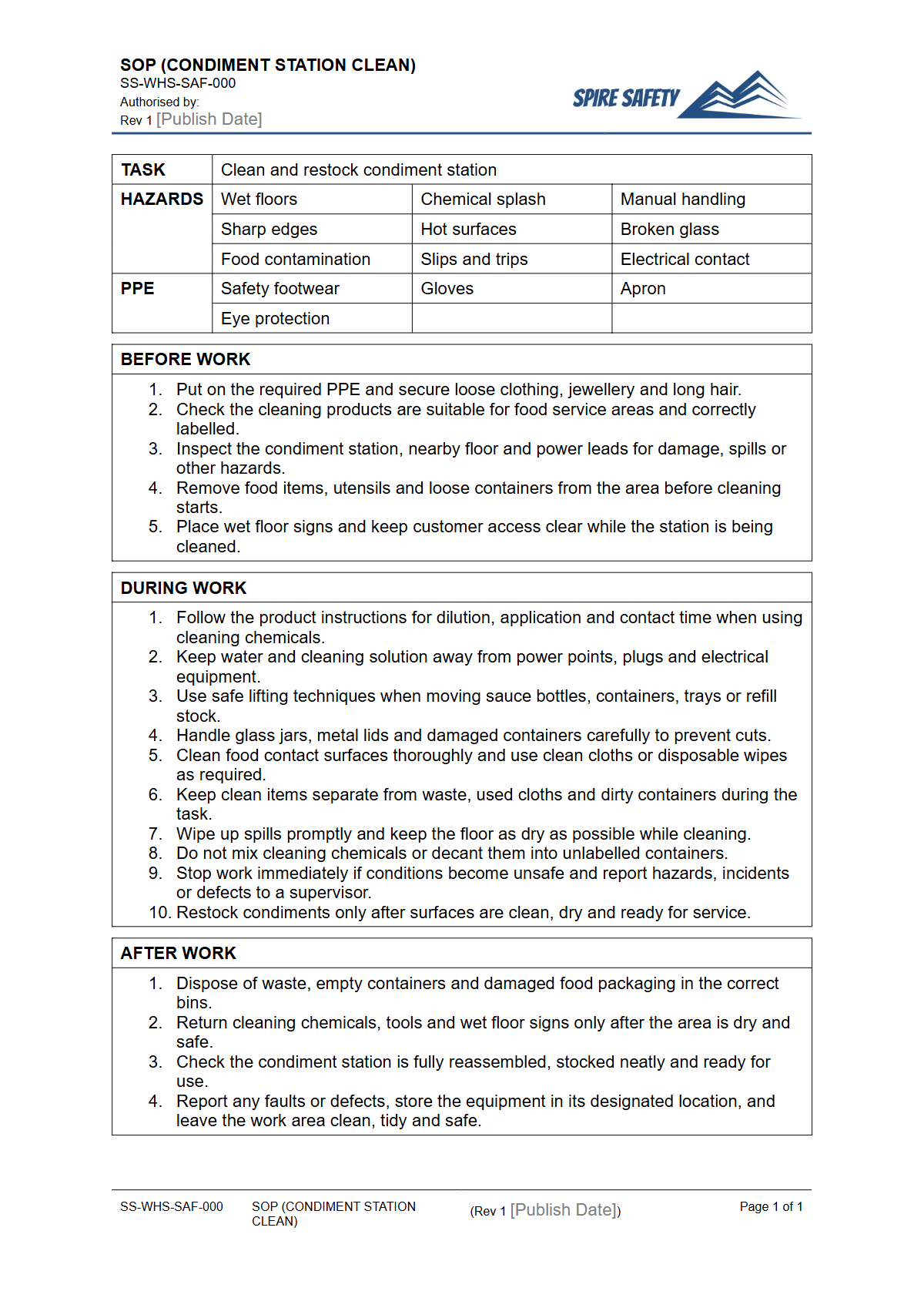
Maintaining a clean and hygienic condiment station is essential in any food service environment, not just for food safety but also for worker safety. This free Safe Operating Procedure (Condiment Station Clean) template provides a structured framework for documenting the specific steps, hazards, and controls associated with this common task.
Using an SOP ensures that every team member follows the same safe and effective process, reducing risks such as slips from spills, exposure to cleaning chemicals, and ergonomic injuries from repetitive motions. It creates a clear, auditable record of your commitment to a safe system of work.
A well-drafted SOP is a fundamental component of a robust safety framework. It formalises risk management at the task level, ensuring that hazard identification and control measures are consistently applied.
Integrating task-specific procedures like this one into broader WHS management systems helps build a proactive safety culture where risks are managed systematically rather than reactively. This process helps your organisation meet its duty of care to provide a safe working environment for all employees.
Video walkthrough
How to use the Free Safe Operating Procedure (Condiment Station Clean) Template
This document is a starting point designed for customisation. To use it effectively, download the DOCX file and adapt it to the specific context of your workplace.
This involves detailing the exact types of cleaning chemicals used, the specific layout of your condiment station, the tools and Personal Protective Equipment (PPE) required, and your site's emergency procedures. The template includes sections for outlining pre-operational checks, the step-by-step cleaning process, and post-cleaning checks to ensure the area is left safe for others.
Important: We have created this template as a guide, not a finished document. You must consult with the workers who will be performing the task.
Their direct experience is invaluable for identifying practical hazards and effective controls that might be missed in a purely theoretical assessment. Once finalised, the SOP should be used as a primary tool for training new staff and for conducting refresher training with existing team members.
Procedures like this should be subject to review, a process that can be formally verified through a WHS compliance auditing program.
When to use it
A Safe Operating Procedure for cleaning the condiment station should be implemented as a core part of your daily or weekly operational schedule. It is most effective when used consistently by all relevant staff to standardise cleaning practices across different shifts and teams.
The document should be readily accessible near the work area for easy reference during the task.
Beyond daily use, the SOP is a critical resource during staff induction and training. It provides a clear, documented standard against which competency can be assessed.
It should also be reviewed and potentially updated whenever there is a change in process, such as the introduction of a new cleaning agent, a modification to the station's equipment, or following any near miss or incident related to the cleaning task. An SOP is a live document that evolves with your operational needs.
Who should use it
This SOP is primarily intended for employees directly responsible for cleaning and maintaining food service areas. This includes front-of-house staff, kitchen hands, dedicated cleaning personnel, and baristas in cafes, restaurants, hotels, and takeaway venues.
By following the procedure, workers can perform their duties confidently, knowing they are using a method that has been assessed for safety.
Supervisors and managers also have a key role. They are responsible for ensuring the SOP is correctly customised, implemented, and followed.
They must provide the necessary training, supply the specified PPE, and lead the consultation and review process. For complex safety challenges that extend beyond single tasks, seeking external expertise through WHS consulting can provide valuable guidance and help ensure your safety framework is robust and effective. An SOP provides clear, step-by-step instructions for a task, whether it's cleaning or performing a first aid action like using a defibrillator in an emergency.
While this SOP covers cleaning food service areas, your workplace likely has other tasks that require documented procedures. These can range from manual handling to using specific equipment.
For instance, other common cleaning-related tasks may require their own SOPs, such as the correct use of a step ladder for cleaning high shelves. This template is just one of many available in our comprehensive free WHS resources library, designed to help you build a complete set of safety documentation.
Common mistakes
Common mistakes to avoid
- Using a generic template without adding site-specific details like chemical names and emergency contacts.
- Failing to consult with the workers who perform the cleaning task.
- Not providing practical training on the finalised SOP to all relevant staff.
- Forgetting to specify the correct type of Personal Protective Equipment (PPE) required for the chemicals being used.
Legal references
Legal considerations
The following legal requirements may be relevant to this type of work.
- Work Health and Safety Act (Harmonised) — Provides the primary duties for protecting workers and other people from work health and safety risks.
- Work Health and Safety Regulations (Harmonised) — Sets out requirements supporting the management of workplace hazards and risks.
The following codes may be relevant to this type of work.
- Managing WHS Risks Code of Practice — Provides practical guidance on identifying hazards, assessing risks and applying effective controls.
- Work Health and Safety Consultation, Cooperation and Coordination Code of Practice — Provides practical guidance on consulting workers and coordinating with other duty holders.
- Managing the Work Environment and Facilities Code of Practice — Provides practical guidance on safe work environments, workplace facilities and related controls.
Did you know
SDS is Key
When writing an SOP involving chemicals, the Safety Data Sheet (SDS) is a critical reference. It provides essential information on hazards, handling, storage, and first aid measures for that specific product.
The Consultation Duty
Under Australian WHS law, employers have a legal duty to consult with workers on matters affecting their health and safety. Involving staff in the creation of SOPs is a fundamental part of meeting this obligation.
FAQ
Frequently asked questions
01What hazards are associated with cleaning a condiment station?
02Why do I need a formal SOP for a simple task like cleaning?
03Is this condiment station cleaning SOP ready to use immediately?
04How often should a Safe Operating Procedure be reviewed?
Share this resource
Free Safe Operating Procedure (Condiment Station Clean) Template
Browse Categories
How To Use It
- 1Download and open in Word or PDF.
- 2Replace the placeholders with your business details.
- 3Get it reviewed by a WHS specialist before rollout.
Need it customised?
Our WHS consultants can adapt this template to your site, run a gap analysis, or audit what you already have in place.
Book a Free Consultation WHS consulting servicesor call 1300 156 382
Related templates
- Free Safe Operating Procedure (Conductivity Meter) Template
- Free Safe Operating Procedure (Conduit Bender) Template
- Free Safe Operating Procedure (Cone Crusher Clearing) Template
- Free Safe Operating Procedure (Confined Space Fan) Template
- Free Safe Operating Procedure (Confined Space Tripod) Template
- Free Safe Operating Procedure (Container Door Check) Template