
Free Safe Operating Procedure (Conductivity Meter) Template
Download our free Safe Operating Procedure (Conductivity Meter) Template.
Free Safe Operating Procedure (Conductivity Meter) Template
DOCX • 126 KB + PDF
Updated Oct 2026
No signup required
Purpose of the Free Safe Operating Procedure (Conductivity Meter) Template
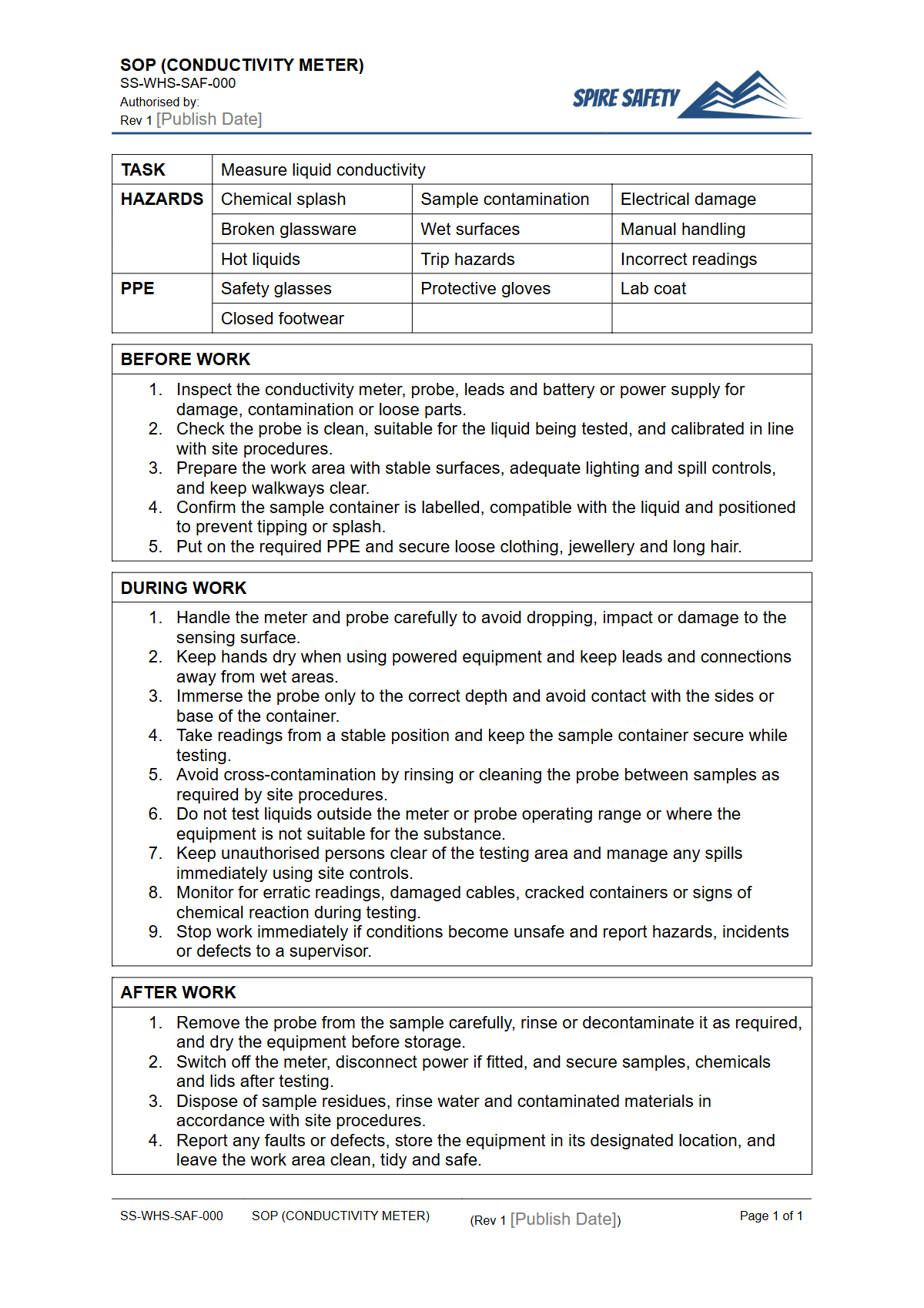
Using technical equipment like a conductivity meter requires precision, consistency, and a strong focus on safety. This Free Safe Operating Procedure (Conductivity Meter) Template provides a structured framework for documenting the safe use of this equipment in your workplace.
A documented SOP ensures that every operator, whether new or experienced, follows a standardised, safe method for calibration, sample handling, measurement, and maintenance. It helps minimise risks such as chemical exposure from samples, electrical hazards from mains-powered units, and ergonomic strain.
Formalising your processes with clear SOPs is a fundamental part of building effective WHS management systems. This template serves as a reliable starting point, helping your organisation meet its duty of care to provide clear instruction and a safe working environment. By outlining potential hazards and control measures, you create a safer, more efficient workflow and ensure the integrity of your measurements.
Video walkthrough
How to use the Free Safe Operating Procedure (Conductivity Meter) Template
This resource is available for instant download in both DOCX and PDF formats. The DOCX file is fully editable, allowing you to tailor the content to your specific operational needs.
While this template is aligned with Australian WHS principles, it is essential to adapt it to reflect the unique context of your workplace.
Important: You must customise this document before use. We provide a comprehensive starting point, but you need to add site-specific information.
This includes the make and model of your conductivity meter, the specific chemicals handled, required Personal Protective Equipment (PPE), emergency procedures, and contact details. A generic procedure is not sufficient for compliance; it must be made relevant to your actual work environment and tasks.
Key Elements of a Safe Operating Procedure
A thorough SOP for a conductivity meter should cover the entire lifecycle of the task. Our template prompts you to consider several critical stages to ensure no steps are missed. These include:
- Associated Risks and Controls: Identifying potential hazards (e.g., electrical shock, chemical splash, spills) and detailing the control measures to mitigate them (e.g., using RCDs, wearing gloves and safety glasses, bunding).
- Pre-operational Checks: Outlining visual inspections of the meter, probe, and cables for damage before use, and ensuring the work area is clean and free of obstructions.
- Step-by-Step Operating Sequence: A clear, logical guide to performing the task, from powering on the device and calibrating the probe to taking a measurement and recording the results.
- Post-operational Tasks: Instructions for cleaning the probe, safely powering down the unit, and storing it correctly to prevent damage and prolong its lifespan. For other common equipment, you might find our Free Air Compressor SOP (Safe Operating Procedure) Template useful as a reference.
- Emergency Procedures: Clear actions to take in case of an incident, such as electrical shock or a significant chemical spill. Documenting these steps is vital, much like in our Free Safe Operating Procedure (Defibrillator Operation) Template.
When to use this SOP
A Safe Operating Procedure for a conductivity meter should be used as a primary reference document for all related activities. It is an essential tool for inducting and training new employees, ensuring they learn the correct, safe method from the outset.
It also serves as a critical refresher for existing staff and a standard against which competency can be assessed.
Furthermore, this SOP becomes a key piece of evidence during safety reviews and inspections. Having documented procedures demonstrates a proactive approach to risk management and is often a requirement reviewed during a WHS compliance audit. It should be reviewed and updated regularly, at least annually, or whenever there is a change in equipment, substances used, or work processes.
Who should use it
This SOP template is designed for a range of personnel within an organisation, including:
- Workers and Operators: Laboratory technicians, environmental scientists, water quality testers, and industrial process operators who use the conductivity meter as part of their daily duties.
- Supervisors and Managers: Those responsible for training staff, overseeing work, and ensuring safety protocols are consistently followed.
- WHS Professionals and PCBUs: Individuals tasked with developing, implementing, and reviewing the organisation's safety management system and meeting legislative duties.
This document is just one of many tools available to help you build a safer workplace. Explore our complete free WHS resources library for more templates, checklists, and guides.
Common mistakes
Common mistakes to avoid
- Failing to properly calibrate the meter before use, leading to inaccurate results.
- Using incorrect or expired calibration standards.
- Not cleaning and storing the probe according to manufacturer specifications, causing damage or contamination.
- Neglecting to wear appropriate PPE, such as gloves and safety glasses, when handling potentially hazardous samples.
Legal references
Legal considerations
The following legal requirements may be relevant to this type of work.
- Work Health and Safety Act (Harmonised) — Provides the primary duties for protecting workers and other people from work health and safety risks.
- Work Health and Safety Regulations (Harmonised) — Sets out requirements supporting the management of workplace hazards and risks.
The following codes may be relevant to this type of work.
- Managing WHS Risks Code of Practice — Provides practical guidance on identifying hazards, assessing risks and applying effective controls.
- Work Health and Safety Consultation, Cooperation and Coordination Code of Practice — Provides practical guidance on consulting workers and coordinating with other duty holders.
- Managing the Work Environment and Facilities Code of Practice — Provides practical guidance on safe work environments, workplace facilities and related controls.
Did you know
Conductivity and Purity
The electrical conductivity of water is an excellent indicator of its purity. Pure deionised water has a very low conductivity, while the presence of dissolved salts and minerals increases it significantly.
FAQ
Frequently asked questions
01What hazards are associated with using a conductivity meter?
02Is this SOP template suitable for any brand of conductivity meter?
03How often should a Safe Operating Procedure be reviewed?
04Why is calibration important in a conductivity meter SOP?
Share this resource
Free Safe Operating Procedure (Conductivity Meter) Template
Browse Categories
How To Use It
- 1Download and open in Word or PDF.
- 2Replace the placeholders with your business details.
- 3Get it reviewed by a WHS specialist before rollout.
Need it customised?
Our WHS consultants can adapt this template to your site, run a gap analysis, or audit what you already have in place.
Book a Free Consultation WHS consulting servicesor call 1300 156 382
Related templates
- Free Safe Operating Procedure (Conduit Bender) Template
- Free Safe Operating Procedure (Cone Crusher Clearing) Template
- Free Safe Operating Procedure (Confined Space Fan) Template
- Free Safe Operating Procedure (Confined Space Tripod) Template
- Free Safe Operating Procedure (Container Door Check) Template
- Free Safe Operating Procedure (Container Handler) Template