
Free Safe Operating Procedure (Cone Crusher Clearing) Template
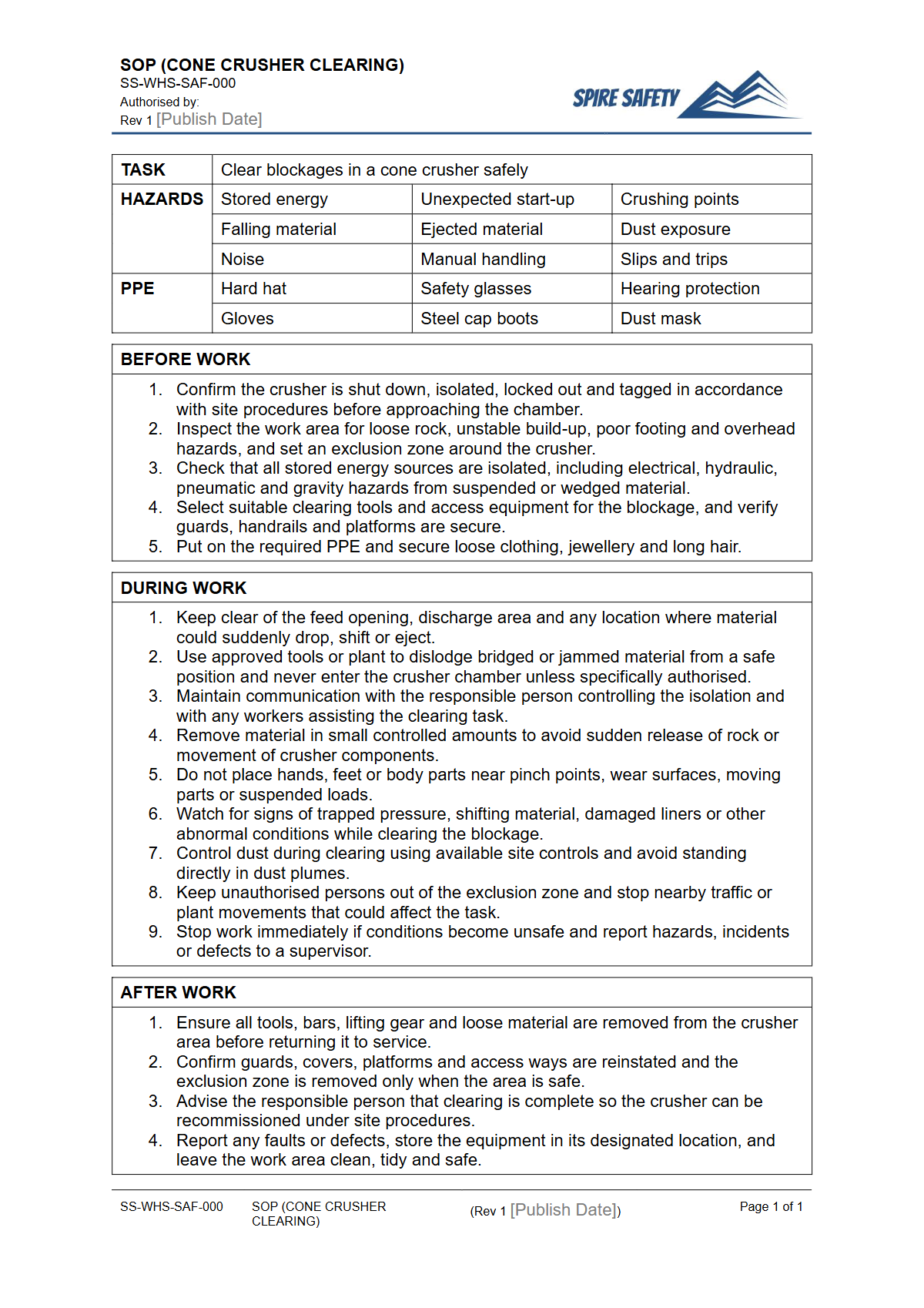
Download our free Safe Operating Procedure (Cone Crusher Clearing) Template. This customisable DOCX & PDF helps you document safe work systems.
Free Safe Operating Procedure (Cone Crusher Clearing) Template
DOCX • 126 KB + PDF
Updated Oct 2026
No signup required
Purpose of the Free Safe Operating Procedure (Cone Crusher Clearing) Template
This Safe Operating Procedure (SOP) template provides a structured starting point for documenting the process of safely clearing blockages from a cone crusher. Clearing a cone crusher is a high-risk activity due to the significant potential for crushing, entanglement, and hazardous contact with stored mechanical energy.
Our free Safe Operating Procedure (Cone Crusher Clearing) Template is designed to help your organisation formalise a step-by-step process that aligns with Australian WHS principles, focusing on critical safety controls like energy isolation, lockout/tagout (LOTO), and verification of de-energisation.
A documented procedure is essential for managing the risks associated with plant and machinery in sectors like mining, quarrying, and recycling. Using this template helps ensure that all personnel follow a consistent, pre-approved method, reducing the likelihood of incidents caused by procedural errors or improvisation.
It serves as a vital tool for worker training, competency assessment, and demonstrating due diligence in managing workplace hazards.
Video walkthrough
How to use the Free Safe Operating Procedure (Cone Crusher Clearing) Template
To effectively use this Safe Operating Procedure (Cone Crusher Clearing) Template, you must adapt it to the specific make and model of the cone crusher at your workplace, as well as your site's unique operational context and hazards. The provided document is a framework, not a finished procedure.
It is crucial to conduct a site-specific risk assessment for the task and incorporate your findings into the SOP. This includes specifying the exact locations of isolation points, the types of tools required, and the communication protocols to be followed.
We must stress that you must customise this document to reflect your actual work practices. Consultation is a mandatory part of this process.
You should involve the workers who perform the task, their supervisors, and any health and safety representatives. Their direct experience is invaluable for creating a procedure that is both safe and practical.
Finalising this SOP is a key step in developing robust WHS management systems that protect your workers from harm.
When to use it
This SOP should be used as a primary reference document for several key activities. It must be consulted by operators and maintenance personnel before commencing any crusher clearing task to refresh their understanding of the required steps.
It is also an essential training document for new employees or for conducting refresher training for existing staff. Furthermore, the SOP should be reviewed as part of any incident investigation or near-miss report related to crusher blockages. This helps identify any gaps in the procedure and allows for continuous improvement, a principle that applies to all high-risk machinery, as seen in resources like our free Dozer SOP template.
Who should use it
This SOP is intended for use by all personnel involved in the operation, maintenance, and supervision of cone crushers. This includes plant operators, who are often the first to identify a blockage; maintenance fitters, who typically perform the clearing task; and supervisors, who are responsible for overseeing the work and ensuring the procedure is followed correctly.
WHS managers and safety officers will also use the document for auditing purposes, training development, and risk management activities across the site. Having clear procedures for all heavy equipment, such as those found in our Scraper SOP template, is a fundamental aspect of site safety.
The successful implementation of this procedure relies on a strong safety culture where every individual understands their role and responsibilities. The procedure helps establish clear expectations for safe work behaviour and provides a benchmark against which performance can be measured.
Regular WHS compliance audits should verify that the documented SOP is being correctly and consistently applied in practice.
Managing the risks of various plant is a key responsibility for any PCBU. Whether dealing with earthmoving equipment or specialised machinery like a concrete pump, a documented safe system of work is non-negotiable.
You can find another example of a plant-specific procedure in our free Boom Pump SOP template. Each template provides a foundation that must be built upon with site-specific details to be effective.
By customising and implementing this SOP, your organisation can take a significant step towards preventing serious injuries associated with cone crusher maintenance. For more templates and safety documents, you can browse our complete library of free WHS resources.
Common mistakes
Common mistakes to avoid
- Failing to perform a full lockout/tagout (LOTO) procedure, relying only on the emergency stop.
- Using a generic SOP without customising it for the specific crusher model and site conditions.
- Neglecting to consult with experienced operators and maintenance staff during the SOP's development.
- Lack of hands-on training and competency verification for the clearing procedure.
Legal references
Legal considerations
The following legal requirements may be relevant to this type of work.
- Work Health and Safety Act (Harmonised) — Provides the primary duties for protecting workers and other people from work health and safety risks.
- Work Health and Safety Regulations (Harmonised) — Sets out requirements supporting the management of workplace hazards and risks.
The following codes may be relevant to this type of work.
- Managing WHS Risks Code of Practice — Provides practical guidance on identifying hazards, assessing risks and applying effective controls.
- Work Health and Safety Consultation, Cooperation and Coordination Code of Practice — Provides practical guidance on consulting workers and coordinating with other duty holders.
- Managing the Work Environment and Facilities Code of Practice — Provides practical guidance on safe work environments, workplace facilities and related controls.
Did you know
Stored Energy Hazard
Even after a cone crusher is electrically isolated, it can retain significant mechanical stored energy in its components. A critical part of any safe clearing procedure is verifying the release or control of this energy before work begins.
FAQ
Frequently asked questions
01What must be included in a cone crusher clearing SOP?
02How often should a Safe Operating Procedure be reviewed?
03Is an SOP enough to manage the risks of clearing a cone crusher?
04Who is responsible for developing the SOP for clearing a cone crusher?
Share this resource
Free Safe Operating Procedure (Cone Crusher Clearing) Template
Browse Categories
How To Use It
- 1Download and open in Word or PDF.
- 2Replace the placeholders with your business details.
- 3Get it reviewed by a WHS specialist before rollout.
Need it customised?
Our WHS consultants can adapt this template to your site, run a gap analysis, or audit what you already have in place.
Book a Free Consultation WHS consulting servicesor call 1300 156 382
Related templates
- Free Safe Operating Procedure (Confined Space Fan) Template
- Free Safe Operating Procedure (Confined Space Tripod) Template
- Free Safe Operating Procedure (Container Door Check) Template
- Free Safe Operating Procedure (Container Handler) Template
- Free Safe Operating Procedure (Container Loading) Template
- Free Safe Operating Procedure (Container Seal Check) Template