
Free Safe Operating Procedure (Confined Space Fan) Template
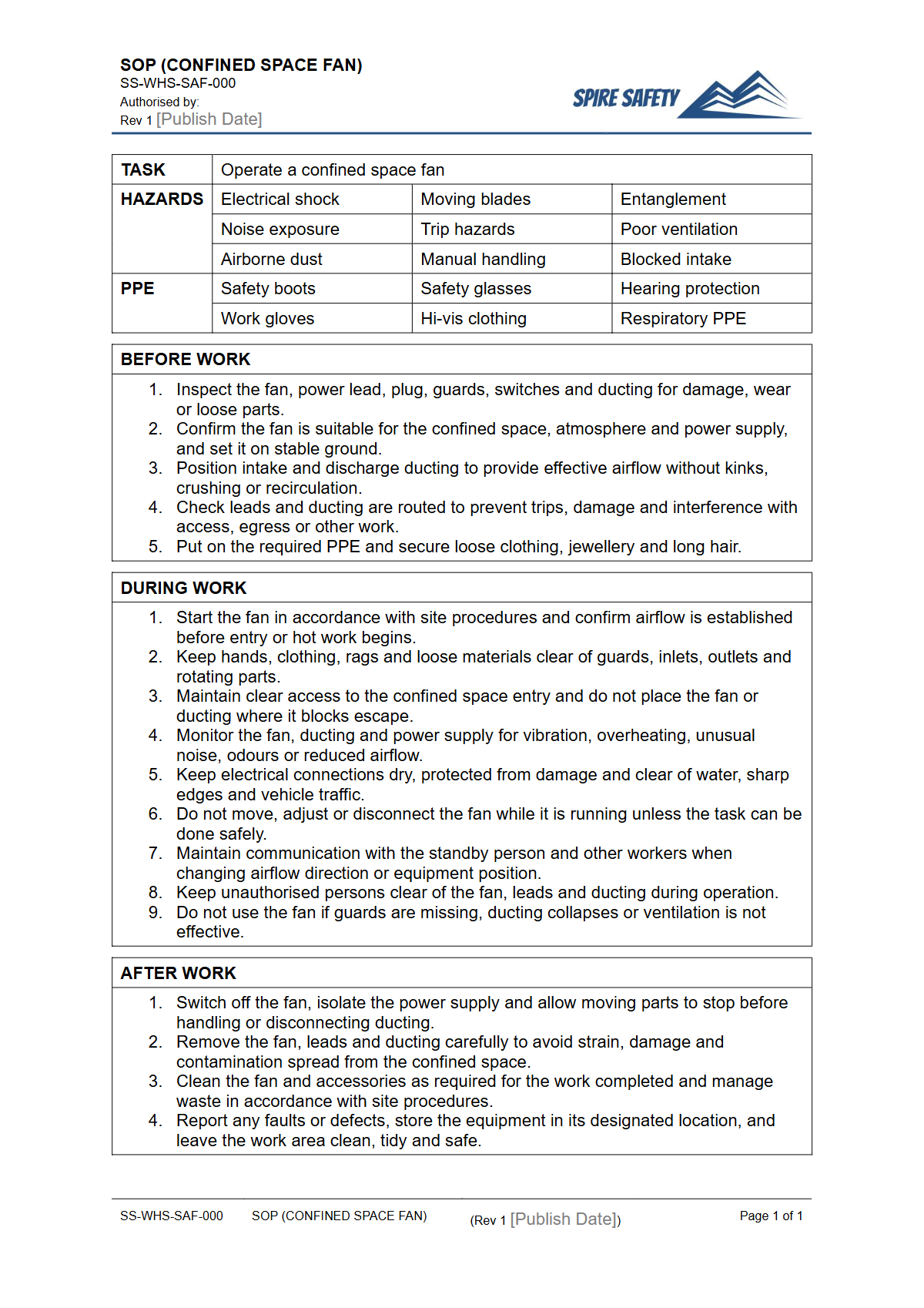
Download our free Safe Operating Procedure (Confined Space Fan) template.
Free Safe Operating Procedure (Confined Space Fan) Template
DOCX • 126 KB + PDF
Updated Oct 2026
No signup required
Purpose of the Free Safe Operating Procedure (Confined Space Fan) Template
Effectively managing air quality in confined spaces is not just best practice—it is a critical control measure to prevent serious injury or death. An unsafe atmosphere is a leading cause of incidents in these high-risk environments.
This Safe Operating Procedure (SOP) provides a structured, documented process for the setup, operation, and maintenance of confined space ventilation fans. It serves as a vital tool for ensuring that workers follow a consistent, safe method every time, reducing the risk of exposure to hazardous atmospheres, oxygen deficiency, or flammable gases.
Using this template helps a Person Conducting a Business or Undertaking (PCBU) demonstrate due diligence in managing worksite hazards. A well-defined SOP is a cornerstone of a safe system of work.
Integrating this procedure into your broader WHS management systems is essential for creating a holistic and robust safety culture within your organisation.
Video walkthrough
How to use the Free Safe Operating Procedure (Confined Space Fan) Template
This resource is available in two formats for your convenience. Download the DOCX file to edit and tailor the document to your specific worksite, equipment, and legislative requirements.
A PDF version is also included for easy distribution and printing once your customisations are complete.
Remember, this is a template, not a finished document. We strongly advise that you customise this SOP in consultation with your workers and other relevant stakeholders. You must ensure it reflects the specific models of fans in use, the unique characteristics of your confined spaces, and the findings of your site-specific risk assessments.
A generic procedure is not sufficient to meet your safety obligations.
Customisation Steps
- Consult: Discuss the procedure with operators, standby persons, and supervisors who will use it.
- Assess Risks: Conduct a thorough risk assessment for confined space work, focusing on atmospheric hazards that require mechanical ventilation.
- Specify Details: Add make, model, and specifications of your fans. Include details on ducting placement, power sources, and required purge times. The fan is often used alongside other equipment, so you may also need a procedure like our Free Air Compressor SOP Template.
- Define Checks: Outline pre-start checks, operational monitoring, and post-use inspections required for the fan.
- Train and Sign Off: Train all relevant personnel on the finalised SOP and document their understanding with a sign-off sheet.
Emergency Preparedness
Beyond standard operation, your SOP must detail emergency responses. This includes procedures for equipment failure and medical emergencies within the confined space. Ensuring your team is prepared for all eventualities is crucial, which may involve having other procedures and resources available, such as a Safe Operating Procedure for Defibrillator Operation.
When to use this Safe Operating Procedure
This SOP should be implemented as a key control measure whenever mechanical ventilation is required for work in or around a confined space. It is not a substitute for a confined space entry permit but a supporting document that details the safe use of a specific piece of equipment.
Use this SOP during:
- Planning and risk assessment for any confined space entry.
- Pre-start meetings and toolbox talks before work commences.
- Worker training, inductions, and competency assessments.
- Audits and inspections of workplace safety procedures.
Regularly reviewing your procedures against on-the-ground practice is a key part of maintaining compliance. A formal WHS compliance auditing process can help identify gaps in your systems, including the practical application of this SOP.
Who should use this Safe Operating Procedure
This document is intended for use by various personnel within an organisation to ensure a shared understanding of safety requirements:
- Managers and Supervisors: To implement and enforce safe work practices for confined space ventilation.
- Workers and Operators: As a clear guide on how to safely set up, use, and check the ventilation equipment.
- Confined Space Standby Persons: To understand ventilation system requirements and recognise signs of failure.
- WHS/HSE Advisors: To integrate the SOP into the wider safety management system and use it as a basis for training and audits.
If you are unsure how to tailor this SOP to your operational needs or integrate it effectively into your existing safety framework, our WHS consulting services can provide expert, practical guidance.
This document is one of many templates designed to assist Australian businesses. For more procedural documents, checklists, and forms, browse our complete free WHS resources library.
Common mistakes
Common mistakes to avoid
- Using a fan not intrinsically safe or rated for a potentially hazardous or flammable atmosphere.
- Placing the fan's fresh air intake too close to exhaust fumes from generators or vehicles.
- Failing to conduct pre-entry and continuous atmospheric monitoring, relying only on ventilation.
- Incorrectly positioning ducting, leading to short-circuiting where contaminated air is drawn back in.
Legal references
Legal considerations
The following legal requirements may be relevant to this type of work.
- Work Health and Safety Act (Harmonised) — Provides the primary duties for protecting workers and other people from work health and safety risks.
- Work Health and Safety Regulations (Harmonised) — Sets out requirements supporting the management of workplace hazards and risks.
The following codes may be relevant to this type of work.
- Managing WHS Risks Code of Practice — Provides practical guidance on identifying hazards, assessing risks and applying effective controls.
- Work Health and Safety Consultation, Cooperation and Coordination Code of Practice — Provides practical guidance on consulting workers and coordinating with other duty holders.
- Managing the Work Environment and Facilities Code of Practice — Provides practical guidance on safe work environments, workplace facilities and related controls.
Did you know
Atmospheric Hazards
According to Safe Work Australia, an unsafe atmosphere is a leading cause of fatalities in confined spaces, contributing to a significant majority of incidents.
Purge Time
A common rule of thumb is to purge a confined space with at least four to ten air volumes before entry, but this must always be verified with a calibrated gas detector.
FAQ
Frequently asked questions
01What should be included in an SOP for a confined space fan?
02Is this template enough for confined space entry compliance?
03How often should we review the SOP for confined space fans?
04Who is responsible for training workers on this SOP?
Share this resource
Free Safe Operating Procedure (Confined Space Fan) Template
Browse Categories
How To Use It
- 1Download and open in Word or PDF.
- 2Replace the placeholders with your business details.
- 3Get it reviewed by a WHS specialist before rollout.
Need it customised?
Our WHS consultants can adapt this template to your site, run a gap analysis, or audit what you already have in place.
Book a Free Consultation WHS consulting servicesor call 1300 156 382
Related templates
- Free Safe Operating Procedure (Confined Space Tripod) Template
- Free Safe Operating Procedure (Container Door Check) Template
- Free Safe Operating Procedure (Container Handler) Template
- Free Safe Operating Procedure (Container Loading) Template
- Free Safe Operating Procedure (Container Seal Check) Template
- Free Safe Operating Procedure (Container Unloading) Template