
Free Safe Operating Procedure (Container Handler) Template
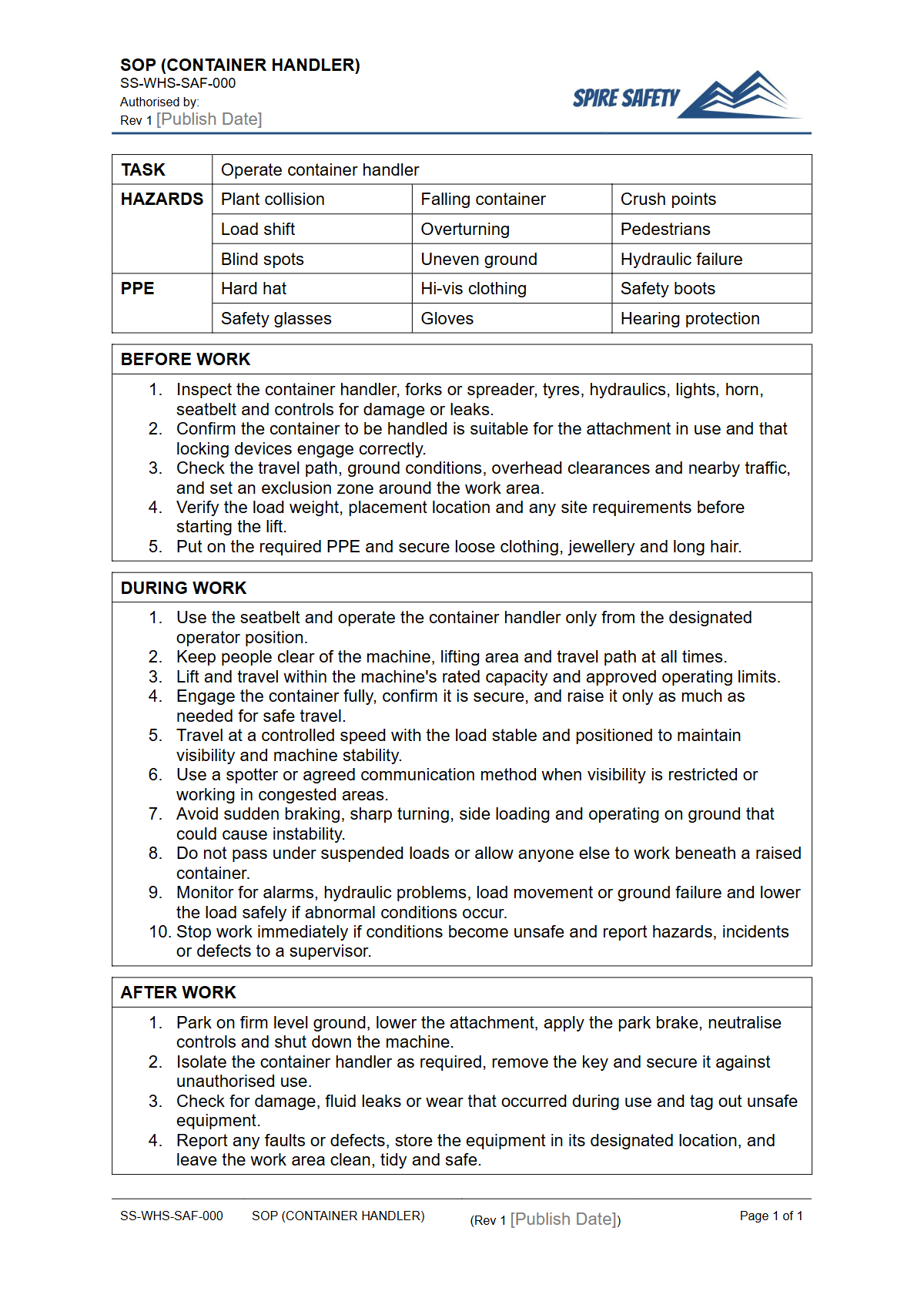
Download our free Safe Operating Procedure (Container Handler) template to formalise safety protocols.
Free Safe Operating Procedure (Container Handler) Template
DOCX • 126 KB + PDF
Updated Oct 2026
No signup required
Purpose of the Free Safe Operating Procedure (Container Handler) Template
Operating a container handler involves significant risks, including crushing, collisions, and dropped loads. A documented Safe Operating Procedure (SOP) is a fundamental tool for controlling these hazards.
This free Safe Operating Procedure (Container Handler) template provides a structured framework for businesses to establish and communicate clear, step-by-step instructions for safely operating this high-risk plant. Formalising your processes helps ensure every operator follows a consistent, safe method, reducing the likelihood of incidents and injuries.
Using a standardised procedure helps your organisation meet its primary duty of care under WHS legislation. It serves as a key training document for new operators, a refresher for experienced staff, and a benchmark for performance.
A well-developed SOP is a critical component of effective WHS management systems, demonstrating a proactive approach to risk management in your workplace.
Video walkthrough
How to use the Free Safe Operating Procedure (Container Handler) Template
This template is provided in both DOCX and PDF formats for your convenience. To use it, simply download the file and open it in a compatible word processor.
The document is structured with key sections that you must populate with information specific to your operational environment. This includes details of the specific container handler model, pre-start checks, operational steps, shutdown procedures, and emergency responses.
Important: This document provides a starting point only. You must customise it with your specific site details, equipment makes and models, risk assessment findings, and control measures to ensure it is effective for your workplace.
We strongly recommend consulting with the operators who use the equipment during the drafting and review process to ensure the procedure is practical and reflects actual work practices. Failure to adapt the template to your unique circumstances can render it ineffective.
Once customised, the SOP should be formally approved, communicated to all relevant personnel, and made readily accessible in the work area. The effectiveness of your procedures can be verified through practical observation and regular WHS compliance auditing to ensure the documented steps are being followed correctly.
When to use a Container Handler Safe Operating Procedure
A Safe Operating Procedure for a container handler should be used consistently as part of daily operations. It is not a document to be filed away and forgotten. Key times to use the SOP include:
- Operator Training and Induction: The SOP forms the basis for training new or inexperienced operators on the correct, safe method for using the equipment.
- Pre-operational Checks: Operators should refer to the pre-start inspection checklist within the SOP before every shift to ensure the machine is safe to use.
- Refresher Training: It should be used during periodic refresher training to reinforce safe work habits and introduce any updates to procedures.
- Incident Investigations: Following an incident or near miss, the SOP is a critical reference document to determine if procedures were followed and whether they need to be revised.
- Operational Reviews: Supervisors can use the SOP to conduct performance observations and competency assessments. This is a common requirement for many types of heavy machinery, similar to the process outlined in our Telehandler SOP template.
Who should use this Safe Operating Procedure
The responsibility for developing, implementing, and using an SOP for a container handler extends across several roles within an organisation:
- Persons Conducting a Business or Undertaking (PCBUs): Have the ultimate responsibility to ensure safe systems of work, like SOPs, are in place and effective.
- Managers and Supervisors: Must ensure that operators are trained on the SOP, have access to it, and follow it during their work. They are also responsible for reviewing and updating the procedure as required.
- Operators: Are the primary users of the SOP. They must understand and follow the specified procedures to ensure their own safety and the safety of others around them. Consultation with operators is vital, as they bring practical experience that is essential for creating a workable document, a principle that applies to all heavy equipment like that covered in our FREE Dozer SOP (Safe Operating Procedure) Template.
- WHS Personnel and Trainers: Use the SOP as a core document for risk management activities, safety training, and competency assessments.
Developing robust procedures for all plant and equipment is a cornerstone of a safe workplace. For complex tasks involving other types of earthmoving equipment, you might find our FREE Scraper SOP (Safe Operating Procedure) Template a useful reference for comparison. If you require assistance in developing site-specific risk assessments and procedures, engaging professional WHS consulting services can provide expert guidance. For more templates and safety guides, feel free to browse our complete free WHS resources library.
Common mistakes
Common mistakes to avoid
- Using a generic template without customising it for the specific machine model and site conditions.
- Failing to include detailed emergency procedures for scenarios like hydraulic failure, fire, or load instability.
- Not consulting with experienced operators during the drafting process, resulting in impractical or incomplete steps.
- Treating the SOP as a compliance document to be filed away, rather than a live operational and training tool.
Legal references
Legal considerations
The following legal requirements may be relevant to this type of work.
- Work Health and Safety Act (Harmonised) — Provides the primary duties for protecting workers and other people from work health and safety risks.
- Work Health and Safety Regulations (Harmonised) — Sets out requirements supporting the management of workplace hazards and risks.
The following codes may be relevant to this type of work.
- Managing WHS Risks Code of Practice — Provides practical guidance on identifying hazards, assessing risks and applying effective controls.
- Work Health and Safety Consultation, Cooperation and Coordination Code of Practice — Provides practical guidance on consulting workers and coordinating with other duty holders.
- Managing the Work Environment and Facilities Code of Practice — Provides practical guidance on safe work environments, workplace facilities and related controls.
Did you know
Incredible Weight
A standard 40-foot shipping container can weigh over 30 tonnes when fully loaded. This immense weight makes precise control and stable ground conditions critical during every lift.
Significant Blind Spots
Container handlers have large blind spots, particularly to the rear and sides of the machine. This is a leading cause of incidents involving collisions with pedestrians, vehicles, and infrastructure in busy port and yard environments.
FAQ
Frequently asked questions
01What is a Safe Operating Procedure for a container handler?
02Is a high-risk work licence required to operate a container handler?
03How often should a container handler SOP be reviewed?
04Can this template be used for all types of container handlers?
Share this resource
Free Safe Operating Procedure (Container Handler) Template
Browse Categories
How To Use It
- 1Download and open in Word or PDF.
- 2Replace the placeholders with your business details.
- 3Get it reviewed by a WHS specialist before rollout.
Need it customised?
Our WHS consultants can adapt this template to your site, run a gap analysis, or audit what you already have in place.
Book a Free Consultation WHS consulting servicesor call 1300 156 382
Related templates
- Free Safe Operating Procedure (Container Loading) Template
- Free Safe Operating Procedure (Container Seal Check) Template
- Free Safe Operating Procedure (Container Unloading) Template
- Free Safe Operating Procedure (Continence Aid Disposal) Template
- Free Safe Operating Procedure (Conveyor Belt Operation) Template
- Free Safe Operating Procedure (Cooking Oil Storage) Template