
Free Safe Operating Procedure (Continence Aid Disposal) Template
Manage infection control and biological hazards with our free Safe Operating Procedure for continence aid disposal. Ideal for aged care and healthcare settings.
Free Safe Operating Procedure (Continence Aid Disposal) Template
DOCX • 126 KB + PDF
Updated Oct 2026
No signup required
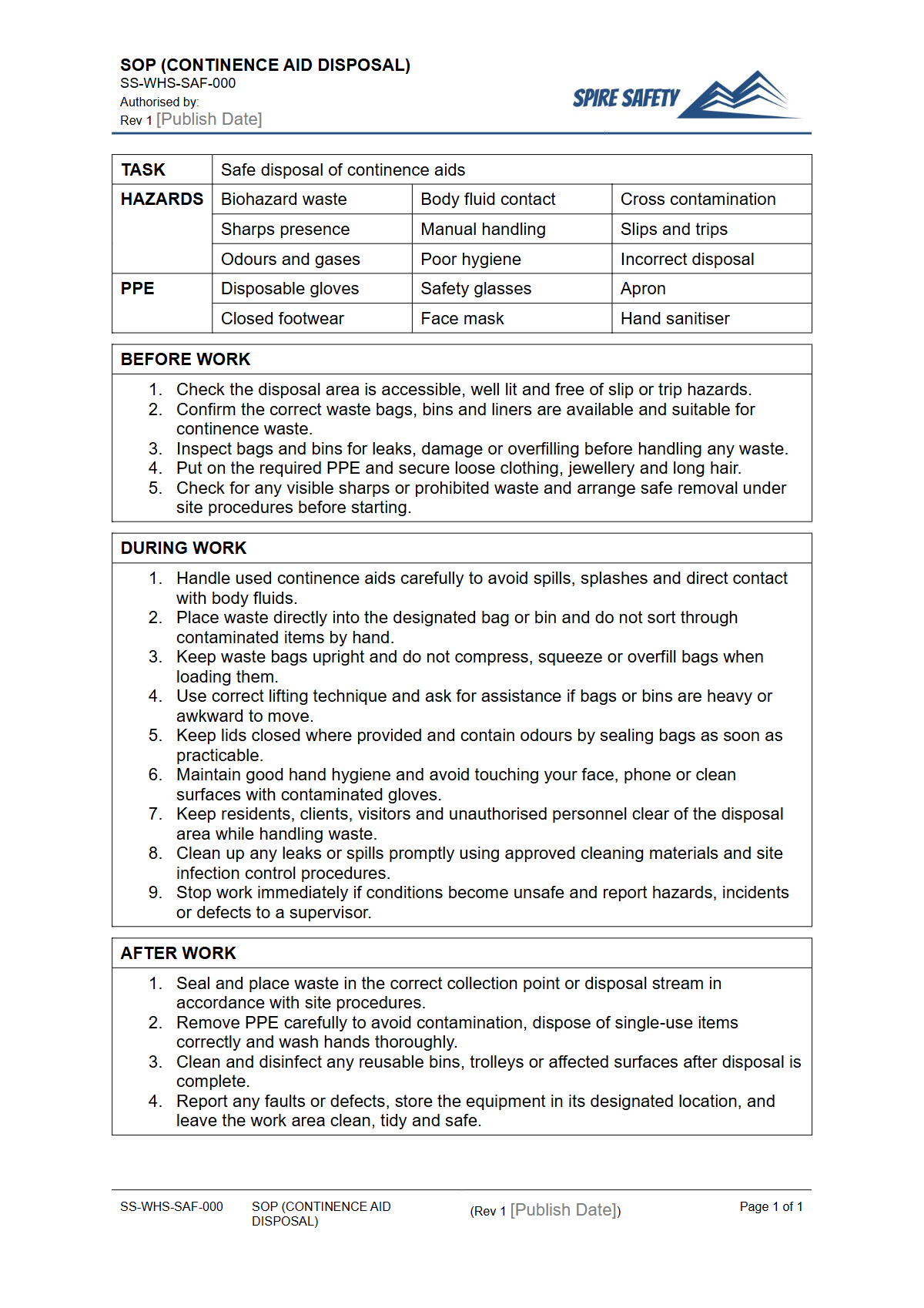
Purpose of the Free Safe Operating Procedure (Continence Aid Disposal) Template
Managing the disposal of continence aids is a critical task in any healthcare, aged care, or NDIS support setting. This process carries significant risks, including exposure to biological hazards, the spread of infections, and manual handling injuries.
Our Free Safe Operating Procedure (Continence Aid Disposal) Template provides a structured framework for documenting a clear, step-by-step process for this task. Using a standardised SOP helps your organisation ensure that all workers follow a consistent, safe method, minimising health risks for both staff and clients.
It forms a key part of your infection prevention and control program and demonstrates a commitment to workplace health and safety.
This template is designed to be integrated into your broader safety framework. A comprehensive approach ensures all procedures are documented, followed, and regularly reviewed.
Developing robust WHS management systems is fundamental to creating a culture of safety where such procedures become second nature to all team members.
Video walkthrough
How to use the Free Safe Operating Procedure (Continence Aid Disposal) Template
This document is a starting point designed for customisation. Download the DOCX or PDF and adapt it to the specific context of your workplace.
You must review and modify the content to reflect your facility's unique environment, equipment (e.g., specific types of clinical waste bins, sanitisers), waste management contractors, and state or territory regulations. Effective procedures are developed in consultation with the workers who perform the task daily.
Important: This is a template and not a complete WHS solution. We have provided a solid foundation, but you are responsible for ensuring the final document is tailored to your specific workplace risks and legal obligations.
We strongly recommend consulting with your team and a WHS professional to ensure the final SOP is comprehensive and effective for your needs.
When to use a Continence Aid Disposal SOP
A Safe Operating Procedure for continence aid disposal should be an active document used in daily operations. It is essential for inducting and training new care staff, support workers, and cleaners, ensuring they understand the correct protocol from day one.
It also serves as a critical tool for refresher training for existing staff to reinforce safe work practices and introduce any changes to the procedure. This SOP should be readily accessible in work areas and reviewed as part of regular toolbox talks or safety meetings.
Furthermore, the procedure must be reviewed and updated following any incident, near miss, or change in legislation or equipment.
Periodically confirming that procedures are being followed correctly is a key part of maintaining safety standards. This can be achieved through regular workplace inspections or more formal WHS compliance auditing to identify any gaps between the documented procedure and actual practice.
Who should use this SOP
This template is intended for use by a range of personnel within the healthcare and community support sectors. This includes:
- WHS Managers and Officers: To develop, implement, and review safety procedures as part of the overall WHS system.
- Facility and Operations Managers: To ensure consistent and safe practices are maintained across a facility or service.
- Team Leaders and Registered Nurses: To train and supervise care staff and ensure adherence to infection control standards.
- Care Workers, Personal Care Assistants (PCAs), and Support Workers: As a direct guide for performing the task safely and hygienically in residential aged care, hospitals, and home care settings.
While this SOP addresses a specific clinical task, general facility safety is also paramount. For example, accessing supplies stored on high shelves requires its own set of precautions.
Our FREE Step Ladder SOP (Safe Operating Procedure) Template can help formalise procedures for other common workplace tasks.
If you require assistance tailoring this document or developing other safety resources, our WHS consulting services can provide expert guidance. You can also explore our complete free WHS resources library for more templates and guides to support your safety management system.
Common mistakes
Common mistakes to avoid
- Placing used continence aids into general waste bins instead of designated clinical waste bins.
- Forgetting to wear appropriate PPE, particularly gloves, before handling soiled items.
- Failing to securely tie or seal disposal bags, leading to leaks, spills, and odours.
- Using incorrect manual handling techniques when lifting and transporting heavy waste bags, increasing the risk of musculoskeletal injury.
Legal references
Legal considerations
The following legal requirements may be relevant to this type of work.
- Work Health and Safety Act (Harmonised) — Provides the primary duties for protecting workers and other people from work health and safety risks.
- Work Health and Safety Regulations (Harmonised) — Sets out requirements supporting the management of workplace hazards and risks.
The following codes may be relevant to this type of work.
- Managing WHS Risks Code of Practice — Provides practical guidance on identifying hazards, assessing risks and applying effective controls.
- Work Health and Safety Consultation, Cooperation and Coordination Code of Practice — Provides practical guidance on consulting workers and coordinating with other duty holders.
- Managing the Work Environment and Facilities Code of Practice — Provides practical guidance on safe work environments, workplace facilities and related controls.
Did you know
Infection Control
According to the Australian Commission on Safety and Quality in Health Care, appropriate hand hygiene is recognised as the single most important factor in preventing the spread of healthcare-associated infections (HAIs).
Waste Segregation
In Australia, clinical waste (or 'regulated waste' in some jurisdictions) must be segregated at the point of generation, specially packaged, and handled by a licensed contractor. Incorrect disposal can lead to significant environmental and public health risks.
FAQ
Frequently asked questions
01What key information should be included in a continence aid disposal SOP?
02Is this safe operating procedure template suitable for NDIS providers?
03How often should we review our continence aid disposal procedures?
04What are the main hazards associated with incorrect disposal of continence aids?
Share this resource
Free Safe Operating Procedure (Continence Aid Disposal) Template
Browse Categories
How To Use It
- 1Download and open in Word or PDF.
- 2Replace the placeholders with your business details.
- 3Get it reviewed by a WHS specialist before rollout.
Need it customised?
Our WHS consultants can adapt this template to your site, run a gap analysis, or audit what you already have in place.
Book a Free Consultation WHS consulting servicesor call 1300 156 382
Related templates
- Free Safe Operating Procedure (Conveyor Belt Operation) Template
- Free Safe Operating Procedure (Cooking Oil Storage) Template
- Free Safe Operating Procedure (Cooking Oil Transfer) Template
- Free Safe Operating Procedure (Cool Room Access) Template
- Free Safe Operating Procedure (Coolant Change) Template
- Free Safe Operating Procedure (Cooling Coil Cleaning) Template