
Free Safe Operating Procedure (Container Loading) Template
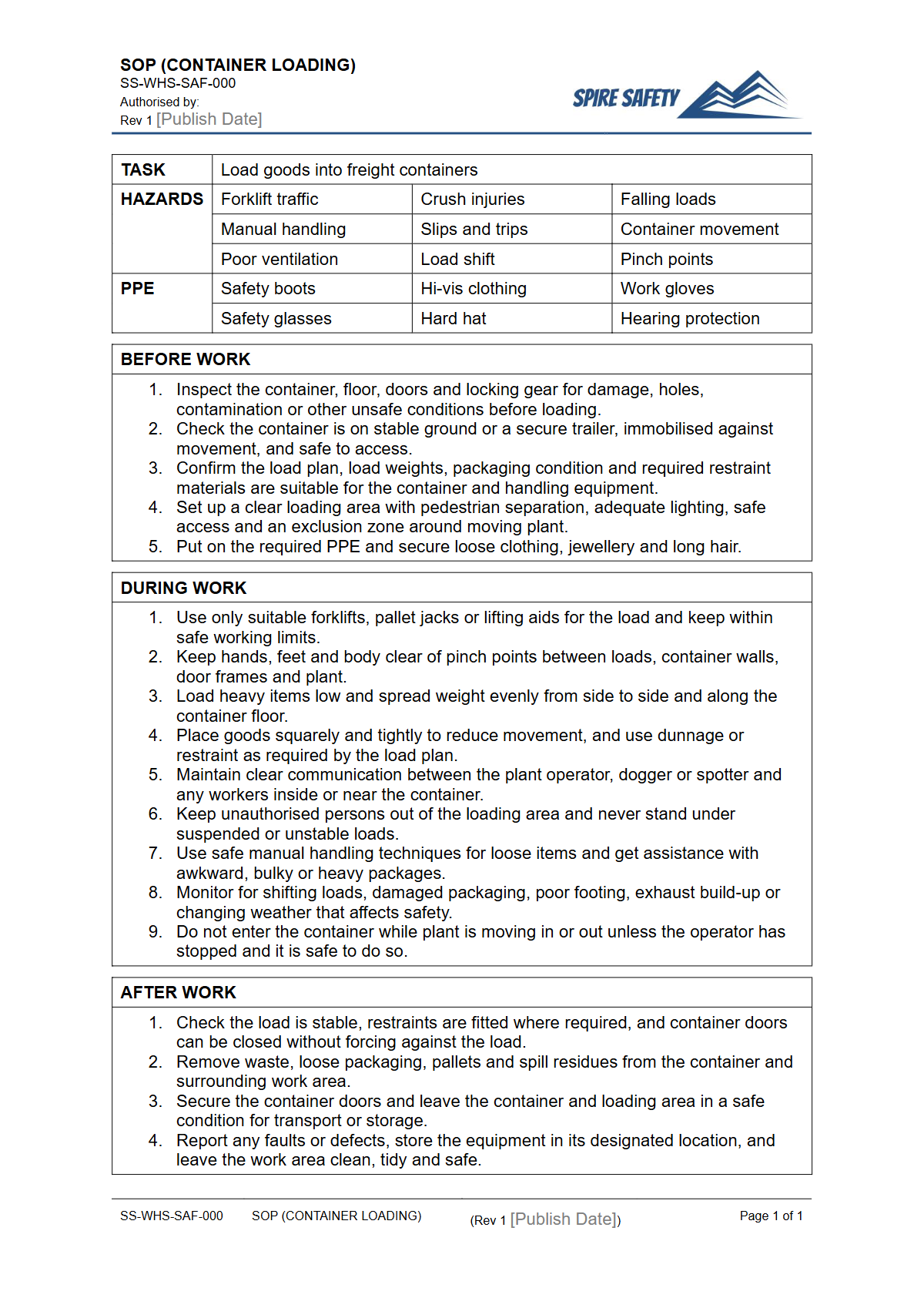
Download our free Safe Operating Procedure (Container Loading) template. This customisable DOCX & PDF provides a clear framework for managing risks.
Free Safe Operating Procedure (Container Loading) Template
DOCX • 126 KB + PDF
Updated Oct 2026
No signup required
Purpose of the Free Safe Operating Procedure (Container Loading) Template
Loading shipping containers is a high-risk activity common in logistics, manufacturing, and transport industries. This free Safe Operating Procedure (Container Loading) template provides a structured framework for documenting and implementing a safe system of work.
It helps your organisation manage significant hazards such as musculoskeletal injuries from manual handling, falls from height, collisions with mobile plant, and injuries caused by shifting loads. By formalising your process, you can ensure consistency, aid worker training, and demonstrate due diligence in managing workplace health and safety.
A comprehensive SOP is a critical tool for risk management. It outlines the step-by-step process for safely packing and securing goods, considering factors like weight distribution, load restraint, and the safe use of equipment.
Using a standardised procedure helps minimise the risk of incidents that can lead to serious injury, equipment damage, or breaches of Chain of Responsibility (CoR) obligations. This template is designed as a starting point, based on Australian WHS principles, to help you create a site-specific document.
Video walkthrough
How to use the Free Safe Operating Procedure (Container Loading) Template
This Safe Operating Procedure template is provided in both an editable DOCX format and a ready-to-print PDF. To use it effectively, download the document and integrate your business's specific details, including company name, relevant personnel, and review dates.
The core of the customisation involves adapting the procedure to match the realities of your workplace.
You must detail the specific types of plant used (e.g., forklifts, pallet jacks), the goods being loaded, and the environmental conditions of your loading area. Walk through the process with the workers who perform the task to ensure the SOP reflects actual practice and addresses the real-world hazards they face. The use of powered mobile plant is a common feature of this task; for related guidance, you can also reference our free Telehandler SOP Template.
Important: This template provides a structured starting point. You must customise it to reflect the specific equipment, environment, and procedures of your workplace.
We recommend a competent person reviews and approves the final document to ensure it is robust and effective for your operational context. If you need assistance, our WHS consulting services can provide expert guidance.
When to use it
A Safe Operating Procedure for container loading should be a 'live' document used consistently throughout your operations. It should be consulted:
- Before work starts: As part of the pre-start checks and risk assessment for each loading task.
- During training and induction: To train new employees or refresh the skills of existing workers on the established safe process.
- For toolbox talks: As a basis for short, focused safety discussions on specific aspects of the loading process, like manual handling techniques or communication protocols.
- After an incident or near miss: To review and identify whether the procedure was followed and if it needs to be updated to prevent a recurrence.
Regularly reviewing and referencing the SOP ensures it becomes an integral part of your safety culture, rather than just a document that sits on a shelf. This practice is a cornerstone of effective WHS management systems.
Who should use it
This SOP is intended for use by a range of personnel within an organisation to ensure a coordinated and safe approach to container loading. Key users include:
- Logistics and Warehouse Managers: To establish, implement, and enforce safe work standards.
- Supervisors: For directing work, conducting pre-start briefings, and monitoring adherence to the procedure.
- Workers and Forklift Operators: As a practical guide for executing their tasks safely and consistently.
- WHS/HSE Officers: For use in risk assessments, incident investigations, and compliance checks.
Even tasks that seem simple, such as using a small ladder to check restraints, carry risks that must be managed. For guidance on related ancillary tasks, you might find documents like our free Step Ladder SOP useful.
The ultimate goal is to ensure everyone involved understands their role and responsibilities. The effectiveness of your procedures can be verified through routine WHS compliance audits.
This document is one of many tools available to help you build a safer workplace. You can explore a wide range of similar documents in our free WHS resources library to support your other operational needs.
Common mistakes
Common mistakes to avoid
- Failing to conduct a pre-start risk assessment for each specific load.
- Incorrectly distributing weight inside the container, leading to instability.
- Neglecting to establish and enforce an exclusion zone for pedestrians around the loading area.
- Using damaged or inappropriate load restraint equipment.
Legal references
Legal considerations
The following legal requirements may be relevant to this type of work.
- Work Health and Safety Act (Harmonised) — Provides the primary duties for protecting workers and other people from work health and safety risks.
- Work Health and Safety Regulations (Harmonised) — Sets out requirements supporting the management of workplace hazards and risks.
The following codes may be relevant to this type of work.
- Managing WHS Risks Code of Practice — Provides practical guidance on identifying hazards, assessing risks and applying effective controls.
- Work Health and Safety Consultation, Cooperation and Coordination Code of Practice — Provides practical guidance on consulting workers and coordinating with other duty holders.
- Managing the Work Environment and Facilities Code of Practice — Provides practical guidance on safe work environments, workplace facilities and related controls.
Did you know
Load Shift Dangers
Even a small shift in cargo inside a container can dramatically alter a truck's centre of gravity, significantly increasing the risk of a rollover accident.
Chain of Responsibility
Under Australia's Chain of Responsibility (CoR) laws, anyone who has influence over the transport task, including the person packing the container, can be held legally liable for breaches.
FAQ
Frequently asked questions
01Is this container loading SOP compliant with Australian WHS laws?
02What are the biggest risks in container loading?
03Who is responsible for safety during container loading under Chain of Responsibility (CoR) laws?
04Does this SOP cover fumigation and hazardous goods?
Share this resource
Free Safe Operating Procedure (Container Loading) Template
Browse Categories
How To Use It
- 1Download and open in Word or PDF.
- 2Replace the placeholders with your business details.
- 3Get it reviewed by a WHS specialist before rollout.
Need it customised?
Our WHS consultants can adapt this template to your site, run a gap analysis, or audit what you already have in place.
Book a Free Consultation WHS consulting servicesor call 1300 156 382
Related templates
- Free Safe Operating Procedure (Container Seal Check) Template
- Free Safe Operating Procedure (Container Unloading) Template
- Free Safe Operating Procedure (Continence Aid Disposal) Template
- Free Safe Operating Procedure (Conveyor Belt Operation) Template
- Free Safe Operating Procedure (Cooking Oil Storage) Template
- Free Safe Operating Procedure (Cooking Oil Transfer) Template