
Free Safe Operating Procedure (Container Seal Check) Template
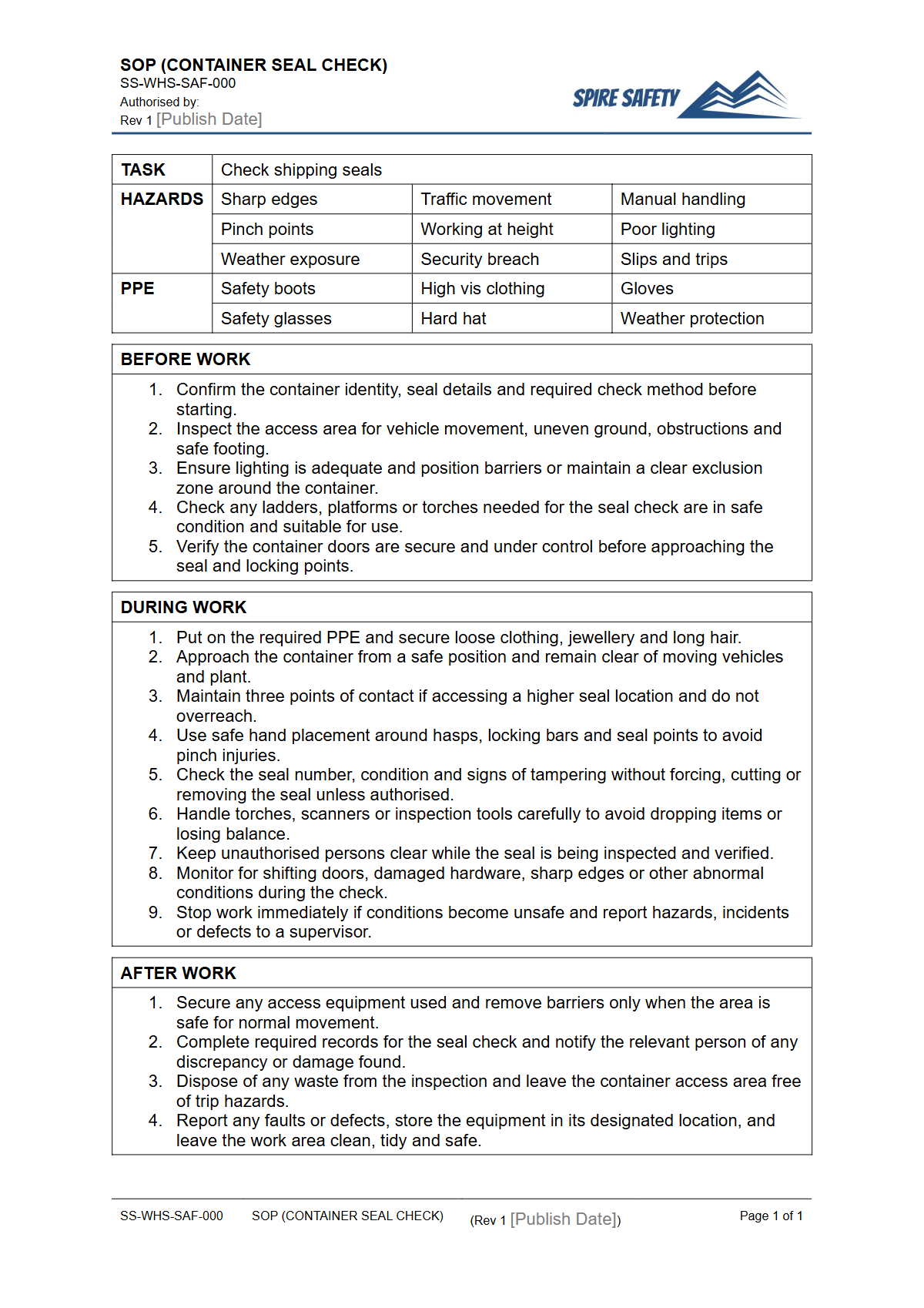
Download our free Safe Operating Procedure (Container Seal Check) template. This customisable DOCX and PDF helps formalise security and safety checks.
Free Safe Operating Procedure (Container Seal Check) Template
DOCX • 126 KB + PDF
Updated Oct 2026
No signup required
Purpose of the Free Safe Operating Procedure (Container Seal Check) Template
Properly inspecting container seals is a critical task in logistics, transport, and warehousing. It ensures the security and integrity of cargo, protecting it from theft, tampering, and contamination.
Our Free Safe Operating Procedure (Container Seal Check) Template provides a structured framework for documenting the steps required to perform these checks safely and consistently. Using a formalised SOP helps standardise your process, train workers effectively, and demonstrate due diligence under Chain of Responsibility (CoR) laws.
This procedure is fundamental for managing risks associated with both high-value goods and hazardous materials.
This SOP template guides users through the essential stages of a seal check, including pre-check preparations, the physical inspection process, and the steps to take when a discrepancy is found. Formalising this process is a key component of a robust safety management system, ensuring every person in the chain performs the task to the same standard.
Integrating such procedures is a core part of building effective WHS management systems that protect both people and assets.
Video walkthrough
How to use the Free Safe Operating Procedure (Container Seal Check) Template
This document is designed as a starting point, ready to be adapted for your specific operational context. To use it, simply download the DOCX file and customise it with details relevant to your business.
This includes adding your company name and logo, and specifying the exact types of seals you use (e.g., bolt seals, cable seals, barrier seals), the tools required, and your internal reporting contacts.
It is vital to tailor the risk control measures to match the hazards present in your work environment, such as working at heights to access a seal on a stacked container, or manual handling risks. Consider the environment where checks occur, which may have moving vehicles like forklifts or require the use of specific equipment.
For related tasks in a logistics yard, you might also need our FREE Telehandler SOP (Safe Operating Procedure) Template to manage plant operations safely.
Important Note on Customisation
This document is a template and must be customised to suit the specific requirements of your workplace. We recommend a consultation process with workers who will perform the task, as their direct input is invaluable for ensuring the Safe Operating Procedure is practical, clear, and effective.
The goal is to create a document that reflects how the work is actually and safely done on your site.
When to use a Container Seal Check SOP
A Safe Operating Procedure for container seal checks should be used at every key handover point in the supply chain to maintain a secure chain of custody. Key moments include:
- Before Dispatch: When a container is loaded and sealed at the point of origin.
- Upon Receipt: When a container arrives at a warehouse, distribution centre, or final destination.
- At Transfer Points: When a container is moved between different modes of transport (e.g., from a truck to a train).
- During Security Audits: As part of routine or unscheduled checks to verify cargo integrity.
- For Customs Clearance: When presenting a container for inspection by border authorities.
Consistently applying the SOP at these stages helps identify any tampering or security breaches as early as possible, minimising potential losses and liability. Regular verification is also a standard practice reviewed during a WHS compliance auditing process.
Who should use this Safe Operating Procedure
This SOP is intended for any person or organisation (PCBU) involved in the physical handling and management of shipping containers. This includes a wide range of roles:
- Warehouse and Logistics Personnel: Staff responsible for loading, unloading, and storing containers.
- Transport Operators: Truck drivers and rail operators who are responsible for the container during transit.
- Security Staff: Personnel tasked with monitoring site security and asset protection.
- Receiving and Dispatch Clerks: Administrative staff who document the container's arrival and departure, including seal numbers.
- Managers and Supervisors: Those responsible for overseeing operations, training staff, and ensuring procedures are followed.
Ensuring all relevant personnel are trained on this SOP is crucial for maintaining a consistent and secure process. It is also important to ensure general safety preparedness in the workplace, for which our Free Safe Operating Procedure (Defibrillator Operation) Template can be a vital resource.
If you need assistance developing this or other documents, our WHS consulting services can provide expert guidance tailored to your industry. You can also explore hundreds of other document templates in our free WHS resources library.
Common mistakes
Common mistakes to avoid
- Failing to record the unique seal number accurately on all documentation.
- Performing only a quick visual glance without physically tugging on the seal to check it is secure.
- Not comparing the physical seal number with the number listed on the bill of lading or other shipping documents.
- Accepting a container with a broken or missing seal without following the proper reporting and investigation protocol.
Legal references
Legal considerations
The following legal requirements may be relevant to this type of work.
- Work Health and Safety Act (Harmonised) — Provides the primary duties for protecting workers and other people from work health and safety risks.
- Work Health and Safety Regulations (Harmonised) — Sets out requirements supporting the management of workplace hazards and risks.
The following codes may be relevant to this type of work.
- Managing WHS Risks Code of Practice — Provides practical guidance on identifying hazards, assessing risks and applying effective controls.
- Work Health and Safety Consultation, Cooperation and Coordination Code of Practice — Provides practical guidance on consulting workers and coordinating with other duty holders.
- Managing the Work Environment and Facilities Code of Practice — Provides practical guidance on safe work environments, workplace facilities and related controls.
Did you know
Chain of Responsibility (CoR)
Under Australia's Heavy Vehicle National Law, CoR provisions mean that anyone who has influence over a transport activity can be held legally liable for safety breaches, including issues arising from improper container seal management.
ISO 17712 Standard
ISO 17712 is the international standard that establishes uniform procedures for the classification, acceptance, and withdrawal of mechanical freight container seals. High-security 'H' class seals must be compliant with this standard for most international shipping.
FAQ
Frequently asked questions
01What is the primary purpose of a shipping container seal?
02Is a visual check enough when inspecting a container seal?
03Who is responsible for checking container seals in Australia?
04What should I do if I find a broken or tampered container seal?
Share this resource
Free Safe Operating Procedure (Container Seal Check) Template
Browse Categories
How To Use It
- 1Download and open in Word or PDF.
- 2Replace the placeholders with your business details.
- 3Get it reviewed by a WHS specialist before rollout.
Need it customised?
Our WHS consultants can adapt this template to your site, run a gap analysis, or audit what you already have in place.
Book a Free Consultation WHS consulting servicesor call 1300 156 382
Related templates
- Free Safe Operating Procedure (Container Unloading) Template
- Free Safe Operating Procedure (Continence Aid Disposal) Template
- Free Safe Operating Procedure (Conveyor Belt Operation) Template
- Free Safe Operating Procedure (Cooking Oil Storage) Template
- Free Safe Operating Procedure (Cooking Oil Transfer) Template
- Free Safe Operating Procedure (Cool Room Access) Template