
Free Safe Operating Procedure (Confined Space Tripod) Template
Download our Free Safe Operating Procedure (Confined Space Tripod) Template.
Free Safe Operating Procedure (Confined Space Tripod) Template
DOCX • 126 KB + PDF
Updated Oct 2026
No signup required
Purpose of the Free Safe Operating Procedure (Confined Space Tripod) Template
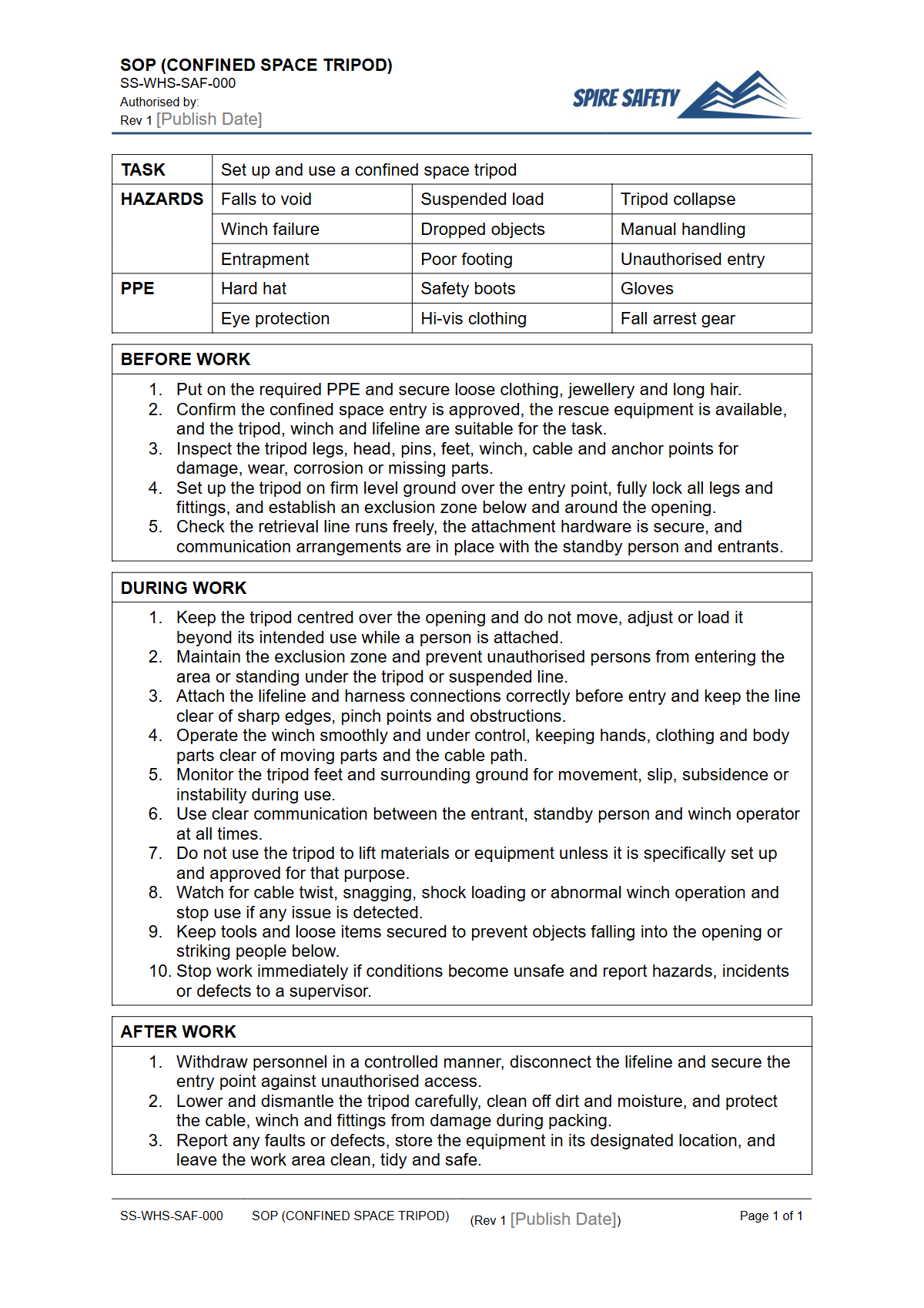
Our Free Safe Operating Procedure (Confined Space Tripod) Template provides a comprehensive framework for documenting the safe use of portable anchor tripods for confined space entry, exit, and rescue. This document is an essential administrative control measure, designed to guide workers through the critical steps of setting up, operating, inspecting, and storing this vital safety equipment.
By standardising the procedure, you help reduce the risk of human error in high-stakes situations.
The primary purpose of this Safe Operating Procedure template is to establish a clear, consistent, and safe method for using tripod systems. It helps organisations meet their duty of care by providing step-by-step instructions that minimise risk to personnel.
A well-developed SOP is a cornerstone of a robust WHS management system, ensuring that all tasks are performed to the same high safety standard every time. It also serves as a legal record demonstrating that a safe system of work has been established and communicated to employees.
Video walkthrough
How to use the Free Safe Operating Procedure (Confined Space Tripod) Template
Download the template in your preferred format (DOCX for easy editing or PDF) and adapt it to your specific operational context. This document is a starting point, not a final, ready-to-use solution.
When customising, pay close attention to manufacturer-specific instructions for your tripod and associated gear like winches and fall arresters. Incorporate information on weight limits (Working Load Limit), inspection criteria, and retirement policies for your equipment.
You must customise this template. We have provided a structured foundation aligned with Australian WHS principles, but the responsibility for adding specific details lies with you. It is crucial to integrate details from your own site-specific risk assessments, confined space entry permits, and rescue plans.
Regular review and updates are essential, and a formal process like a WHS compliance audit can help identify gaps in your safety documentation and processes.
When to use this Safe Operating Procedure
This SOP should be consulted before any work involving a confined space where a tripod is required as part of the safety and rescue system. It is an integral part of the planning and preparation phase, alongside the confined space risk assessment and entry permit.
The SOP should be readily available at the worksite for reference by the entry team, standby person, and supervisor. It also serves as a crucial training tool for new workers and for refresher training sessions, ensuring competency is maintained and verified.
It should form the basis for toolbox talks or pre-start meetings before any confined space entry begins.
Who should use this Safe Operating Procedure
This SOP is intended for all personnel involved in confined space operations using a tripod system. This includes the workers entering the space (entrants), the standby person responsible for monitoring the entrant and the environment, the entry supervisor overseeing the entire operation, and any designated rescue personnel.
While management is responsible for implementing the SOP, the workers using the equipment are accountable for ensuring the procedure is understood and followed correctly. If you need expert assistance in developing complex procedures for high-risk work, consider engaging professional WHS consulting services.
A critical component of any confined space operation is emergency preparedness. The tripod is often central to the rescue plan, allowing for non-entry retrieval of a worker.
Your SOP must detail the setup and operation of the rescue components, such as winches or self-retracting lifelines. This procedure should work in conjunction with other emergency plans, such as those covered in our free Safe Operating Procedure (Defibrillator Operation) template, to form a complete emergency response capability.
Maintaining a library of up-to-date SOPs is a key function of WHS management. As you build out your procedures for different plant and equipment, ensure they are stored in a central, accessible location for all staff. You can find more templates and checklists to support your safety systems in our comprehensive free WHS resources library.
Common mistakes
Common mistakes to avoid
- Using the tripod on unstable or uneven ground without proper footing plates or stabilisation.
- Failing to perform and document pre-use inspections to check for damage, wear, or missing parts.
- Exceeding the manufacturer's specified Working Load Limit (WLL) for the tripod, winch, or other components.
- Not having a trained, competent, and dedicated standby person monitoring the entry at all times.
Legal references
Legal considerations
The following legal requirements may be relevant to this type of work.
- Work Health and Safety Act (Harmonised) — Provides the primary duties for protecting workers and other people from work health and safety risks.
- Work Health and Safety Regulations (Harmonised) — Sets out requirements supporting the management of workplace hazards and risks.
The following codes may be relevant to this type of work.
- Managing WHS Risks Code of Practice — Provides practical guidance on identifying hazards, assessing risks and applying effective controls.
- Work Health and Safety Consultation, Cooperation and Coordination Code of Practice — Provides practical guidance on consulting workers and coordinating with other duty holders.
- Managing the Work Environment and Facilities Code of Practice — Provides practical guidance on safe work environments, workplace facilities and related controls.
Did you know
Anchorage Point Strength
The anchorage point on a compliant confined space tripod must be strong enough to withstand the forces generated during a fall arrest or rescue, typically rated to at least 15kN for one person.
FAQ
Frequently asked questions
01Is this Confined Space Tripod SOP ready to use immediately?
02What should be included in a Confined Space Tripod SOP?
03Who is responsible for creating a Safe Operating Procedure?
04How often should an SOP for a confined space tripod be reviewed?
Share this resource
Free Safe Operating Procedure (Confined Space Tripod) Template
Browse Categories
How To Use It
- 1Download and open in Word or PDF.
- 2Replace the placeholders with your business details.
- 3Get it reviewed by a WHS specialist before rollout.
Need it customised?
Our WHS consultants can adapt this template to your site, run a gap analysis, or audit what you already have in place.
Book a Free Consultation WHS consulting servicesor call 1300 156 382
Related templates
- Free Safe Operating Procedure (Container Door Check) Template
- Free Safe Operating Procedure (Container Handler) Template
- Free Safe Operating Procedure (Container Loading) Template
- Free Safe Operating Procedure (Container Seal Check) Template
- Free Safe Operating Procedure (Container Unloading) Template
- Free Safe Operating Procedure (Continence Aid Disposal) Template