
Free Safe Operating Procedure (Container Door Check) Template
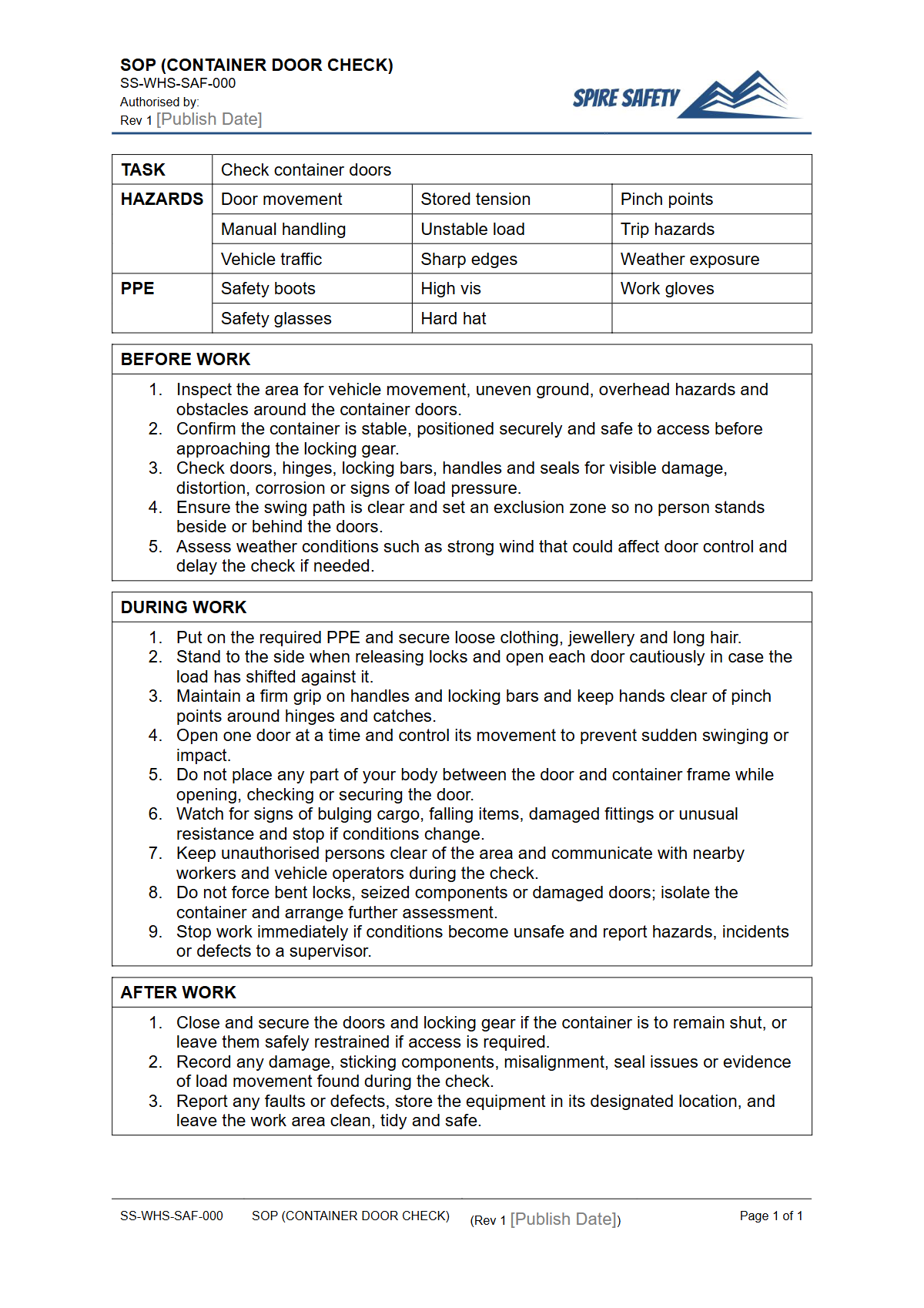
Download our Free Safe Operating Procedure (Container Door Check) Template to manage risks when opening shipping containers. Customisable DOCX & PDF.
Free Safe Operating Procedure (Container Door Check) Template
DOCX • 126 KB + PDF
Updated Oct 2026
No signup required
Purpose of the Free Safe Operating Procedure (Container Door Check) Template
Opening shipping container doors presents significant and often underestimated risks, from stored pressure release to falling cargo. This Free Safe Operating Procedure (Container Door Check) Template provides a structured framework to help your organisation manage these hazards effectively.
Implementing a clear, documented procedure ensures that workers follow a consistent, safe method every time they approach a container, minimising the risk of serious injury. A robust SOP is a fundamental part of effective WHS management systems.
This Safe Operating Procedure template guides users through a pre-opening inspection, focusing on identifying signs of door damage, bulging, or potential internal load shifts that could cause doors to spring open violently. It addresses common hazards such as stored kinetic energy, hazardous manual tasks associated with leveraging door handles, and working near heavy, swinging objects. For tasks that require accessing high locking bars, ensuring correct equipment is used is vital, as detailed in resources like our FREE Step Ladder SOP Template.
What's included in this Safe Operating Procedure?
The template is designed as a comprehensive starting point, aligned with Australian WHS principles. It includes sections for:
- Identifying required Personal Protective Equipment (PPE) such as gloves and safety boots.
- Listing potential hazards and their corresponding control measures.
- Detailing a step-by-step process for inspecting and opening both doors safely.
- Outlining emergency procedures in case of an incident.
- A sign-off area for workers who have been trained in the procedure.
Video walkthrough
How to use the Free Safe Operating Procedure (Container Door Check) Template
To get started, simply download the template in your preferred format (DOCX for easy editing or PDF for straightforward printing). The most critical step is to adapt the document to the specific context of your workplace.
This involves conducting a risk assessment of your container handling tasks and incorporating the findings into the SOP.
Remember, this is a template. We have not been to your workplace or assessed your specific operations, so you must customise it to reflect your unique environment, equipment, and processes.
A generic document is not sufficient for compliance. For a thorough review of your implemented procedures, consider engaging a professional for a WHS compliance auditing service.
Consultation is a key part of the process. Involve your workers—the ones who will be opening the containers—in reviewing and refining the draft SOP.
Their practical experience is invaluable for creating a procedure that is both safe and workable. This SOP should also integrate with other procedures for equipment used in the area, such as the process outlined in a FREE Telehandler SOP (Safe Operating Procedure) Template.
When to use it
This Safe Operating Procedure should be used every time a worker needs to open a sealed shipping container, regardless of its origin or perceived contents. It is particularly crucial in the following situations:
- Receiving Goods: Before unloading any container delivered to your site.
- Unknown Condition: When a container shows any visible signs of damage, rust, or bulging.
- Training and Induction: As a core training document for new employees or for refresher courses.
- After an Incident: To reinforce correct procedure following any near miss or incident involving container doors.
Like any critical safety document, such as a Free Safe Operating Procedure (Defibrillator Operation) Template, it should be readily accessible at the point of work.
Who should use it
This SOP is intended for any person conducting a business or undertaking (PCBU) whose workers handle shipping containers. It should be implemented and used by:
- Logistics and Warehouse Personnel: The primary users who perform the task of opening containers.
- Supervisors and Managers: To train staff, oversee operations, and ensure the procedure is being followed correctly.
- WHS/HSE Representatives: To assist in the development, implementation, and review of the procedure as part of the broader safety framework.
All personnel required to use the SOP must be trained in its contents and deemed competent to perform the task safely. If this template isn't quite what you need, feel free to browse our complete free WHS resources library for other templates and guides.
Common mistakes
Common mistakes to avoid
- Standing directly in the 'swing zone' of the door while unlocking it.
- Using makeshift tools or excessive force to open stuck handles, leading to injury.
- Failing to inspect the top and bottom of the container for signs of bulging or damage.
- Opening both doors at the same time instead of one at a time, starting with the right-hand door.
Legal references
Legal considerations
The following legal requirements may be relevant to this type of work.
- Work Health and Safety Act (Harmonised) — Provides the primary duties for protecting workers and other people from work health and safety risks.
- Work Health and Safety Regulations (Harmonised) — Sets out requirements supporting the management of workplace hazards and risks.
The following codes may be relevant to this type of work.
- Managing WHS Risks Code of Practice — Provides practical guidance on identifying hazards, assessing risks and applying effective controls.
- Work Health and Safety Consultation, Cooperation and Coordination Code of Practice — Provides practical guidance on consulting workers and coordinating with other duty holders.
- Managing the Work Environment and Facilities Code of Practice — Provides practical guidance on safe work environments, workplace facilities and related controls.
Did you know
Stored Energy
A container door that is under pressure from shifted cargo can release with enough force to throw a person several metres, causing life-threatening injuries.
Global Standardisation
While container dimensions are globally standardised (ISO 668), the condition and maintenance of their locking mechanisms can vary dramatically, making a pre-opening check essential.
FAQ
Frequently asked questions
01What are the main hazards of opening a shipping container door?
02Why can't I just use this SOP template as-is?
03What is the 'cam and keeper' on a container door?
04What should I do if a container door is bulging?
Share this resource
Free Safe Operating Procedure (Container Door Check) Template
Browse Categories
How To Use It
- 1Download and open in Word or PDF.
- 2Replace the placeholders with your business details.
- 3Get it reviewed by a WHS specialist before rollout.
Need it customised?
Our WHS consultants can adapt this template to your site, run a gap analysis, or audit what you already have in place.
Book a Free Consultation WHS consulting servicesor call 1300 156 382
Related templates
- Free Safe Operating Procedure (Container Handler) Template
- Free Safe Operating Procedure (Container Loading) Template
- Free Safe Operating Procedure (Container Seal Check) Template
- Free Safe Operating Procedure (Container Unloading) Template
- Free Safe Operating Procedure (Continence Aid Disposal) Template
- Free Safe Operating Procedure (Conveyor Belt Operation) Template