
Free Safe Operating Procedure (Conduit Bender) Template
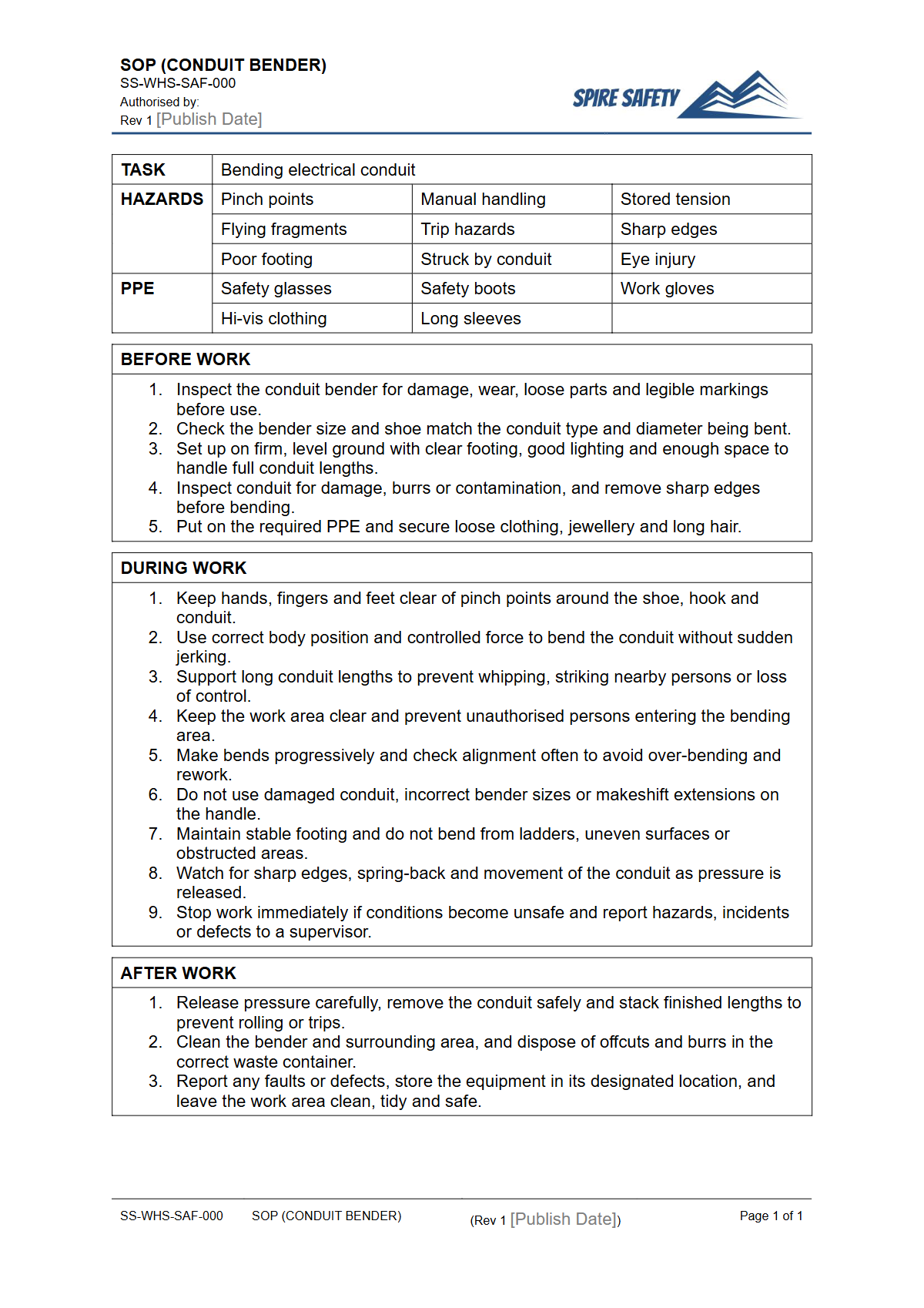
Download our free Safe Operating Procedure (Conduit Bender) template. This customisable DOCX and PDF helps you detail safe work methods for bending conduit.
Free Safe Operating Procedure (Conduit Bender) Template
DOCX • 126 KB + PDF
Updated Oct 2026
No signup required
Purpose of the Free Safe Operating Procedure (Conduit Bender) Template
A conduit bender is an essential tool for electricians, plumbers, and construction workers, used to bend electrical metallic tubing (EMT), rigid conduit, and other pipes to specific angles. While seemingly straightforward, its use involves risks such as musculoskeletal strain, crushing injuries, and slips or falls.
This Free Safe Operating Procedure (Conduit Bender) Template provides a structured framework for documenting the safest way to perform this task in your workplace.
By establishing a clear, step-by-step process, this SOP helps to standardise work methods, train new operators effectively, and minimise the risk of injury. It serves as a critical component of your overall safety management system, demonstrating a commitment to proactive risk management.
A well-developed SOP is a key part of effective WHS management systems, ensuring that all workers understand the expected safe behaviours and control measures.
Video walkthrough
How to use the Free Safe Operating Procedure (Conduit Bender) Template
This resource is available for download as a DOCX file, which is fully editable in Microsoft Word or other compatible software, and as a PDF for easy printing and distribution. The template is designed as a starting point, pre-filled with common sections found in a comprehensive Safe Operating Procedure, including pre-operational checks, operational steps, and post-task clean-up.
Important Note: This document is a template and must be customised to your specific workplace. You must review and edit the content to reflect your unique environment, including the specific models of conduit benders used (manual, ratchet, hydraulic), the types of conduit being bent, your site-specific risk assessment findings, and the required personal protective equipment (PPE).
We cannot be held responsible for the application of this document as we are not familiar with the specifics of your operation.
When customising this document, consider all related tasks and equipment. For instance, if conduit installation involves working at heights, you should integrate procedures from resources like our FREE Step Ladder SOP (Safe Operating Procedure) Template to ensure comprehensive safety coverage.
Key sections to customise include:
- Risk Assessment: Identify all potential hazards associated with the task at your site and document the corresponding control measures based on the hierarchy of controls.
- PPE Requirements: Specify the exact PPE your workers must use, such as impact-resistant safety glasses, cut-resistant gloves, and steel-capped boots.
- Pre-operational Checks: Detail the inspection steps for your specific bender models, checking for cracks, loose parts, or hydraulic leaks.
- Step-by-Step Procedure: Write clear, concise instructions for setting up, measuring, bending, and finishing the task, including proper body positioning to avoid ergonomic strain.
- Post-operational Tasks: Outline procedures for cleaning the equipment and work area. In workshops, this may involve using compressed air, which requires its own set of safety protocols detailed in documents like our Free Air Compressor SOP (Safe Operating Procedure) Template.
When to use it
A Safe Operating Procedure for a conduit bender should be used consistently as a reference tool and a training guide. It is most effective when integrated into daily operations.
Use this SOP when:
- Inducting and training new employees or apprentices on how to use a conduit bender safely.
- Conducting refresher training for existing workers to reinforce correct procedures.
- Preparing for a task to review the required safety checks and steps.
- Investigating an incident or near-miss to identify procedural gaps.
- Conducting regular workplace inspections and safety reviews.
These procedures should be readily accessible to all relevant personnel, either in digital format or as a laminated hard copy near the work area. Regular reviews of your SOPs are also a key part of preparation for formal WHS compliance auditing.
Who should use it
This SOP template is intended for use by a range of personnel within an organisation to ensure a unified approach to safety. Key users include:
- Persons Conducting a Business or Undertaking (PCBUs): To meet their primary duty of care by providing safe systems of work.
- WHS Managers and Safety Officers: To develop, implement, and review workplace safety documentation.
- Supervisors and Team Leaders: To train their teams, enforce safe work practices, and oversee tasks involving conduit bending.
- Workers: Electricians, plumbers, apprentices, and maintenance staff who operate conduit benders must follow the finalised procedure to ensure their own safety and that of others.
This document is just one of many that can help build a robust safety library. For more templates and checklists, you can explore our complete free WHS resources library, which covers a wide range of equipment and tasks.
Common mistakes
Common mistakes to avoid
- Failing to secure the bender or workpiece firmly before applying pressure.
- Using excessive or improper body leverage, leading to strains, slips, and falls.
- Neglecting to wear appropriate PPE, particularly safety glasses and gloves.
- Not inspecting the equipment for cracks, defects, or hydraulic leaks before use.
Legal references
Legal considerations
The following legal requirements may be relevant to this type of work.
- Work Health and Safety Act (Harmonised) — Provides the primary duties for protecting workers and other people from work health and safety risks.
- Work Health and Safety Regulations (Harmonised) — Sets out requirements supporting the management of workplace hazards and risks.
The following codes may be relevant to this type of work.
- Managing WHS Risks Code of Practice — Provides practical guidance on identifying hazards, assessing risks and applying effective controls.
- Work Health and Safety Consultation, Cooperation and Coordination Code of Practice — Provides practical guidance on consulting workers and coordinating with other duty holders.
- Managing the Work Environment and Facilities Code of Practice — Provides practical guidance on safe work environments, workplace facilities and related controls.
Did you know
Ergonomic Risk
Repetitive strain injuries (RSIs) are a significant risk with manual conduit benders. Using correct body mechanics, such as bending with your legs and keeping your back straight, is crucial to prevent long-term musculoskeletal issues.
Material Matters
Different types of conduit, like EMT, IMC, or Rigid, have different wall thicknesses and require specific shoes or bending techniques. Using the wrong setup can result in a 'kinked' bend, damaging the conduit and potentially the bender itself.
FAQ
Frequently asked questions
01What is the difference between an SOP and a SWMS?
02Can this template be used for hydraulic conduit benders?
03What PPE is generally required for using a conduit bender?
04How often should a Safe Operating Procedure be reviewed?
Share this resource
Free Safe Operating Procedure (Conduit Bender) Template
Browse Categories
How To Use It
- 1Download and open in Word or PDF.
- 2Replace the placeholders with your business details.
- 3Get it reviewed by a WHS specialist before rollout.
Need it customised?
Our WHS consultants can adapt this template to your site, run a gap analysis, or audit what you already have in place.
Book a Free Consultation WHS consulting servicesor call 1300 156 382
Related templates
- Free Safe Operating Procedure (Cone Crusher Clearing) Template
- Free Safe Operating Procedure (Confined Space Fan) Template
- Free Safe Operating Procedure (Confined Space Tripod) Template
- Free Safe Operating Procedure (Container Door Check) Template
- Free Safe Operating Procedure (Container Handler) Template
- Free Safe Operating Procedure (Container Loading) Template