
Free Safe Operating Procedure (Condensate Drain Flush) Template
Download our free Safe Operating Procedure (Condensate drain flush) template. This customisable DOCX and PDF helps you document safe work steps. Download now.
Free Safe Operating Procedure (Condensate Drain Flush) Template
DOCX • 126 KB + PDF
Updated Oct 2026
No signup required
Purpose of the Free Safe Operating Procedure (Condensate Drain Flush) Template
This Safe Operating Procedure (SOP) template outlines the steps for safely flushing condensate drains, typically found on air compressor receiver tanks and associated compressed air systems. The purpose of this procedure is to control the risks associated with stored energy (compressed air), hazardous substances (oil and water contaminants), and hot surfaces.
Flushing condensate is a critical maintenance task that prevents corrosion, ensures the quality of compressed air, and prolongs the life of the equipment and downstream tools. By providing a clear, step-by-step guide, this SOP helps ensure the task is performed consistently and safely every time.
A documented procedure is a cornerstone of a safe system of work, especially for routine maintenance tasks. It formalises the expected safety behaviour and provides a clear reference for training and supervision.
This SOP is designed to be integrated into your maintenance program, working alongside other key documents like our Air Compressor SOP to build a comprehensive safety framework for your compressed air equipment. It acts as a critical administrative control to manage hazards that cannot be completely eliminated through engineering solutions.
Video walkthrough
How to use the Free Safe Operating Procedure (Condensate Drain Flush) Template
This resource is provided as a fully editable DOCX file and a ready-to-use PDF. To use it effectively, you should download the document and adapt it to the specific context of your workplace.
An SOP is not a one-size-fits-all document; its effectiveness depends on how well it reflects your actual equipment, environment, and risk controls. Key details to customise include the specific make and model of the compressor, isolation point locations, required PPE, and emergency contact information.
Important: This document is a template and must be customised to suit your business's specific needs. We have provided a structured starting point based on Australian WHS principles, but you are responsible for ensuring the final document is accurate and reflects the unique hazards and control measures of your workplace.
Once customised, the SOP should be reviewed by a competent person, approved by management, and used to train all relevant workers before they undertake the task. Integrating this process into your broader WHS management systems ensures it remains a living document that is reviewed and updated regularly.
When to use it
This SOP should be used every time a worker is required to manually flush a condensate drain. The frequency of this task is determined by several factors, including the humidity of the operating environment, the compressor's duty cycle, and the manufacturer’s recommendations.
It is commonly performed as part of daily or weekly pre-start checks. The procedure should also be followed during scheduled preventative maintenance services or if there are signs of excessive water in the system.
It establishes a mandatory, non-negotiable process to follow, preventing workers from taking shortcuts that could lead to injury.
Who should use it
The procedure for flushing a condensate drain should only be performed by personnel who are trained, competent, and specifically authorised to do so. This typically includes maintenance staff, technicians, or experienced operators who have received training on the specific hazards of the compressed air system.
Workers must understand the principles of energy isolation, be familiar with the specific equipment, and be trained on the steps outlined in the customised SOP. Untrained or unauthorised personnel should never attempt this task. Using other simple equipment during maintenance, like a ladder, may also require its own procedure, such as a step ladder SOP.
Key Elements of a Condensate Drain Flush Procedure
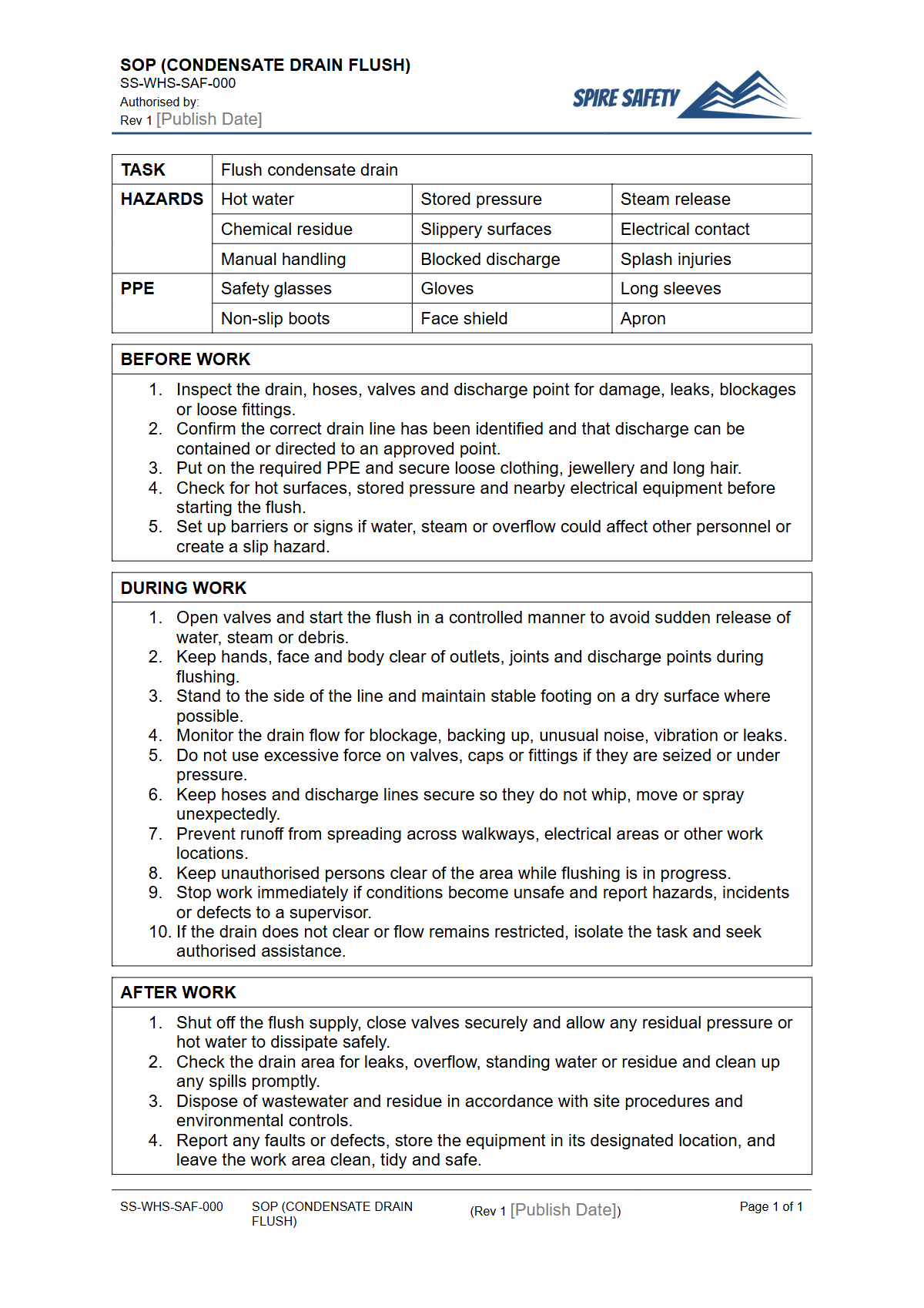
A robust SOP for this task includes several critical sections that guide the user from start to finish. This template provides a framework covering:
- Associated Hazards and Risks: Identifies potential dangers like pressurised air release, chemical exposure from condensate, noise, and hot components.
- Required Personal Protective Equipment (PPE): Specifies the necessary PPE, such as safety glasses, gloves, and protective footwear.
- Pre-operational Checks: Details the steps for preparing the equipment, most importantly the process for isolating and depressurising the system.
- Step-by-Step Procedure: Provides a clear, sequential guide for safely opening the drain, collecting the condensate, and closing the valve.
- Post-operational Checks: Outlines the steps for safely re-energising the system and verifying that the task is complete and the area is safe.
The process of confirming that procedures like this are being followed correctly is often handled through WHS compliance auditing, which helps verify that safe work practices are being implemented effectively on the ground.
Integrating this SOP into Your WHS System
An SOP is most effective when it is part of a holistic safety management system. It should not exist in isolation.
Use this template as a tool for worker training and competency assessments. Refer to it in your risk assessments and maintenance schedules.
Regular reviews and updates, especially after an incident or when new equipment is introduced, are essential for maintaining its relevance and effectiveness. This proactive approach to documentation is a key part of fulfilling a PCBU's duty of care.
For expert help in developing these broader systems, consider seeking advice through WHS consulting services.
Explore our extensive free WHS resources library for more templates and guides to support your safety management efforts.
Common mistakes
Common mistakes to avoid
- Forgetting to depressurise the air receiver tank before attempting to open the drain valve.
- Failing to wear appropriate PPE, particularly safety glasses to protect from pressurised spray.
- Neglecting to check if automatic drains are functioning correctly, assuming they don't need manual inspection.
- Improperly disposing of the collected condensate, which may be classified as hazardous or oily waste.
Legal references
Legal considerations
The following legal requirements may be relevant to this type of work.
- Work Health and Safety Act (Harmonised) — Provides the primary duties for protecting workers and other people from work health and safety risks.
- Work Health and Safety Regulations (Harmonised) — Sets out requirements supporting the management of workplace hazards and risks.
The following codes may be relevant to this type of work.
- Managing WHS Risks Code of Practice — Provides practical guidance on identifying hazards, assessing risks and applying effective controls.
- Work Health and Safety Consultation, Cooperation and Coordination Code of Practice — Provides practical guidance on consulting workers and coordinating with other duty holders.
- Managing the Work Environment and Facilities Code of Practice — Provides practical guidance on safe work environments, workplace facilities and related controls.
Did you know
Water Accumulation
For every 10°C that compressed air cools inside a receiver tank, its capacity to hold water vapour is roughly halved. This process causes significant amounts of water to condense, especially in humid Australian climates.
FAQ
Frequently asked questions
01What is a condensate drain on an air compressor?
02Why is flushing a condensate drain a hazardous task?
03How often should condensate drains be flushed?
04Can I use this template for any brand of equipment?
Share this resource
Free Safe Operating Procedure (Condensate Drain Flush) Template
Browse Categories
How To Use It
- 1Download and open in Word or PDF.
- 2Replace the placeholders with your business details.
- 3Get it reviewed by a WHS specialist before rollout.
Need it customised?
Our WHS consultants can adapt this template to your site, run a gap analysis, or audit what you already have in place.
Book a Free Consultation WHS consulting servicesor call 1300 156 382
Related templates
- Free Safe Operating Procedure (Condiment Bottle Filling) Template
- Free Safe Operating Procedure (Condiment Station Clean) Template
- Free Safe Operating Procedure (Conductivity Meter) Template
- Free Safe Operating Procedure (Conduit Bender) Template
- Free Safe Operating Procedure (Cone Crusher Clearing) Template
- Free Safe Operating Procedure (Confined Space Fan) Template