
Free Safe Operating Procedure (Concrete Pump Hose) Template
Download a free Safe Operating Procedure for concrete pump hoses. Our DOCX and PDF template helps you manage high-pressure concrete hazards.
Free Safe Operating Procedure (Concrete Pump Hose) Template
DOCX • 126 KB + PDF
Updated Oct 2026
No signup required
Purpose of the Free Safe Operating Procedure (Concrete Pump Hose) Template
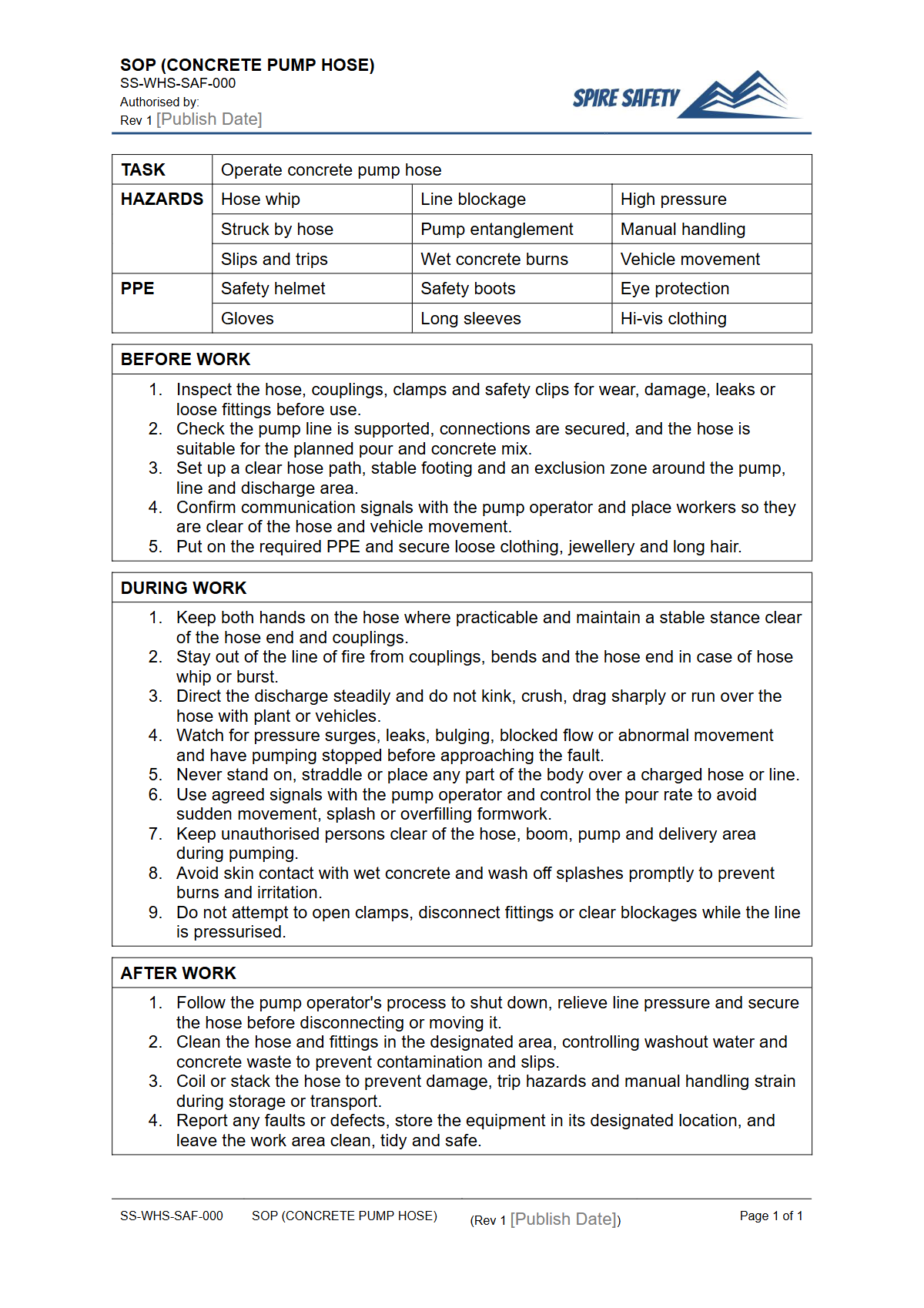
This Free Safe Operating Procedure (Concrete Pump Hose) Template provides a structured framework for outlining the safety requirements for handling concrete pump delivery hoses on a worksite. It helps persons conducting a business or undertaking (PCBUs) manage high-risk hazards such as hose whip, blockages, high-pressure fluid injection, and musculoskeletal injuries.
A documented Safe Operating Procedure (SOP) is a critical tool for worker training, competency verification, and demonstrating that reasonably practicable steps have been taken to ensure safety. While this document focuses on the hose, the entire system must be considered, which often involves a specific safe operating procedure for boom pumps.
Video walkthrough
How to use the Free Safe Operating Procedure (Concrete Pump Hose) Template
This document is a starting point, designed to be adapted to your unique operational context. After downloading the DOCX or PDF, you must review and customise it to reflect your specific equipment, site conditions, personnel roles, and risk control measures.
The template guides you through the process, with sections for detailing PPE, pre-start checks, emergency actions, and the step-by-step work sequence.
Important Note on Customisation
This document is a template and is not a substitute for a site-specific risk assessment. We have developed it as a guide aligned with Australian WHS principles.
To make it effective, you MUST add details specific to your machinery, work environment, and the tasks your workers perform. Its effectiveness is entirely dependent on its correct customisation and implementation in your workplace.
What's Inside the Concrete Pump Hose Safe Operating Procedure Template?
Our template is logically structured to guide you through creating a comprehensive procedure for your workplace. Key sections include:
- Required PPE: A checklist for mandatory personal protective equipment such as eye protection, hard hats, safety boots, and protective gloves.
- Pre-Operational Checks: A step-by-step list for inspecting the hose for wear and tear, checking couplings, verifying safety latches, and confirming communication equipment is functional before starting the pump.
- Step-by-Step Operating Procedure: A clear sequence for safely priming, pouring, and finishing the job, including essential communication protocols between the pump operator and line hands.
- Post-Operational Tasks: Instructions for safely cleaning out the hose and pump system ('pigging out') and storing equipment correctly.
- Emergency Procedures: Critical steps to take in case of a blockage, hose failure, or personal injury.
Proper management of equipment extends beyond the pump itself to other machinery commonly found on site, which should also have documented procedures, like an SOP for telehandler use.
When to Use This Safe Operating Procedure
A Safe Operating Procedure for concrete pump hoses should be integrated into your daily work cycle. It is not a document to be filed away; it is an active tool for risk management used at various stages:
- Before Work Starts: Used by supervisors and operators for conducting pre-start inspections and planning the pour.
- During Work: Serves as a direct reference for the correct, safe sequence of tasks for operators and line hands.
- Training and Induction: A core document for inducting new workers to the task and for conducting refresher training or toolbox talks.
- Incident Investigation: Provides a baseline of expected safe behaviour and practice when investigating why an incident occurred.
Implementing this SOP effectively is a key component of building comprehensive WHS management systems that protect workers and ensure operational continuity.
Who Should Use It
This SOP is intended for all personnel involved in concrete pumping operations on a construction site or other workplace. It defines roles and responsibilities to ensure everyone understands their part in maintaining a safe work environment.
- Pump Operators: To ensure they operate the machinery in coordination with the hose crew and follow shutdown procedures.
- Line Hands/Hosemen: As the primary guide for safely handling, positioning, and directing the delivery hose.
- Site Supervisors and Foremen: To oversee the work, conduct toolbox talks, and ensure the procedures are being followed correctly by the entire crew.
- WHS Managers and Advisors: To integrate the procedure into the site's overall safety framework and use it as part of safety audits.
For organisations needing assistance in tailoring this document or developing other complex procedures, our specialist WHS consulting team can provide expert guidance. Periodic reviews are essential and can be verified through regular WHS compliance auditing to ensure practices on site match the documented SOP. Explore our library of free WHS resources for more templates to support your safety management system.
Common mistakes
Common mistakes to avoid
- Failing to conduct a thorough pre-start inspection of the hose, clamps, and couplings before each use.
- Using the SOP template without customising it for the specific pump model, site conditions, and concrete mix.
- Neglecting to train all workers involved, especially line hands (hosemen), on the SOP's contents and emergency actions.
- Not establishing clear, confirmed communication signals between the pump operator and the hose crew before starting a pour.
Legal references
Legal considerations
The following legal requirements may be relevant to this type of work.
- Work Health and Safety Act (Harmonised) — Provides the primary duties for protecting workers and other people from work health and safety risks.
- Work Health and Safety Regulations (Harmonised) — Sets out requirements supporting the management of workplace hazards and risks.
The following codes may be relevant to this type of work.
- Managing WHS Risks Code of Practice — Provides practical guidance on identifying hazards, assessing risks and applying effective controls.
- Work Health and Safety Consultation, Cooperation and Coordination Code of Practice — Provides practical guidance on consulting workers and coordinating with other duty holders.
- Managing the Work Environment and Facilities Code of Practice — Provides practical guidance on safe work environments, workplace facilities and related controls.
Did you know
Hose Whip Danger
A blockage in a concrete pump hose can cause it to whip violently with enough force to cause fatal injuries. Never stand in the 'danger zone' of a strained or potentially blocked hose.
Pressure Risks
The pressure inside a concrete pump line can exceed 85 bar (1200 psi), capable of injecting concrete or air into the skin. Such injuries require immediate, specialist medical attention.
FAQ
Frequently asked questions
01What are the main hazards of a concrete pump hose?
02How often should a concrete pump hose SOP be reviewed?
03Is an SOP enough to manage concrete pumping risks?
04Who is responsible for creating a Safe Operating Procedure for concrete pump hoses?
Share this resource
Free Safe Operating Procedure (Concrete Pump Hose) Template
Browse Categories
How To Use It
- 1Download and open in Word or PDF.
- 2Replace the placeholders with your business details.
- 3Get it reviewed by a WHS specialist before rollout.
Need it customised?
Our WHS consultants can adapt this template to your site, run a gap analysis, or audit what you already have in place.
Book a Free Consultation WHS consulting servicesor call 1300 156 382
Related templates
- Free Safe Operating Procedure (Concrete Scarifier) Template
- Free Safe Operating Procedure (Concrete Screed) Template
- Free Safe Operating Procedure (Condensate Drain Flush) Template
- Free Safe Operating Procedure (Condiment Bottle Filling) Template
- Free Safe Operating Procedure (Condiment Station Clean) Template
- Free Safe Operating Procedure (Conductivity Meter) Template