
Free Safe Operating Procedure (Concrete Scarifier) Template
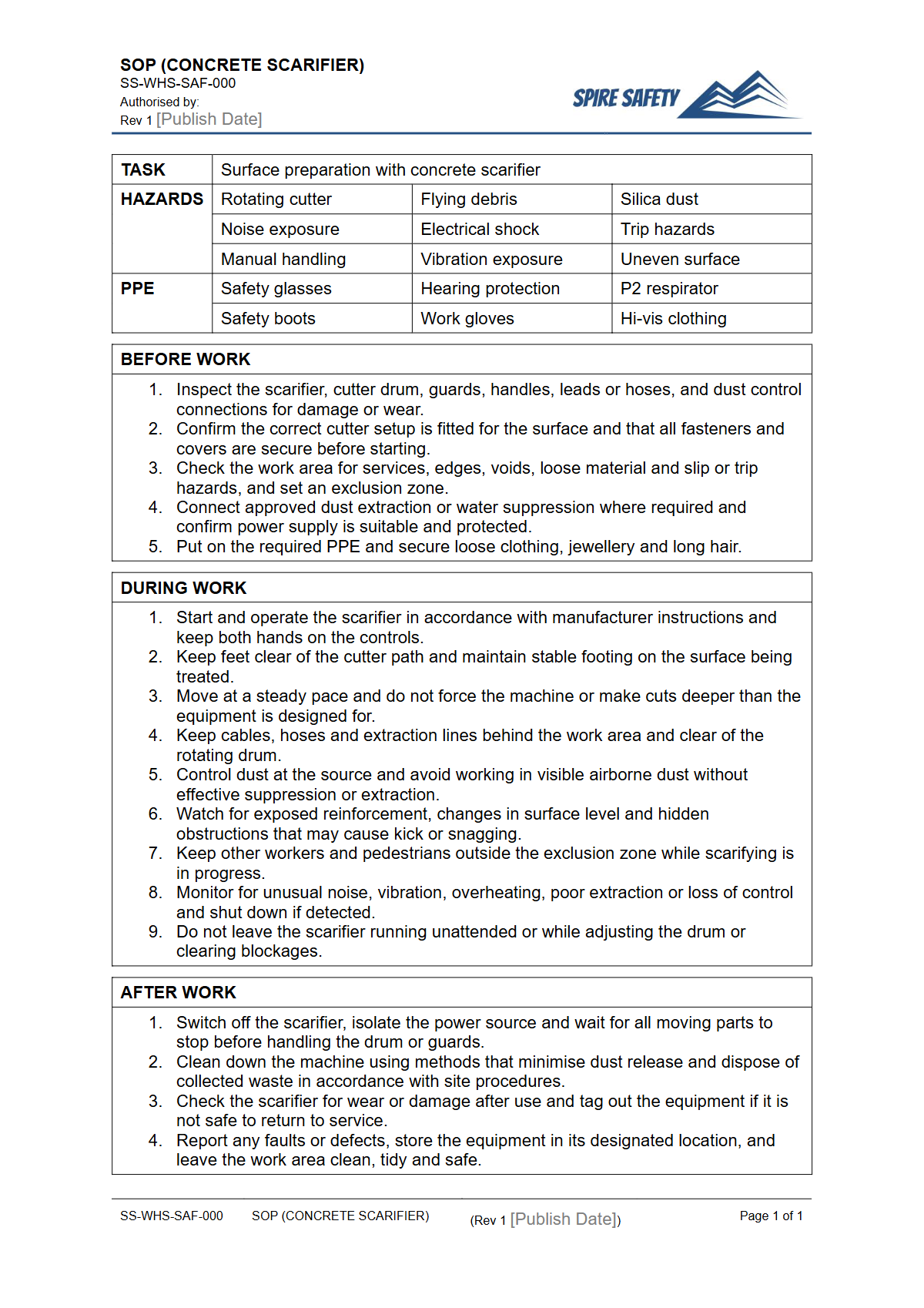
Download our free Safe Operating Procedure (Concrete Scarifier) Template. This customisable DOCX and PDF helps you document safety controls for high-risk work.
Free Safe Operating Procedure (Concrete Scarifier) Template
DOCX • 126 KB + PDF
Updated Oct 2026
No signup required
Purpose of the Free Safe Operating Procedure (Concrete Scarifier) Template
Operating a concrete scarifier, also known as a floor planer or milling machine, involves significant health and safety risks. This free Safe Operating Procedure (Concrete Scarifier) Template provides a structured starting point for your organisation to document the step-by-step process for safely using this equipment.
It helps formalise controls for major hazards like respirable crystalline silica (RCS) dust, extreme noise, hand-arm vibration (HAV), and projectiles.
A documented SOP is a critical tool for ensuring every operator understands and follows the required safety measures, from pre-start checks to shutdown procedures. By clearly outlining these steps, you can minimise the risk of serious injury or long-term occupational illness.
Much like other high-risk power tools used in construction and fabrication, a formal procedure is essential for managing your WHS duties. The principles outlined are similar to those found in our free Circular Saw SOP template, focusing on hazard identification and control.
Video walkthrough
How to use the Free Safe Operating Procedure (Concrete Scarifier) Template
This resource is provided in both DOCX and PDF formats for your convenience. The DOCX file is fully editable, allowing you to tailor it directly to your operational needs.
A comprehensive SOP must be site-specific and machine-specific, addressing the unique conditions of your workplace and the particular model of scarifier in use. Using this document effectively involves more than just adding your company logo; it requires careful customisation.
Important: This is a template only. We've provided a solid framework based on Australian WHS principles, but you must customise this Safe Operating Procedure to reflect the specific equipment, tasks, and environment at your workplace.
You should review and adapt sections on personal protective equipment (PPE), dust control systems (e.g., on-tool extraction), emergency procedures, and maintenance schedules. Consultation with your workers during this customisation process is not only good practice but a legal requirement. When dealing with specific machinery, a detailed procedure is just as important for ancillary equipment, which is why we also offer resources like our Free Air Compressor SOP Template.
When to use this Safe Operating Procedure
A concrete scarifier SOP should be a living document integrated into your daily operations. It is not a set-and-forget form.
Use it before work begins to inform your risk assessments and job planning, ensuring all necessary controls are in place. It is an essential training aid for new operators and a valuable tool for refresher training for experienced workers.
Supervisors can use the SOP as a checklist for observations and to guide toolbox talks on specific hazards.
Furthermore, the procedure serves as a critical reference point during safety audits and after any incident or near miss involving the equipment. Consistent application of the SOP is a cornerstone of a robust safety system.
Building a library of such procedures helps create comprehensive WHS management systems that actively reduce risk across all business activities.
Who should use this Procedure
This Safe Operating Procedure is intended for use by multiple roles within an organisation. Primarily, operators of concrete scarifiers must be trained on the SOP and follow it meticulously to protect their own health and safety and that of others around them.
Supervisors and managers are responsible for implementing the procedure, ensuring operators are competent, and monitoring compliance on site.
WHS managers and safety officers will use this template as a foundation for developing and reviewing risk controls as part of their broader safety duties. Documenting safe work methods is a key obligation for any Person Conducting a Business or Undertaking (PCBU).
Regular reviews of these documents are often a key part of formal WHS compliance auditing to verify that documented processes match workplace practices. Similar surface preparation equipment requires the same level of procedural detail, as demonstrated in our FREE Scraper SOP Template.
For more templates covering a wide range of plant and equipment, you can browse our complete free WHS resources library.
Common mistakes
Common mistakes to avoid
- Failing to use an appropriate dust extraction system (e.g., M or H-class vacuum).
- Using incorrect or poorly maintained personal protective equipment (PPE), especially respiratory masks and hearing protection.
- Operating the machine with worn or damaged cutting drums, leading to poor performance and increased vibration.
- Neglecting to perform and document pre-start safety checks before each use.
Legal references
Legal considerations
The following legal requirements may be relevant to this type of work.
- Work Health and Safety Act (Harmonised) — Provides the primary duties for protecting workers and other people from work health and safety risks.
- Work Health and Safety Regulations (Harmonised) — Sets out requirements supporting the management of workplace hazards and risks.
The following codes may be relevant to this type of work.
- Managing WHS Risks Code of Practice — Provides practical guidance on identifying hazards, assessing risks and applying effective controls.
- Work Health and Safety Consultation, Cooperation and Coordination Code of Practice — Provides practical guidance on consulting workers and coordinating with other duty holders.
- Managing the Work Environment and Facilities Code of Practice — Provides practical guidance on safe work environments, workplace facilities and related controls.
Did you know
Silica Dust Danger
Breathing in very small amounts of respirable crystalline silica (RCS) dust from concrete can cause silicosis, a serious and incurable lung disease. Effective dust control is not optional; it's a critical health measure.
Noise Levels
A typical concrete scarifier can operate at over 100 decibels (dB), well above the Australian exposure standard of 85 dB. This means hearing protection is mandatory for operators and anyone nearby.
FAQ
Frequently asked questions
01What are the main hazards of using a concrete scarifier?
02Is specific training required to operate a concrete scarifier?
03What is the most critical control for concrete scarifying?
04How often should a Safe Operating Procedure for a concrete scarifier be reviewed?
Share this resource
Free Safe Operating Procedure (Concrete Scarifier) Template
Browse Categories
How To Use It
- 1Download and open in Word or PDF.
- 2Replace the placeholders with your business details.
- 3Get it reviewed by a WHS specialist before rollout.
Need it customised?
Our WHS consultants can adapt this template to your site, run a gap analysis, or audit what you already have in place.
Book a Free Consultation WHS consulting servicesor call 1300 156 382
Related templates
- Free Safe Operating Procedure (Concrete Screed) Template
- Free Safe Operating Procedure (Condensate Drain Flush) Template
- Free Safe Operating Procedure (Condiment Bottle Filling) Template
- Free Safe Operating Procedure (Condiment Station Clean) Template
- Free Safe Operating Procedure (Conductivity Meter) Template
- Free Safe Operating Procedure (Conduit Bender) Template