
Free Verification of Competency (Jib Crane) Template
Assess and confirm jib crane operator skills with our Free Verification of Competency (Jib Crane) Template.
Free Verification of Competency (Jib Crane) Template
DOCX • 138 KB + PDF
Updated Oct 2026
No signup required
Purpose of the Free Verification of Competency (Jib Crane) Template
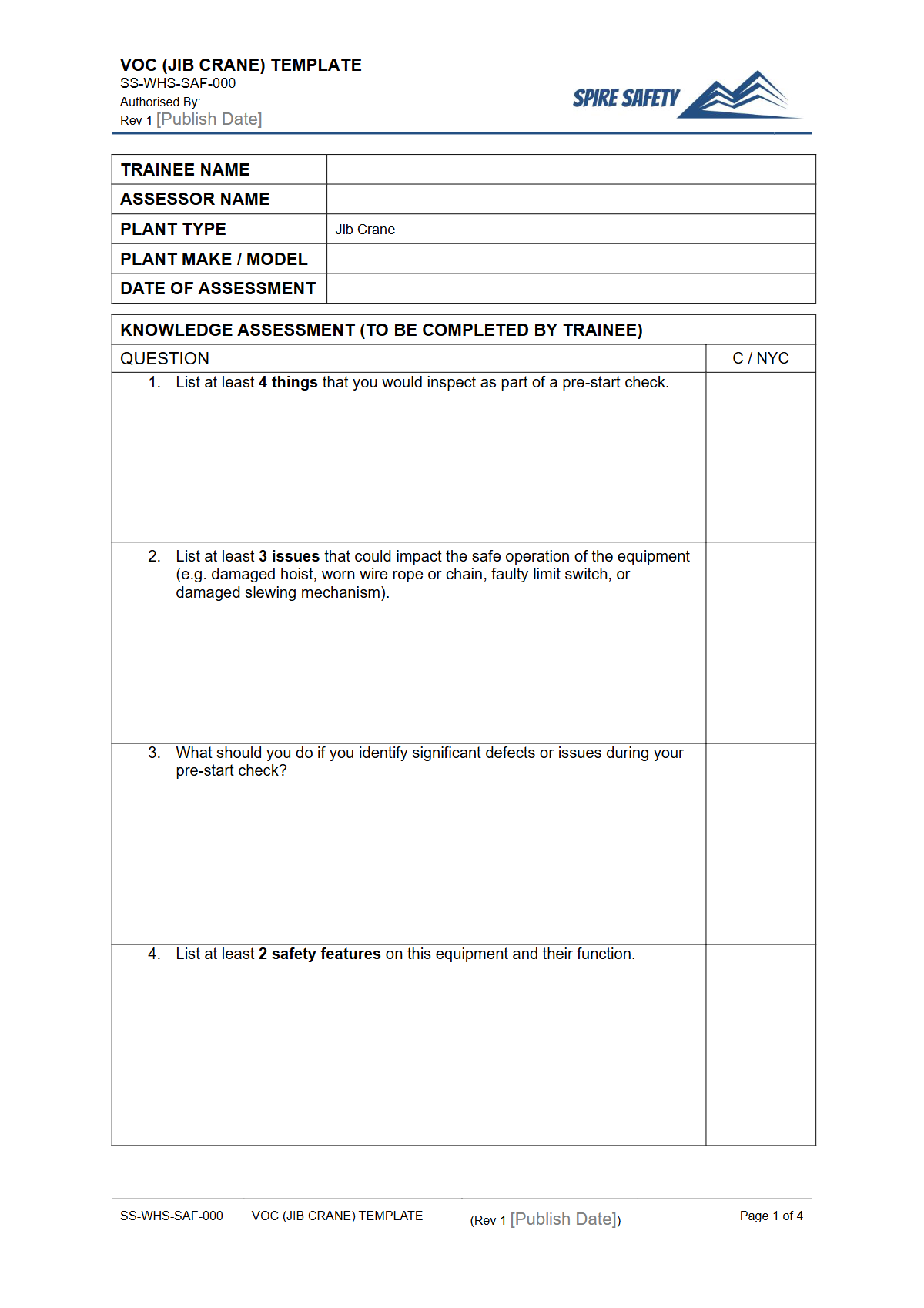
This Free Verification of Competency (Jib Crane) Template provides a structured framework for employers and site supervisors to confirm that an operator possesses the required skills and knowledge to operate a jib crane safely. A Verification of Competency (VOC) is not a substitute for formal training or licensing, but rather an assessment conducted after training to verify that the theoretical knowledge can be applied in a practical, workplace setting.
It serves as a critical tool for a Person Conducting a Business or Undertaking (PCBU) to meet their duty of care under Australian WHS legislation by ensuring workers are competent for their assigned tasks.
The template helps an assessor evaluate an operator's ability to perform pre-start checks, identify hazards, understand load charts, execute lifts safely, and follow correct shutdown procedures. While focused on jib cranes, the core principles of verifying skills are transferable to other types of plant.
For instance, assessing mobile equipment involves different risks, as covered in a Verification of Competency (Rough Terrain Forklift), which addresses stability on uneven ground.
Video walkthrough
How to use the Free Verification of Competency (Jib Crane) Template
To effectively use this resource, download the DOCX file and adapt it to your specific operational context. The document is a starting point designed for customisation, ensuring the assessment is relevant and robust.
A generic checklist is not sufficient to ensure safety; the VOC must reflect the actual conditions and equipment used on site.
Key Steps:
- Customise the Checklist: Update the criteria to match the specific make and model of the jib crane(s) in your workplace. Include checks relevant to its controls, safety features, and lifting capacity.
- Incorporate Site-Specific Procedures: Add criteria related to your organisation’s safe work methods, communication protocols (e.g., hand signals), and emergency procedures.
- Conduct the Assessment: The process should involve both a theory component (e.g., questions about load calculations and Australian Standards) and a practical observation where the operator demonstrates their ability to perform a series of tasks safely.
- Document Everything: Record the date, assessor's name, operator's name, the outcome, and any identified gaps in competence. Note any corrective actions required, such as further training. This documentation is a vital record for your WHS management systems.
Note: You must customise this template to reflect the specific models of jib cranes used at your site, the types of loads being lifted, and your organisation's own safe work procedures. We provide the structure; you provide the site-specific detail. The principles of competency verification apply to many types of machinery, such as those detailed in our Verification of Competency (Mini Excavator) Template.
When to use it
A VOC for a jib crane should be conducted at several key points to maintain a safe working environment. It is not a one-off event but part of an ongoing safety and compliance cycle. Consider using this template in the following scenarios:
- Pre-Employment or Mobilisation: For new employees who arrive with existing licences or qualifications, a VOC verifies their skills are current and applicable to your site's equipment and procedures.
- Introduction of New Equipment: When a new type or model of jib crane is introduced, a VOC ensures operators are familiar with any differences in controls, capacity, or safety features.
- Post-Incident or Near Miss: Following any incident involving a jib crane, a VOC is essential to identify and address any competency gaps that may have contributed to the event.
- Periodic Re-assessment: Conducting VOCs on a regular basis (e.g., annually or biennially) helps ensure that skills remain sharp and unsafe habits have not developed over time. These checks can be scheduled as part of your program of WHS compliance auditing.
Who should use it
The Verification of Competency should be conducted by a person with the necessary knowledge, skills, and experience to make a sound judgement about the operator's competence. This person is typically a supervisor, manager, or an internal trainer who has extensive operational experience with the specific type of jib crane being assessed.
The assessor must be able to identify both safe and unsafe practices and provide constructive feedback.
This template is designed for use by:
- WHS Managers and Safety Advisors
- Site Supervisors and Forepersons
- Experienced Operators designated as workplace assessors
- Internal Trainers and Training Coordinators
The assessor’s own expertise is paramount. The complexity of assessing competence varies significantly with the equipment, from a workshop tool like that in the Free Drill Press VOC (Verification of Competency) Template to heavy civil machinery covered by the Asphalt Paver Verification of Competency (VOC) Template. Find more assessment tools in our free WHS resources library to support your safety programs.
Common mistakes
Common mistakes to avoid
- Using a generic template without customising it for the specific jib crane model and workplace environment.
- Treating the VOC as a simple 'tick-box' exercise instead of a genuine assessment of skill and knowledge.
- Failing to properly document the VOC outcome, assessor details, and any required follow-up actions.
- Allowing an inexperienced person to conduct the assessment, leading to an inaccurate evaluation of competence.
Legal references
Legal considerations
The following legal requirements may be relevant to this type of work.
- Work Health and Safety Act (Harmonised) — Provides the primary duties for protecting workers and other people from work health and safety risks.
- Work Health and Safety Regulations (Harmonised) — Sets out requirements supporting the management of workplace hazards and risks.
The following codes may be relevant to this type of work.
- Managing WHS Risks Code of Practice — Provides practical guidance on identifying hazards, assessing risks and applying effective controls.
- Work Health and Safety Consultation, Cooperation and Coordination Code of Practice — Provides practical guidance on consulting workers and coordinating with other duty holders.
- Managing the Work Environment and Facilities Code of Practice — Provides practical guidance on safe work environments, workplace facilities and related controls.
Did you know
Duty of Care
Under Australian WHS law, a PCBU has a primary duty of care to ensure workers are competent for the tasks they perform. Verifying competency for plant like jib cranes is a key part of fulfilling this duty.
Load Moment Indicators
Many modern cranes are fitted with Load Moment Indicators (LMIs) that alert the operator if a lift is approaching the crane's rated capacity, helping to prevent toppling or structural failure.
FAQ
Frequently asked questions
01What is a Verification of Competency (VOC) for a jib crane?
02Is a VOC the same as a jib crane licence?
03How often should a jib crane VOC be conducted?
04Who is qualified to assess a jib crane operator's competency?
Share this resource
Free Verification of Competency (Jib Crane) Template
Browse Categories
How To Use It
- 1Download and open in Word or PDF.
- 2Replace the placeholders with your business details.
- 3Get it reviewed by a WHS specialist before rollout.
Need it customised?
Our WHS consultants can adapt this template to your site, run a gap analysis, or audit what you already have in place.
Book a Free Consultation WHS consulting servicesor call 1300 156 382
Related templates
- Free Verification of Competency (Laser Level) Template
- Free Verification of Competency (Laser Screed) Template
- Free Verification of Competency (Lighting Tower) Template
- Free Verification of Competency (Log Splitter) Template
- Free Verification of Competency (Manual Pallet Jack) Template
- Free Verification of Competency (Material Hoist) Template