
Safe Work Method Statement (All-Terrain Forklift Operation) Template
Download this free Safe Work Method Statement (SWMS) for all-terrain forklift operations. A structured starting point for your risk management.
Safe Work Method Statement (All-Terrain Forklift Operation) Template
DOCX • 159 KB + PDF
Updated Oct 2026
No signup required
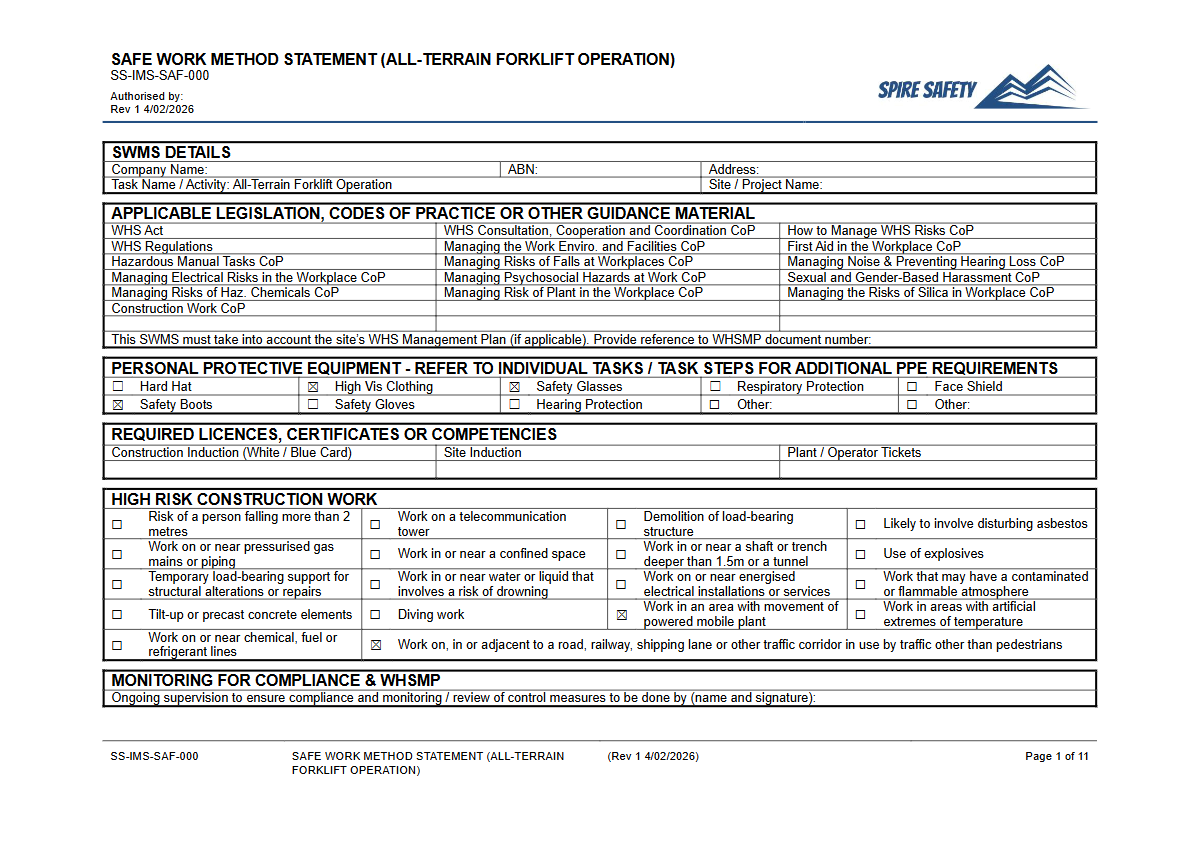
Purpose of the Safe Work Method Statement (All-Terrain Forklift Operation) Template
Our free Safe Work Method Statement (SWMS) for All-Terrain Forklift Operation provides a structured template designed to help you identify and control risks associated with operating these specialised vehicles in diverse and challenging environments. All-terrain forklifts are essential plant on many Australian worksites, often in construction, agriculture, or logistics, requiring robust risk management.
This template assists your organisation in documenting a systematic approach to safe work, aligned with Australian WHS practice. It prompts you to consider specific hazards, assess risks, and implement effective control measures to protect workers and others on site.
Utilising a detailed SWMS is a key component of effective WHS management systems, ensuring that high-risk work activities are planned and executed safely.
Video walkthrough
How to use the Safe Work Method Statement (All-Terrain Forklift Operation) Template
This downloadable template serves as a foundational document for developing your site-specific Safe Work Method Statement (All-Terrain Forklift Operation). It is crucial to understand that this template must be customised to your workplace's unique conditions, equipment, personnel, and specific tasks. Begin by reviewing the pre-filled sections for common hazards and control measures, then systematically modify and add details relevant to your context.
This includes outlining site-specific conditions, the exact model of forklift, operator qualifications, environmental factors, and relevant emergency procedures. Involve your workers in this process to draw on their experience and ensure the SWMS is practical and effective.
Once completed, the SWMS should be communicated to all relevant workers and reviewed regularly, especially if work processes or conditions change. Remember, a generic SWMS is insufficient; it must reflect your actual work practices to be effective and demonstrate due diligence.
When to use it
This template should be used whenever all-terrain forklifts are operating as part of high-risk construction work, or any other work activity where their use poses significant risks that require formal documentation and control. It is particularly relevant for tasks involving uneven terrain, lifting heavy or awkward loads, working near excavations, or in areas with pedestrian traffic.
Who should use it
This resource is valuable for WHS officers, site managers, supervisors, and business owners responsible for planning, authorising, and overseeing activities involving all-terrain forklifts. Operators of all-terrain forklifts should also familiarise themselves with the content to understand the documented safe work procedures and contribute to its development and review.
For more free WHS resources, explore our free WHS resources library.
Common mistakes
Common mistakes to avoid
- Not adequately assessing site-specific ground conditions and hazards (e.g., slopes, soft ground, excavations).
- Using a generic SWMS without customising it to the specific all-terrain forklift model and task.
- Failing to consult with workers who actually operate the all-terrain forklift during SWMS development or review.
- Inadequate training or supervision for operators, particularly concerning stability on uneven terrain.
Legal references
Legal considerations
The following legal requirements may be relevant to this type of work.
- Work Health and Safety Act (Harmonised) — Provides the primary duties for protecting workers and other people from work health and safety risks.
- Work Health and Safety Regulations (Harmonised) — Sets out requirements supporting the management of workplace hazards and risks.
The following codes may be relevant to this type of work.
- Managing WHS Risks Code of Practice — Provides practical guidance on identifying hazards, assessing risks and applying effective controls.
- Work Health and Safety Consultation, Cooperation and Coordination Code of Practice — Provides practical guidance on consulting workers and coordinating with other duty holders.
- Managing the Work Environment and Facilities Code of Practice — Provides practical guidance on safe work environments, workplace facilities and related controls.
Did you know
Tip-overs are a major risk
Rough terrain and uneven ground significantly increase the risk of forklift tip-overs. Control measures often include load stability training, maintaining safe speed, and operating within load limits.
Noise hazards are common
Operating an all-terrain forklift, especially for extended periods, can expose operators to significant noise levels, necessitating hearing protection and a <a href="/services/iso-consulting/">noise management plan</a>.
FAQ
Frequently asked questions
01What specifically identifies a forklift as 'all-terrain'?
02Do I need specific licensing for an all-terrain forklift in Australia?
03How often should an SWMS for all-terrain forklift operation be reviewed?
04Can this template be used for other types of forklifts?
Share this resource
Safe Work Method Statement (All-Terrain Forklift Operation) Template
Browse Categories
How To Use It
- 1Download and open in Word or PDF.
- 2Replace the placeholders with your business details.
- 3Get it reviewed by a WHS specialist before rollout.
Need it customised?
Our WHS consultants can adapt this template to your site, run a gap analysis, or audit what you already have in place.
Book a Free Consultation WHS consulting servicesor call 1300 156 382
Related templates
- Safe Work Method Statement (Articulated Dump Truck Operation) Template
- Safe Work Method Statement (Backhoe Loader Operation) Template
- Safe Work Method Statement (Body Truck Operation) Template
- Safe Work Method Statement (Bulldozer Operation) Template
- Safe Work Method Statement (Concrete Truck Operation) Template
- Safe Work Method Statement (Elevated Work Platform Operation) Template