
Free Inspection & Test Plan (Autoclaved Aerated Concrete (AAC) Block) Template
Download our free Inspection & Test Plan for Autoclaved Aerated Concrete (AAC) blockwork. This DOCX template helps ensure quality and compliance. Get yours now.
Free Inspection & Test Plan (Autoclaved Aerated Concrete (AAC) Block) Template
DOCX • 135 KB + PDF
Updated Oct 2026
No signup required
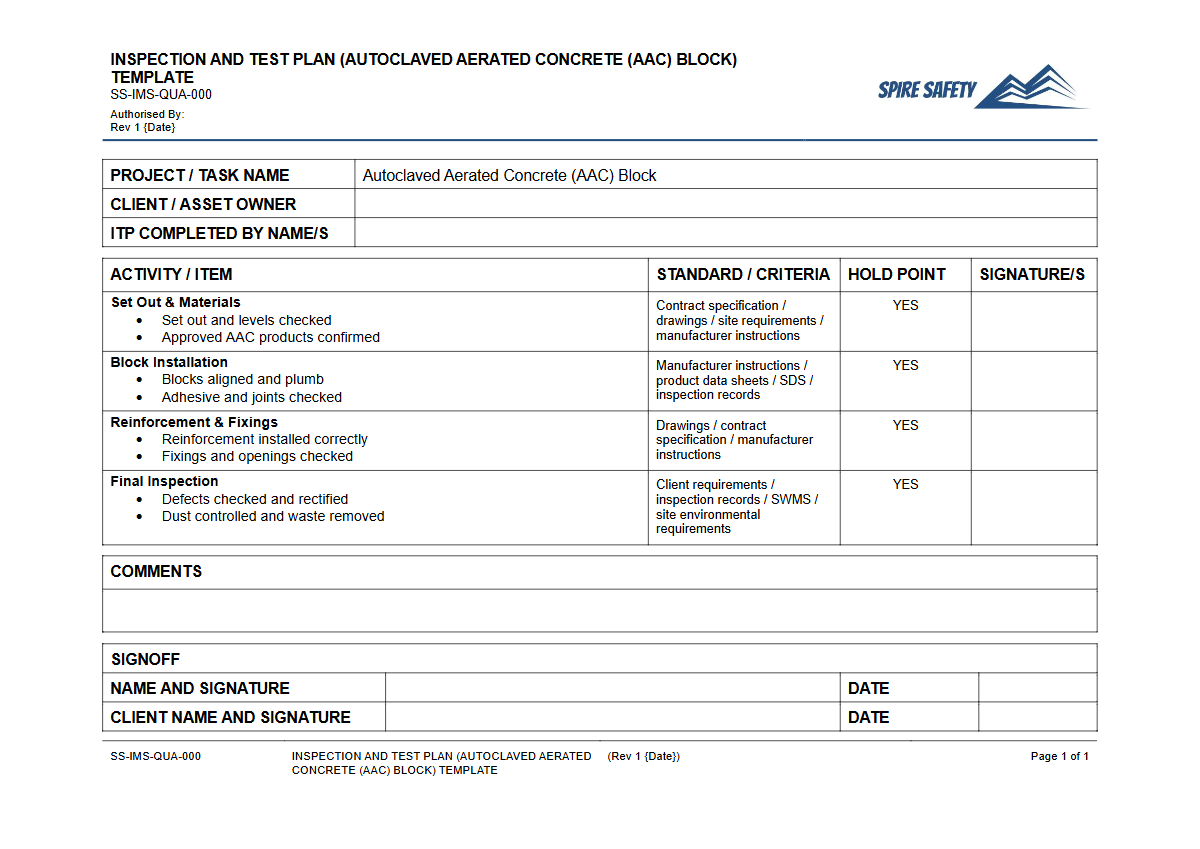
Purpose of the Free Inspection & Test Plan (Autoclaved Aerated Concrete (AAC) Block) Template
Ensuring the quality and compliance of Autoclaved Aerated Concrete (AAC) blockwork is critical for any construction project. This Free Inspection & Test Plan (Autoclaved Aerated Concrete (AAC) Block) Template provides a structured framework to verify that all materials and installation processes meet the specified standards and engineering requirements.
An ITP is an essential quality assurance document that outlines the sequence of inspections, tests, and checks required at various stages of the AAC installation.
The primary purpose of this Inspection & Test Plan is to establish a systematic process for quality control during the construction of AAC walls. It serves as a formal record that key project specifications, tolerances, and Australian Standards have been met.
By outlining specific hold points, witness points, and surveillance checks, the ITP helps prevent defects, avoid costly rework, and provides documented evidence of due diligence. It ensures all parties—from suppliers to installers and project managers—are aligned on the quality expectations for material handling, mortar preparation, block laying, and reinforcement installation.
Video walkthrough
How to use the Free Inspection & Test Plan (Autoclaved Aerated Concrete (AAC) Block) Template
This template is provided in DOCX format for easy customisation to your specific project. To use it effectively, you should review the engineering drawings, project specifications, and the manufacturer's technical literature.
Populate the plan with project-specific details, including drawing numbers, standards, and acceptance criteria for each inspection point. Assign clear responsibilities for performing, witnessing, and signing off on each check.
Note: It's important to remember that this is a template. We've designed it as a structured starting point, and you must customise it to reflect the specific requirements of your project, site conditions, legal obligations, and organisational procedures.
It is not a complete, ready-to-use document.
Integrating this ITP into your project documentation ensures a clear, auditable trail of quality management. For businesses looking to formalise their safety and quality processes across all operations, this document can form a valuable part of a comprehensive WHS management system.
When to use an Inspection & Test Plan
The ITP for AAC blockwork should be developed and approved during the pre-construction phase, before any materials arrive on site. It becomes an active working document from the moment blocks are delivered and continues to be used until the final wall is completed and signed off.
Regular reviews of the ITP should be conducted during toolbox talks or pre-start meetings to ensure all relevant personnel understand the upcoming inspection points. A well-maintained ITP is also a critical document during any formal WHS compliance auditing, demonstrating proactive quality and safety management.
Who should use this ITP
This ITP template is designed for use by various personnel involved in the construction and oversight of building projects. Key users include:
- Project Managers: For overall project quality oversight and progress tracking.
- Site Engineers & Supervisors: For day-to-day management of construction activities and conducting inspections.
- Quality Assurance/Quality Control (QA/QC) Officers: For formal verification, record-keeping, and ensuring compliance with standards.
- Foremen and Leading Hands: To guide their installation teams and ensure work is ready for inspection at each stage.
- Principal Contractors and Builders: To ensure their subcontractors are meeting the required quality standards.
The principles of systematic inspection and verification of competency are universal in construction. For example, similar structured approaches are vital when operating specialised equipment on site, which can be managed using our Verification of Competency (Concrete Pump (Stationary)) Template.
By providing a clear set of checkpoints, the ITP fosters accountability and clear communication among all team members. If you need assistance developing comprehensive safety and quality documentation tailored to your specific operations, our team of experts offers dedicated WHS consulting services.
This template is just one of many tools available to help you streamline your safety and quality processes; you can browse our complete free WHS resources library for more.
Common mistakes
Common mistakes to avoid
- Failing to check AAC block delivery for damage (chips, cracks) before acceptance and installation.
- Using an incorrect mortar mix or application thickness, leading to weak bonds and potential cracking.
- Ignoring specified locations for control joints, lintels, or reinforcement, compromising structural integrity.
- Not protecting stored blocks from rain or ground moisture, which can affect material performance and lead to efflorescence.
Legal references
Legal considerations
The following legal requirements may be relevant to this type of work.
- Work Health and Safety Act (Harmonised) — Provides the primary duties for protecting workers and other people from work health and safety risks.
- Work Health and Safety Regulations (Harmonised) — Sets out requirements supporting the management of workplace hazards and risks.
The following codes may be relevant to this type of work.
- Managing WHS Risks Code of Practice — Provides practical guidance on identifying hazards, assessing risks and applying effective controls.
- Work Health and Safety Consultation, Cooperation and Coordination Code of Practice — Provides practical guidance on consulting workers and coordinating with other duty holders.
- Managing the Work Environment and Facilities Code of Practice — Provides practical guidance on safe work environments, workplace facilities and related controls.
Did you know
Lightweight Champion
Autoclaved Aerated Concrete is up to five times lighter than traditional concrete, significantly reducing the structural dead load on buildings and simplifying manual handling on site.
Excellent Fire Resistance
AAC is non-combustible and offers superior fire resistance compared to many other building materials. Certain AAC panel and block systems can achieve a Fire Resistance Level (FRL) of up to 240/240/240.
FAQ
Frequently asked questions
01What is the difference between a witness point and a hold point in an ITP?
02Does this ITP cover seismic bracing requirements for AAC?
03Is an ITP the same as a Safe Work Method Statement (SWMS)?
04What records should be attached to a completed ITP?
Share this resource
Free Inspection & Test Plan (Autoclaved Aerated Concrete (AAC) Block) Template
Browse Categories
How To Use It
- 1Download and open in Word or PDF.
- 2Replace the placeholders with your business details.
- 3Get it reviewed by a WHS specialist before rollout.
Need it customised?
Our WHS consultants can adapt this template to your site, run a gap analysis, or audit what you already have in place.
Book a Free Consultation WHS consulting servicesor call 1300 156 382
Related templates
- Free Inspection & Test Plan (Balcony Podium Waterproofing) Template
- Free Inspection & Test Plan (Basement Waterproofing) Template
- Free Inspection & Test Plan (Bathroom Vanity and Fixtures) Template
- Free Inspection & Test Plan (Bracing and Tie-Down) Template
- Free Inspection & Test Plan (Brick Veneer Cladding) Template
- Free Inspection & Test Plan (Bridge Construction) Template