
Free Inspection & Test Plan (Bracing and Tie-Down) Template
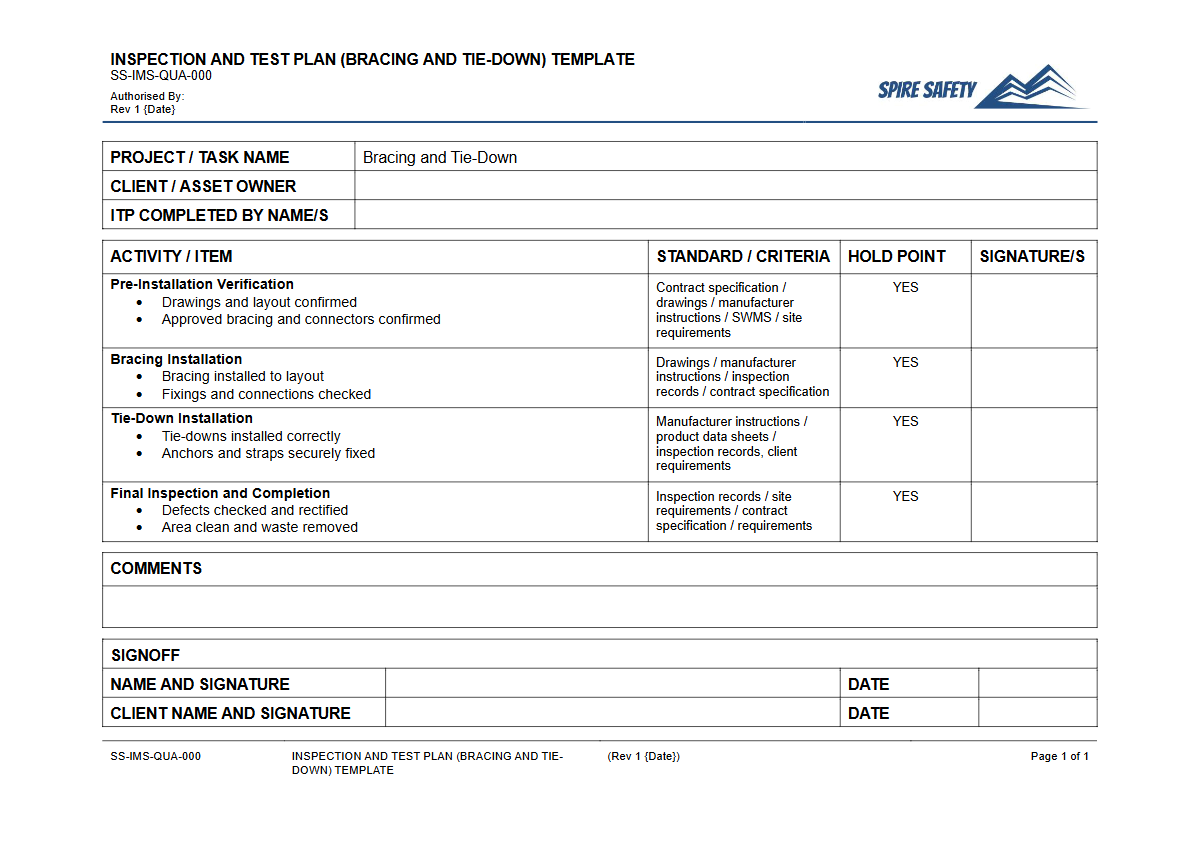
Download our free Inspection & Test Plan (Bracing and Tie-Down) Template. This structured DOCX & PDF helps formalise quality checks for structural supports.
Free Inspection & Test Plan (Bracing and Tie-Down) Template
DOCX • 136 KB + PDF
Updated Oct 2026
No signup required
Purpose of the Free Inspection & Test Plan (Bracing and Tie-Down) Template
This free Inspection & Test Plan (Bracing and Tie-Down) Template provides a structured framework for documenting, witnessing, and verifying critical safety and quality checks on a construction project. It is specifically designed for activities involving temporary or permanent bracing, structural tie-downs, and load restraint systems.
The primary purpose is to ensure all stages—from design verification and material receival to installation and final handover—are properly inspected and recorded. Using a formal ITP helps prevent structural instability or collapse, which can lead to catastrophic failures, injuries, or fatalities.
By systematically outlining inspection points, acceptance criteria, and responsible personnel, this document forms a crucial part of your quality assurance process. It creates a clear, auditable trail demonstrating that all works comply with engineering specifications, relevant Australian Standards, and the project's safety requirements.
Integrating such procedural documents is a cornerstone of developing robust WHS management systems that actively manage high-risk construction work.
Video walkthrough
How to use the Free Inspection & Test Plan (Bracing and Tie-Down) Template
Our free template provides a comprehensive starting point for your project. It includes columns for detailing each activity, referencing relevant drawings or standards, defining inspection and test requirements, and outlining acceptance criteria.
It also features common verification methods like Surveillance (S), Witness Points (W), and Hold Points (H), which require formal sign-off before work can proceed. These verification stages ensure critical checks are not missed.
To use the template effectively:
- Download the DOCX file and open it in your preferred word processor.
- Review the pre-filled examples and adapt the activities to match your project's scope.
- Customise the document by adding your company branding, project details, and specific roles and responsibilities.
- Integrate references to your project's engineering plans, specifications, and applicable Australian Standards.
- Circulate the draft ITP to relevant stakeholders, including project managers, engineers, and site supervisors, for review and approval before work commences.
Important: This is a template only. We provide it as a starting point, and you must customise it to suit your specific workplace, project requirements, engineering designs, and legal obligations.
Its effectiveness depends on its correct implementation by competent persons.
When to use it
An Inspection & Test Plan for bracing and tie-down should be developed during the project planning phase and implemented before any physical work begins. It is a live document used throughout the construction lifecycle.
Key stages for its use include the pre-construction phase for design and material verification, the construction phase for installation and tensioning checks, and the post-construction phase for final inspection before handover or removal of temporary works.
It is essential for any construction or engineering project where structural stability relies on bracing or tie-down systems. This includes building construction, civil infrastructure projects like bridges and tunnels, temporary works for excavations, façade retention, and securing components for transport or lifting.
On large-scale projects, these activities are often managed under principal hazard management plans due to the high-risk nature of potential ground or structural failure.
Who should use it
This template is designed for use by a range of personnel involved in the management, supervision, and execution of construction projects. The individuals responsible for developing, implementing, and signing off on the ITP typically include:
- Project Managers: For overall quality and safety oversight.
- Site Engineers & Supervisors: For managing day-to-day installation and inspection activities on site.
- Quality Assurance / Quality Control (QA/QC) Officers: For monitoring compliance with the plan and maintaining records.
- WHS Advisors and Officers: To ensure safety requirements are integrated and high-risk work is controlled.
- Third-Party Inspectors or Certifiers: For verifying critical hold points or conducting final certification.
The completed ITP serves as a key piece of evidence during internal and external WHS compliance audits, demonstrating that a systematic process was followed to ensure structural safety. If your team lacks the expertise to adapt this template confidently, seeking specialist WHS consulting is recommended to ensure your documentation is robust and fit for purpose.
You can explore our complete free WHS resources library for other templates to support your operational needs.
Common mistakes
Common mistakes to avoid
- Using the template without customising it for site-specific engineering drawings.
- Failing to reference the correct, current versions of Australian Standards or manufacturer's instructions.
- Skipping witness points or having unqualified personnel sign off on mandatory hold points.
- Poor record-keeping, making it difficult or impossible to prove compliance during an incident investigation or audit.
Legal references
Legal considerations
The following legal requirements may be relevant to this type of work.
- Work Health and Safety Act (Harmonised) — Provides the primary duties for protecting workers and other people from work health and safety risks.
- Work Health and Safety Regulations (Harmonised) — Sets out requirements supporting the management of workplace hazards and risks.
The following codes may be relevant to this type of work.
- Managing WHS Risks Code of Practice — Provides practical guidance on identifying hazards, assessing risks and applying effective controls.
- Work Health and Safety Consultation, Cooperation and Coordination Code of Practice — Provides practical guidance on consulting workers and coordinating with other duty holders.
- Managing the Work Environment and Facilities Code of Practice — Provides practical guidance on safe work environments, workplace facilities and related controls.
Did you know
A Common Cause of Failure
Structural failures and collapses are a leading cause of fatalities in the construction industry, with inadequate or improperly installed bracing being a common contributing factor identified in incident investigations.
The Formwork Standard
Australian Standard AS 3610.1, 'Formwork for concrete', contains specific and detailed clauses on the design, stability, and inspection of bracing systems, making it a critical reference for many ITPs.
FAQ
Frequently asked questions
01What is the difference between a witness point and a hold point in an ITP?
02Does this bracing and tie-down ITP cover scaffolding?
03How often should inspections be carried out for temporary bracing?
04Who is qualified to sign off on a bracing and tie-down ITP?
Share this resource
Free Inspection & Test Plan (Bracing and Tie-Down) Template
Browse Categories
How To Use It
- 1Download and open in Word or PDF.
- 2Replace the placeholders with your business details.
- 3Get it reviewed by a WHS specialist before rollout.
Need it customised?
Our WHS consultants can adapt this template to your site, run a gap analysis, or audit what you already have in place.
Book a Free Consultation WHS consulting servicesor call 1300 156 382
Related templates
- Free Inspection & Test Plan (Brick Veneer Cladding) Template
- Free Inspection & Test Plan (Bridge Construction) Template
- Free Inspection & Test Plan (Bulk Earthworks) Template
- Free Inspection & Test Plan (Car Park Basement Construction) Template
- Free Inspection & Test Plan (Carpentry Fix Out Joinery) Template
- Free Inspection & Test Plan (Carpentry Framing) Template