
Free Inspection & Test Plan (Bridge Construction) Template
Formalise quality and safety checks for bridge construction with our free Inspection & Test Plan template. Customisable DOCX & PDF. Download your copy today.
Free Inspection & Test Plan (Bridge Construction) Template
DOCX • 139 KB + PDF
Updated Oct 2026
No signup required
Purpose of the Free Inspection & Test Plan (Bridge Construction) Template
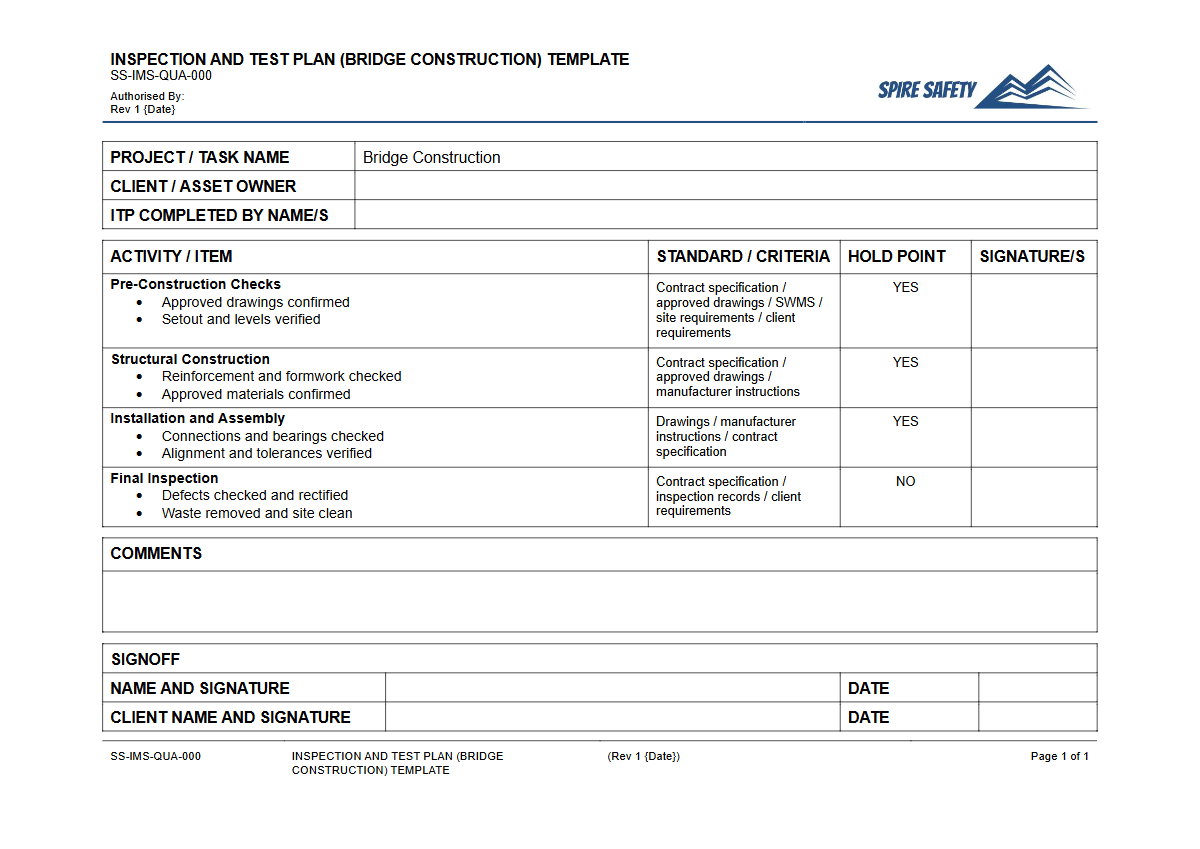
An Inspection and Test Plan (ITP) is a crucial quality assurance and project management document for complex, high-risk construction projects. This free Inspection & Test Plan (Bridge Construction) template provides a structured framework for outlining the sequence of inspections and tests required to verify that materials, components, and construction processes meet the project’s specific requirements and Australian Standards.
It systematically documents all quality control activities, ensuring every critical stage—from foundation piling and concrete testing to steel fabrication and bearing installation—is checked, verified, and signed off.
Using a detailed ITP helps prevent defects, minimises costly rework, and provides auditable evidence that all works comply with the design specifications and safety regulations. It forms a key part of managing the WHS requirements for construction site safety by integrating quality control directly into the construction sequence.
The plan identifies specific hold points (work cannot proceed without inspection), witness points (operations can proceed but must be witnessed), and surveillance points to ensure comprehensive oversight.
Key elements addressed by this template:
- Activity/Task Description: A breakdown of specific construction activities.
- Inspection/Test Type: The nature of the check to be performed (e.g., visual, measurement, material test).
- Acceptance Criteria: The standards or specifications the work must meet.
- Responsible Person: Who performs the inspection and who signs off.
- Records: The type of document to be generated as evidence (e.g., report, photo, certificate).
Video walkthrough
How to use the Free Inspection & Test Plan (Bridge Construction) Template
This Inspection & Test Plan (Bridge Construction) template is a foundational document designed to be adapted for your specific project. Upon downloading, you must systematically work through each section and populate it with details relevant to your bridge's design, materials, location, and construction methodology.
Generic, unedited templates do not provide adequate project control or a defence in the event of an incident.
To effectively use this template, you must customise it for your workplace. We have provided a structured starting point, but it is your responsibility to ensure the final document reflects the unique risks, engineering specifications, and legal obligations of your project. This involves reviewing engineer's drawings, project specifications, supplier data, and relevant Australian Standards to define the inspection points and acceptance criteria accurately.
Integrate this ITP into your project's overarching WHS management system. Ensure all personnel referenced in the ITP are trained on its use, understand their responsibilities, and have the competence to carry out the required inspections and tests. Regular reviews of the ITP should be scheduled to accommodate any changes in design, methodology, or site conditions.
When to use it
The Inspection and Test Plan should be developed during the project planning phase, before any physical construction works commence. It is a live document used continuously throughout the entire project lifecycle, from materials procurement and fabrication through to final commissioning and handover.
It should be referenced daily by site supervisors and project engineers to guide their quality and safety assurance activities.
This ITP should be used in conjunction with other critical safety documents. For example, for each high-risk construction activity listed in the ITP, a corresponding Safe Work Method Statement must be developed.
You can use our General Construction SWMS template as a starting point for this process. Specific plant-related checks, such as a pre-start checklist for a Bar Bender used for reinforcing steel, should also be referenced where applicable.
Who should use it
This template is intended for use by a range of personnel involved in the management, supervision, and execution of bridge construction projects. The responsibility for its development, implementation, and maintenance is typically shared among several key roles:
- Project Managers: For overall quality and project delivery oversight.
- Construction/Site Engineers: For day-to-day implementation, execution of checks, and technical verification.
- Quality Assurance/Quality Control (QA/QC) Managers: For developing the ITP, monitoring its implementation, and managing all related records.
- WHS Advisors: To ensure safety-critical checks are included and align with the project's safety management plan.
- Site Supervisors/Foremen: To ensure their teams are working in accordance with the ITP's requirements and that hold/witness points are respected.
The ITP also serves as a key document for clients, superintendents, and independent verifiers. For organisations seeking to formalise their processes, the data collected from the ITP can be a valuable input for independent WHS compliance auditing to verify that procedures are being followed correctly.
This provides an objective assessment of the project's adherence to its quality and safety commitments.
Common mistakes
Common mistakes to avoid
- Using a generic template without customising it for the specific project design and site conditions.
- Failing to define clear, measurable, and objective acceptance criteria for each inspection point.
- Not properly training personnel on their specific roles and responsibilities within the ITP.
- Poor record-keeping, making it difficult or impossible to provide evidence of quality compliance during an audit.
Legal references
Legal considerations
The following legal requirements may be relevant to this type of work.
- Work Health and Safety Act (Harmonised) — Provides the primary duties for protecting workers and other people from work health and safety risks.
- Work Health and Safety Regulations (Harmonised) — Sets out requirements supporting the management of workplace hazards and risks.
The following codes may be relevant to this type of work.
- Managing WHS Risks Code of Practice — Provides practical guidance on identifying hazards, assessing risks and applying effective controls.
- Work Health and Safety Consultation, Cooperation and Coordination Code of Practice — Provides practical guidance on consulting workers and coordinating with other duty holders.
- Managing the Work Environment and Facilities Code of Practice — Provides practical guidance on safe work environments, workplace facilities and related controls.
Did you know
A Legacy of Quality
The principles behind ITPs have been used in major projects for over a century. The construction of the Sydney Harbour Bridge involved extensive materials testing and inspections, forming a foundational quality assurance process long before modern standards were written.
Digital Transformation
Modern ITPs are often integrated into digital construction management software. This allows for real-time data capture on-site using tablets, instant notifications for hold points, and automated generation of progress reports.
FAQ
Frequently asked questions
01What is the difference between an Inspection and Test Plan (ITP) and a Safe Work Method Statement (SWMS)?
02What are 'hold points' and 'witness points' in an ITP?
03Does this template cover all safety and quality aspects of bridge construction?
04How should I manage the records generated from the ITP?
Share this resource
Free Inspection & Test Plan (Bridge Construction) Template
Browse Categories
How To Use It
- 1Download and open in Word or PDF.
- 2Replace the placeholders with your business details.
- 3Get it reviewed by a WHS specialist before rollout.
Need it customised?
Our WHS consultants can adapt this template to your site, run a gap analysis, or audit what you already have in place.
Book a Free Consultation WHS consulting servicesor call 1300 156 382
Related templates
- Free Inspection & Test Plan (Bulk Earthworks) Template
- Free Inspection & Test Plan (Car Park Basement Construction) Template
- Free Inspection & Test Plan (Carpentry Fix Out Joinery) Template
- Free Inspection & Test Plan (Carpentry Framing) Template
- Free Inspection & Test Plan (Carpet Installation) Template
- Free Inspection & Test Plan (Colorbond Zincalume Roofing) Template