
Free Inspection & Test Plan (Bulk Earthworks) Template
Ensure quality and safety standards for your bulk earthworks projects with our free Inspection & Test Plan template. Aligned with Australian WHS practices.
Free Inspection & Test Plan (Bulk Earthworks) Template
DOCX • 140 KB + PDF
Updated Oct 2026
No signup required
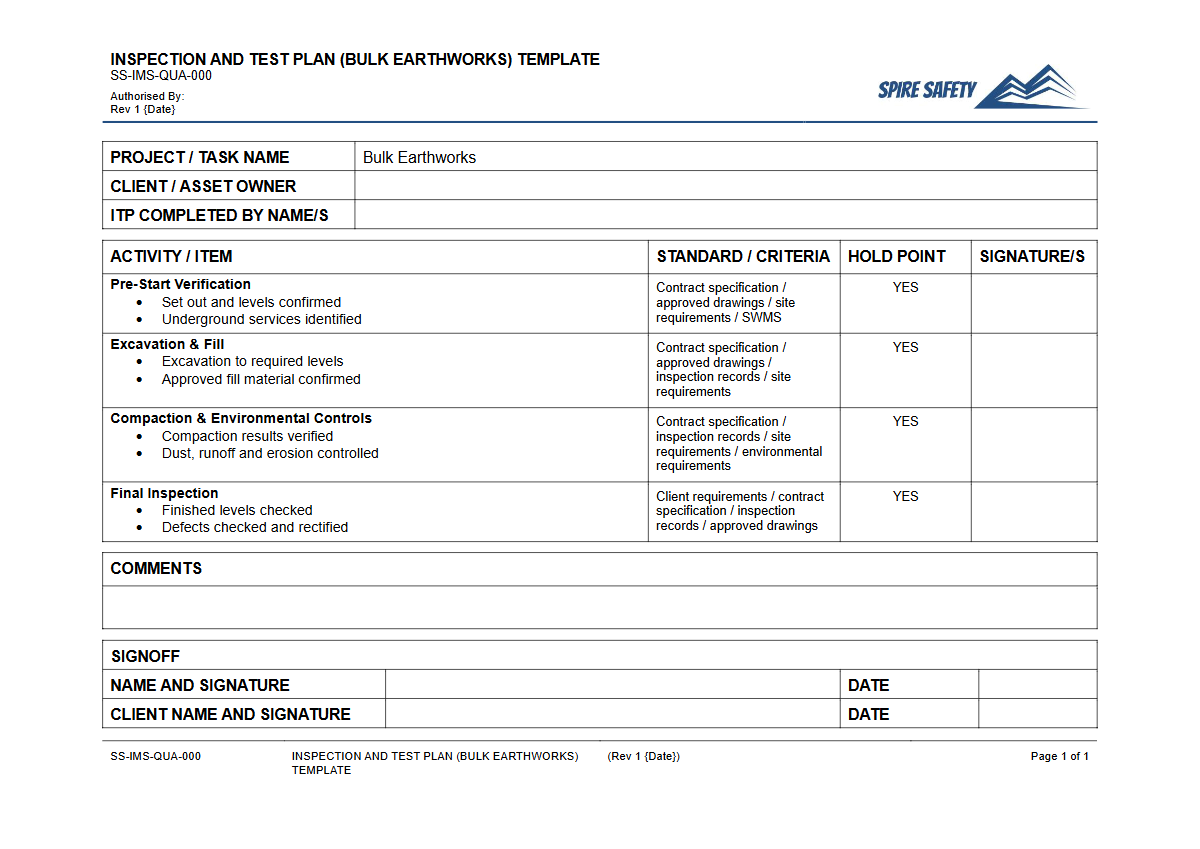
Purpose of the Free Inspection & Test Plan (Bulk Earthworks) Template
This Free Inspection & Test Plan (Bulk Earthworks) Template provides a structured framework for ensuring that all site clearing, excavation, filling, and compaction activities meet project specifications and safety requirements. An Inspection and Test Plan (ITP) is a critical quality assurance document that outlines the sequence of inspections and tests required to verify compliance at key stages of a project.
Using this template helps formalise your quality control processes, ensuring that all earthworks are performed correctly, documented thoroughly, and signed off by authorised personnel.
A well-executed ITP is a cornerstone of proactive project management. It defines hold points (work cannot proceed without inspection), witness points (inspections that must be witnessed by specific parties), and surveillance checks.
By methodically planning these verifications, you can minimise rework, prevent defects, and create a clear audit trail of quality and compliance. Integrating this process into your site procedures is a key part of developing effective WHS management systems that protect both your workers and your project outcomes.
Video walkthrough
How to use the Free Inspection & Test Plan (Bulk Earthworks) Template
This document serves as a comprehensive starting point. To make it effective, you must adapt it to the unique requirements of your project, including the specific soil types, machinery used, site hazards, and engineering standards.
Start by filling in the project details and then review each activity listed, from topsoil stripping to final trimming. Customise the 'Acceptance Criteria' column with the specific tolerances and standards from your project's design documentation, such as required compaction densities or moisture content levels.
Assign clear responsibilities for conducting each test and inspection, and for signing off on the results. This creates accountability and ensures that nothing is overlooked.
For large-scale civil or mining projects, this ITP can be integrated with broader safety frameworks, such as principal hazard management plans, to address high-risk activities associated with deep excavation or slope stability.
Please note: This template provides a foundational structure. We have designed it to be customised to the specific risks, requirements, and regulatory context of your project and workplace.
It does not replace the need for professional engineering or geotechnical advice.
When to use an Inspection & Test Plan
An ITP for bulk earthworks should be developed during the project planning phase, before any work commences on site. This allows project managers, engineers, and supervisors to agree on the quality standards and verification processes ahead of time.
It sets clear expectations for contractors and provides a roadmap for supervision and quality control.
The ITP is a live document used throughout the project's duration. It should be referenced daily by site personnel to guide their work and ensure they are aware of upcoming hold and witness points.
As each stage of the earthworks is completed, the ITP is progressively filled out and signed, creating a contemporaneous record of compliance. If unforeseen site conditions arise, such as unexpected rock or groundwater, the ITP may need to be reviewed and updated with guidance from WHS consulting professionals or geotechnical engineers.
Who should use it
This Inspection & Test Plan template is designed for professionals involved in the management and execution of civil construction, mining, and land development projects. Key users include:
- Project Managers: To oversee quality control and ensure project milestones are met in accordance with specifications.
- Site Engineers & Supervisors: To manage daily operations, conduct inspections, and ensure work crews adhere to the planned sequence and standards.
- Quality Assurance / Quality Control (QA/QC) Managers: To implement and monitor the project's quality management system and maintain compliance records.
- WHS Professionals: To ensure that safety considerations are integrated into the work sequence, particularly for high-risk activities like excavation and operating heavy machinery.
The completed ITP becomes a critical part of the project handover documentation, providing evidence that the earthworks were completed to the required standard. These records are invaluable during WHS compliance auditing and can be essential for demonstrating due diligence.
To support the safe operation of equipment used in these activities, consider implementing checks using our WHS Inspection (Vehicle Workshop) Template for your maintenance bays. You can find more templates like this in our free WHS resources library.
Common mistakes
Common mistakes to avoid
- Using a generic ITP without customising it for specific site conditions and project specifications.
- Failing to define clear, measurable acceptance criteria for each activity (e.g., 'compacted' vs. 'compacted to 98% Standard Proctor Density').
- Not assigning specific, named responsibilities for inspections, tests, and sign-offs.
- Poor record-keeping, making it difficult to prove compliance or trace the source of a defect.
Legal references
Legal considerations
The following legal requirements may be relevant to this type of work.
- Work Health and Safety Act (Harmonised) — Provides the primary duties for protecting workers and other people from work health and safety risks.
- Work Health and Safety Regulations (Harmonised) — Sets out requirements supporting the management of workplace hazards and risks.
The following codes may be relevant to this type of work.
- Managing WHS Risks Code of Practice — Provides practical guidance on identifying hazards, assessing risks and applying effective controls.
- Work Health and Safety Consultation, Cooperation and Coordination Code of Practice — Provides practical guidance on consulting workers and coordinating with other duty holders.
- Managing the Work Environment and Facilities Code of Practice — Provides practical guidance on safe work environments, workplace facilities and related controls.
Did you know
Geotechnical Risk
Geotechnical failure, often related to unforeseen ground conditions during earthworks, is a leading cause of major structural collapses and budget overruns in civil construction projects.
The Power of Compaction
Proper soil compaction using specified techniques and machinery can increase the load-bearing capacity of soil by more than 100%, preventing future settlement and structural damage.
FAQ
Frequently asked questions
01What is the difference between a hold point and a witness point in an ITP?
02Is an Inspection and Test Plan a legal requirement in Australia?
03How detailed should my Bulk Earthworks ITP be?
04Can this template be used for small-scale residential earthworks?
Share this resource
Free Inspection & Test Plan (Bulk Earthworks) Template
Browse Categories
How To Use It
- 1Download and open in Word or PDF.
- 2Replace the placeholders with your business details.
- 3Get it reviewed by a WHS specialist before rollout.
Need it customised?
Our WHS consultants can adapt this template to your site, run a gap analysis, or audit what you already have in place.
Book a Free Consultation WHS consulting servicesor call 1300 156 382
Related templates
- Free Inspection & Test Plan (Car Park Basement Construction) Template
- Free Inspection & Test Plan (Carpentry Fix Out Joinery) Template
- Free Inspection & Test Plan (Carpentry Framing) Template
- Free Inspection & Test Plan (Carpet Installation) Template
- Free Inspection & Test Plan (Colorbond Zincalume Roofing) Template
- Free Inspection & Test Plan (Commercial Facade Signage) Template