
Free Inspection & Test Plan (Concrete Rectification Repair) Template
Download our Free Inspection & Test Plan (Concrete Rectification Repair) Template. A structured DOCX and PDF to ensure quality and safety.
Free Inspection & Test Plan (Concrete Rectification Repair) Template
DOCX • 136 KB + PDF
Updated Oct 2026
No signup required
Purpose of the Free Inspection & Test Plan (Concrete Rectification Repair) Template
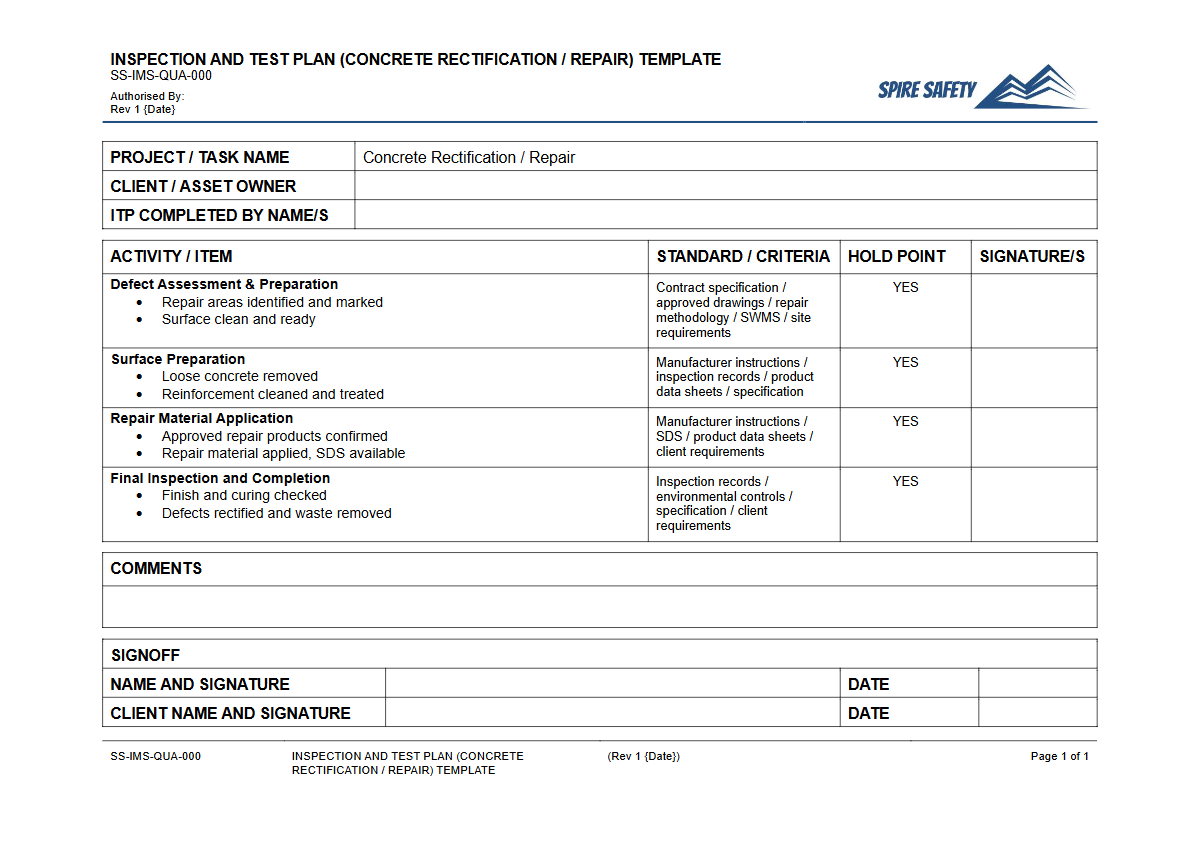
An Inspection and Test Plan (ITP) is a critical quality assurance document that outlines the specific checks, tests, and verification stages required to ensure a task meets project specifications and safety standards. This Free Inspection & Test Plan (Concrete Rectification Repair) Template provides a structured framework for managing the quality control process for all stages of concrete repair, from initial surface preparation to final curing and sign-off.
Using a formal ITP helps ensure that repairs are durable, structurally sound, and compliant with engineering requirements, preventing costly rework and potential failures.
Integrating this ITP into your project workflows promotes a systematic approach to quality. It establishes clear responsibilities, acceptance criteria, and documentation requirements for each step.
This process is a fundamental component of effective comprehensive WHS management systems, demonstrating due diligence and a commitment to quality outcomes for clients and stakeholders.
Video walkthrough
How to use the Free Inspection & Test Plan (Concrete Rectification Repair) Template
This template is designed as a starting point. It lists common activities and inspection points associated with concrete rectification, such as substrate assessment, reinforcement cleaning, material mixing, application, and curing procedures.
You will find columns for defining the inspection type (e.g., witness, hold point, surveillance), acceptance criteria, responsible personnel, and a section for recording results and sign-offs.
Customisation is Essential
You must adapt this document to the specific requirements of your project and workplace. This includes referencing the relevant project specifications, Australian Standards, engineer's drawings, and manufacturer's data sheets for the repair materials being used.
We cannot know the specific hazards, materials, or quality benchmarks of your site. It is your responsibility to add, remove, or modify checklist items to create a document that is fit for purpose for your operations.
Once customised, the ITP serves as a live document on-site. It guides supervisors and workers through the required quality sequence and provides a clear record of completed inspections.
This documentation is invaluable during handover and can be a key piece of evidence during a WHS compliance audit to verify that processes were followed correctly.
When to use it
An ITP for concrete rectification should be implemented on any project where the quality and integrity of the repair are critical. This includes, but is not limited to:
- Structural repairs to beams, columns, slabs, or precast panels.
- Remediation of concrete cancer (spalling) caused by reinforcement corrosion.
- Projects with strict client or engineering specifications.
- Large-scale or repetitive repair programs where consistency is vital.
- Any situation where a documented quality record is required for contractual or compliance purposes.
The plan should be prepared before any physical work begins and agreed upon by relevant parties, such as the site engineer, project manager, and client representative. Ensuring all personnel involved in the work are competent is also crucial; this may involve a Verification of Competency for stationary concrete pumps and other key plant.
Who should use it
This Inspection & Test Plan is intended for use by personnel responsible for overseeing and executing construction and maintenance projects. Key users include:
- Project Managers: For overall quality management and client liaison.
- Site Engineers: For technical oversight and verification against specifications.
- Quality Assurance/Quality Control (QA/QC) Officers: For implementing and managing the inspection process.
- Forepersons and Supervisors: For directing work crews and conducting on-the-ground checks.
- Specialist Remedial Contractors: To demonstrate their quality process and meet contractual obligations.
In sectors like mining and quarrying, concrete infrastructure is often subject to harsh conditions, making robust repair processes essential. On these sites, quality plans like this ITP can form part of broader risk management documents, such as principal mining hazard management plans, to ensure the integrity of critical structures.
For more specific document examples, our free WHS resources library has a wide range of templates for various industries.
Common mistakes
Common mistakes to avoid
- Failing to properly prepare the concrete substrate (e.g., not removing all unsound material).
- Inadequate cleaning of exposed steel reinforcement or failing to treat it with a primer.
- Using the wrong repair material for the defect type, depth, or exposure conditions.
- Skipping or shortening critical curing procedures, leading to a weak or failed repair bond.
Legal references
Legal considerations
The following legal requirements may be relevant to this type of work.
- Work Health and Safety Act (Harmonised) — Provides the primary duties for protecting workers and other people from work health and safety risks.
- Work Health and Safety Regulations (Harmonised) — Sets out requirements supporting the management of workplace hazards and risks.
The following codes may be relevant to this type of work.
- Managing WHS Risks Code of Practice — Provides practical guidance on identifying hazards, assessing risks and applying effective controls.
- Work Health and Safety Consultation, Cooperation and Coordination Code of Practice — Provides practical guidance on consulting workers and coordinating with other duty holders.
- Managing the Work Environment and Facilities Code of Practice — Provides practical guidance on safe work environments, workplace facilities and related controls.
Did you know
Concrete Cancer
"Concrete cancer" or spalling is most commonly caused by the steel reinforcement inside the concrete rusting. As the steel corrodes, it expands, cracking the surrounding concrete and causing it to break away.
Curing is Key
Improperly cured concrete can lose up to 50% of its potential strength. Curing is a critical chemical process, not just 'drying', and requires maintaining adequate moisture and temperature for a set period.
FAQ
Frequently asked questions
01What is the difference between a Witness Point and a Hold Point in an ITP?
02Does this ITP cover the use of specific concrete repair materials?
03Is an ITP a legal requirement for concrete repair in Australia?
04How do I document inspections within this template?
Share this resource
Free Inspection & Test Plan (Concrete Rectification Repair) Template
Browse Categories
How To Use It
- 1Download and open in Word or PDF.
- 2Replace the placeholders with your business details.
- 3Get it reviewed by a WHS specialist before rollout.
Need it customised?
Our WHS consultants can adapt this template to your site, run a gap analysis, or audit what you already have in place.
Book a Free Consultation WHS consulting servicesor call 1300 156 382
Related templates
- Free Inspection & Test Plan (Concrete Staircase) Template
- Free Inspection & Test Plan (Concrete Subfloor Ground Slab) Template
- Free Inspection & Test Plan (Concrete Terracotta Roof Tile) Template
- Free Inspection & Test Plan (Cornice and Set) Template
- Free Inspection & Test Plan (Curtain Wall Unitised Facade) Template
- Free Inspection & Test Plan (Data Communications Cabling) Template