
Free Inspection & Test Plan (Concrete Terracotta Roof Tile) Template
Download your free Inspection & Test Plan (ITP) for concrete and terracotta roof tiling.
Free Inspection & Test Plan (Concrete Terracotta Roof Tile) Template
DOCX • 136 KB + PDF
Updated Oct 2026
No signup required
Purpose of the Free Inspection & Test Plan (Concrete Terracotta Roof Tile) Template
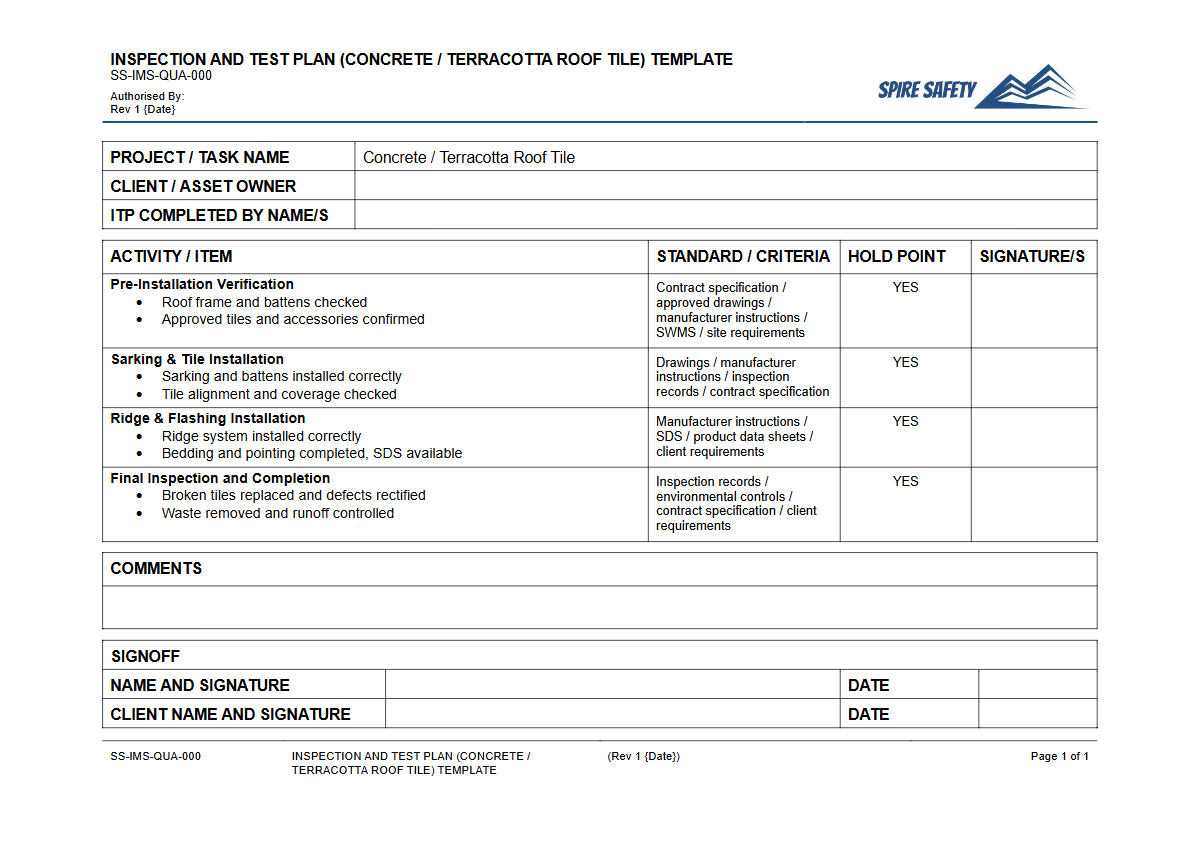
An Inspection & Test Plan (ITP) is a formal quality assurance document that systematically outlines all the necessary inspections, tests, and checks for a specific construction process. This Free Inspection & Test Plan (Concrete Terracotta Roof Tile) Template provides a structured framework for ensuring that all stages of a concrete or terracotta roof tile installation meet the project's technical specifications, Australian Standards, and the manufacturer's requirements.
It serves as a definitive record, proving that quality control activities have been performed correctly from material delivery to final project handover.
By defining critical checkpoints, known as witness and hold points, the ITP ensures that no stage of work proceeds without proper verification. This proactive approach helps prevent costly rework, reduces defects, and improves client satisfaction.
Furthermore, a well-executed ITP is a core component of professional WHS management systems, demonstrating a commitment to quality, safety, and due diligence.
Video walkthrough
How to use the Free Inspection & Test Plan (Concrete Terracotta Roof Tile) Template
This template is provided in DOCX and PDF formats to serve as a comprehensive starting point. To implement it effectively, you should review and adapt the document to align with your specific project's scope.
This involves identifying the key stages of your roof tiling process, defining the acceptance criteria for each stage, assigning responsibilities for inspections, and specifying the records that need to be maintained.
Key columns in the ITP typically include the activity or task, the inspection method, acceptance criteria (often referencing a specific standard or drawing), the type of inspection point (e.g., witness, hold, or surveillance), and sign-offs for verification.
Customisation is Essential
Please note: This document is a template and must be customised to suit the specific requirements of your project, site, and organisation's policies. The effectiveness of this ITP depends on its correct adaptation and implementation.
We are not responsible for its application on your project.
The process of customising the ITP should involve competent persons who understand the technical aspects of roofing and the associated risks. The plan should integrate seamlessly with any required Safe Work Method Statements (SWMS) for high-risk construction work, such as working at heights.
Properly sequencing these checks is fundamental to managing principal hazards in high-risk environments, ensuring that safety controls are verified at critical stages, not just planned.
When to use an ITP for Roof Tiling
The Inspection & Test Plan should be developed and approved during the project planning phase, well before any physical work begins on site. It is a live document used throughout the entire roofing project lifecycle.
It should be triggered at key milestones, including the verification of incoming materials, checking the roof structure and sarking, inspecting batten installation, monitoring tile laying and fixing, and finally, inspecting the installation of ridge caps and flashings.
Upon project completion, the fully signed-off ITP forms a crucial part of the handover documentation, providing an auditable trail of quality assurance activities. These records are invaluable for demonstrating compliance during any future WHS compliance auditing or if defects are identified post-completion.
Who should use it
This template is designed for use by various personnel involved in construction and project management. Key users include:
- Project Managers: For overall project quality oversight and client assurance.
- Site Supervisors and Foremen: For day-to-day management of quality and the execution of on-site checks.
- Quality Assurance (QA) Managers: For establishing and monitoring the project's quality framework.
- Roofing Contractors: To ensure their work meets contractual requirements and industry standards.
- Principal Contractors: To verify the quality of work performed by subcontractors.
For a site supervisor, the ITP is a practical tool for daily management. Beyond the specific roofing tasks, they must also ensure other site activities are properly managed. For example, a supervisor must ensure operators of key equipment are competent, a process formalised with tools like a Verification of Competency for concrete pump operators.
This document provides a solid foundation for your project's quality control. Professionals looking for more tools are encouraged to browse our free WHS resources library for a wide range of templates and guides.
Common mistakes
Common mistakes to avoid
- Failing to reference specific Australian Standards (e.g., AS 2049, AS 2050) in the ITP.
- Not including inspections for substrate and sarking preparation before tile installation.
- Overlooking integration with Safe Work Method Statements (SWMS) for high-risk activities.
- Using a generic ITP without customising it for the specific tile profile, roof pitch, and site conditions.
Legal references
Legal considerations
The following legal requirements may be relevant to this type of work.
- Work Health and Safety Act (Harmonised) — Provides the primary duties for protecting workers and other people from work health and safety risks.
- Work Health and Safety Regulations (Harmonised) — Sets out requirements supporting the management of workplace hazards and risks.
The following codes may be relevant to this type of work.
- Managing WHS Risks Code of Practice — Provides practical guidance on identifying hazards, assessing risks and applying effective controls.
- Work Health and Safety Consultation, Cooperation and Coordination Code of Practice — Provides practical guidance on consulting workers and coordinating with other duty holders.
- Managing the Work Environment and Facilities Code of Practice — Provides practical guidance on safe work environments, workplace facilities and related controls.
Did you know
Colour Fading
Terracotta tiles are colour-fast as the colour is baked into the clay, while concrete tiles have a painted surface that can fade over time with UV exposure.
Weight Difference
Concrete tiles are generally heavier than terracotta tiles, which can impact roof structure engineering and manual handling requirements during installation.
FAQ
Frequently asked questions
01What is an Inspection & Test Plan (ITP) for roofing?
02Is this roof tile ITP template ready to use?
03What are 'hold points' in a roofing ITP?
04Who signs off on an ITP?
Share this resource
Free Inspection & Test Plan (Concrete Terracotta Roof Tile) Template
Browse Categories
How To Use It
- 1Download and open in Word or PDF.
- 2Replace the placeholders with your business details.
- 3Get it reviewed by a WHS specialist before rollout.
Need it customised?
Our WHS consultants can adapt this template to your site, run a gap analysis, or audit what you already have in place.
Book a Free Consultation WHS consulting servicesor call 1300 156 382
Related templates
- Free Inspection & Test Plan (Cornice and Set) Template
- Free Inspection & Test Plan (Curtain Wall Unitised Facade) Template
- Free Inspection & Test Plan (Data Communications Cabling) Template
- Free Inspection & Test Plan (Defects Liability Inspection) Template
- Free Inspection & Test Plan (Demolition) Template
- Free Inspection & Test Plan (Double Brick Construction) Template