
Free Inspection & Test Plan (Demolition) Template
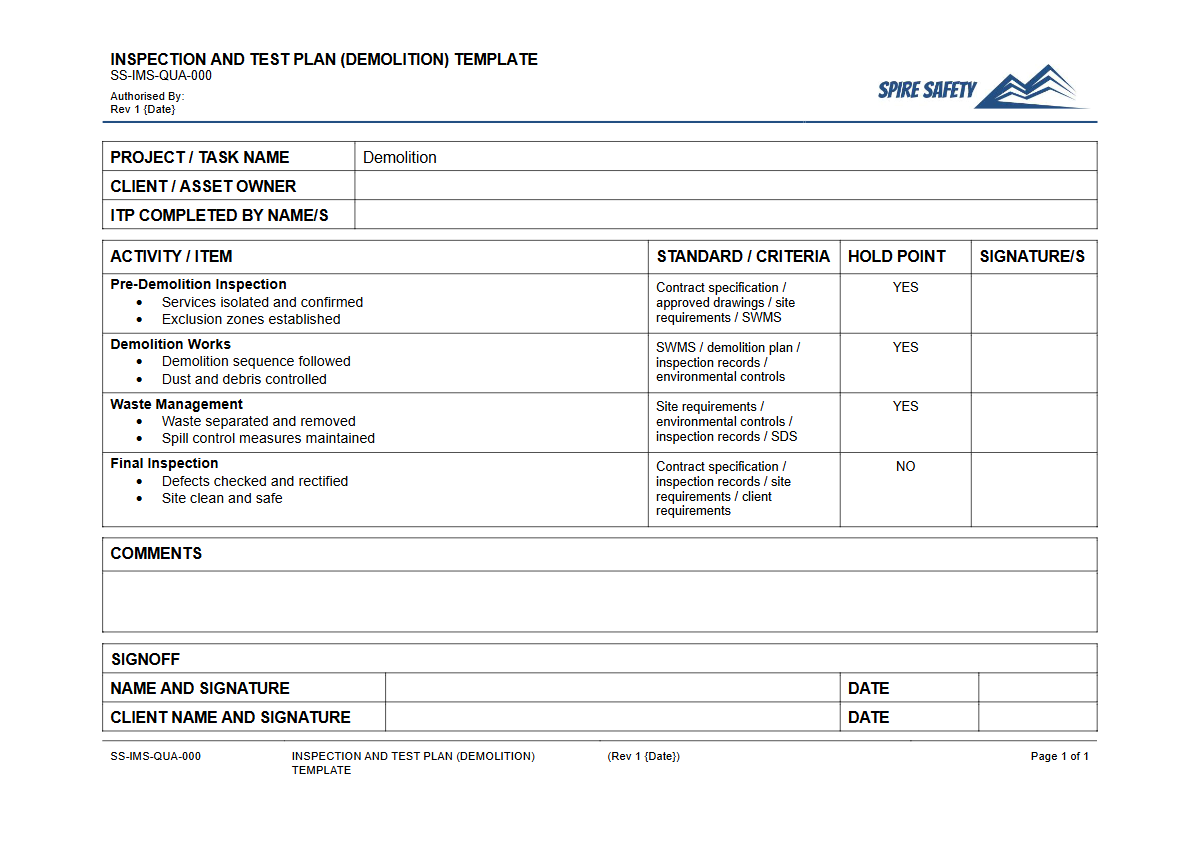
Download our free Inspection & Test Plan (Demolition) template. This structured DOCX & PDF helps manage quality and safety for demolition projects.
Free Inspection & Test Plan (Demolition) Template
DOCX • 141 KB + PDF
Updated Oct 2026
No signup required
Purpose of the Free Inspection & Test Plan (Demolition) Template
An Inspection and Test Plan (ITP) is a critical quality assurance document that outlines the sequence of inspections, tests, and checks required to ensure a demolition project meets all specified requirements, from safety standards to engineering specifications. Our Free Inspection & Test Plan (Demolition) Template provides a structured framework for documenting these crucial hold points, witness points, and review stages.
Using an ITP ensures that every phase of the demolition—from initial site setup and hazardous material removal to structural deconstruction and site clearance—is systematically verified against predefined criteria. This proactive approach helps prevent defects, control risks, and ensures the final outcome is safe and compliant.
It serves as an essential component within broader WHS management systems, providing tangible evidence of due diligence and quality control throughout the project lifecycle.
Video walkthrough
How to use the Free Inspection & Test Plan (Demolition) Template
This template is designed to be a comprehensive starting point for your demolition projects. To use it effectively, you must systematically work through each stage of your project and identify the necessary control points.
The plan is structured with columns for detailing the activity, the type of check required (e.g., inspection, test, survey), the standards or specifications to be met, and the records to be kept. You will need to define the acceptance criteria for each check, assign responsibility, and specify the frequency of the inspection or test.
This process is particularly important for high-risk activities, which require a level of planning similar to developing principal hazard management plans to ensure all risks are identified and controlled.
Customising Your Demolition ITP
It is vital that you adapt this template to the unique context of your specific project. Factors like the type of structure being demolished, the presence of hazardous materials (like asbestos), site location, and the specific demolition methods used will all influence the content of your ITP.
Please note: This document is a template and must be customised to your specific workplace, demolition project, plant, and equipment. We are not liable for any non-compliance or safety incidents arising from its use.
When to use an Inspection & Test Plan
An ITP for demolition should be developed and implemented during the project's planning phase, well before any physical work commences on site. It should be treated as a live document, reviewed and updated as the project progresses or if the scope of work changes.
The ITP is used daily by site supervisors and project managers to guide their quality control activities. It also serves as a key reference during site meetings and progress reviews.
For large or complex projects, the ITP can be used as a core document for external verification activities, such as when engaging third-party consultants for WHS compliance auditing to independently confirm that project standards are being met.
Who should use this ITP
This Inspection & Test Plan template is intended for use by a range of personnel involved in demolition projects. This includes:
- Project Managers: To oversee project quality and ensure contractual and regulatory obligations are fulfilled.
- Site Supervisors and Foremen: To manage day-to-day quality control activities and direct work crews.
- WHS Officers and Safety Advisors: To integrate safety checks and supports your compliance efforts with WHS regulations at critical stages.
- Demolition Contractors: To provide their clients with assurance that quality and safety procedures are in place and being followed.
- Engineers and Consultants: To specify technical hold points and verification requirements for structural and environmental elements.
Properly managing the entire demolition process includes handling waste and cleared materials. This ITP can be expanded to include checks for waste segregation and disposal, ensuring materials are directed to the correct facilities.
You may find our WHS inspection template for resource recovery centres useful for managing the downstream risks associated with demolition waste.
This template is just one of many documents available to help you manage your safety and compliance obligations. For more tools and checklists, explore our complete free WHS resources library.
Common mistakes
Common mistakes to avoid
- Using a generic ITP template without customising it for the specific structure, site conditions, and demolition methods.
- Failing to define clear, measurable, and objective acceptance criteria for each inspection point.
- Not involving key personnel, such as site supervisors and specialist contractors, in the development and review of the ITP.
- Poor record-keeping, resulting in an incomplete audit trail and an inability to prove compliance or work quality.
Legal references
Legal considerations
The following legal requirements may be relevant to this type of work.
- Work Health and Safety Act (Harmonised) — Provides the primary duties for protecting workers and other people from work health and safety risks.
- Work Health and Safety Regulations (Harmonised) — Sets out requirements supporting the management of workplace hazards and risks.
The following codes may be relevant to this type of work.
- Managing WHS Risks Code of Practice — Provides practical guidance on identifying hazards, assessing risks and applying effective controls.
- Work Health and Safety Consultation, Cooperation and Coordination Code of Practice — Provides practical guidance on consulting workers and coordinating with other duty holders.
- Managing the Work Environment and Facilities Code of Practice — Provides practical guidance on safe work environments, workplace facilities and related controls.
Did you know
Hierarchy of Controls in Demolition
The most effective method of risk control in demolition is elimination, such as using remote-controlled demolition robots for hazardous tasks, which removes workers from the immediate danger zone.
Construction Industry Risks
The construction industry, which includes demolition, is one of Australia's highest-risk industries, accounting for a significant percentage of serious workplace injury claims according to Safe Work Australia data.
FAQ
Frequently asked questions
01What is the difference between an ITP and a SWMS for demolition?
02Does this demolition ITP cover asbestos removal?
03Who needs to sign off on an Inspection and Test Plan?
04How often should an ITP be reviewed during a demolition project?
Share this resource
Free Inspection & Test Plan (Demolition) Template
Browse Categories
How To Use It
- 1Download and open in Word or PDF.
- 2Replace the placeholders with your business details.
- 3Get it reviewed by a WHS specialist before rollout.
Need it customised?
Our WHS consultants can adapt this template to your site, run a gap analysis, or audit what you already have in place.
Book a Free Consultation WHS consulting servicesor call 1300 156 382
Related templates
- Free Inspection & Test Plan (Double Brick Construction) Template
- Free Inspection & Test Plan (Ductwork Installation) Template
- Free Inspection & Test Plan (Earthworks Excavation) Template
- Free Inspection & Test Plan (Electrical Installation) Template
- Free Inspection & Test Plan (Electrical Rough-In (First Fix)) Template
- Free Inspection & Test Plan (Electrical Second Fix Fit off) Template