
Free Inspection & Test Plan (Electrical Installation) Template
Download our free Inspection & Test Plan (Electrical Installation) Template.
Free Inspection & Test Plan (Electrical Installation) Template
DOCX • 139 KB + PDF
Updated Oct 2026
No signup required
Purpose of the Free Inspection & Test Plan (Electrical Installation) Template
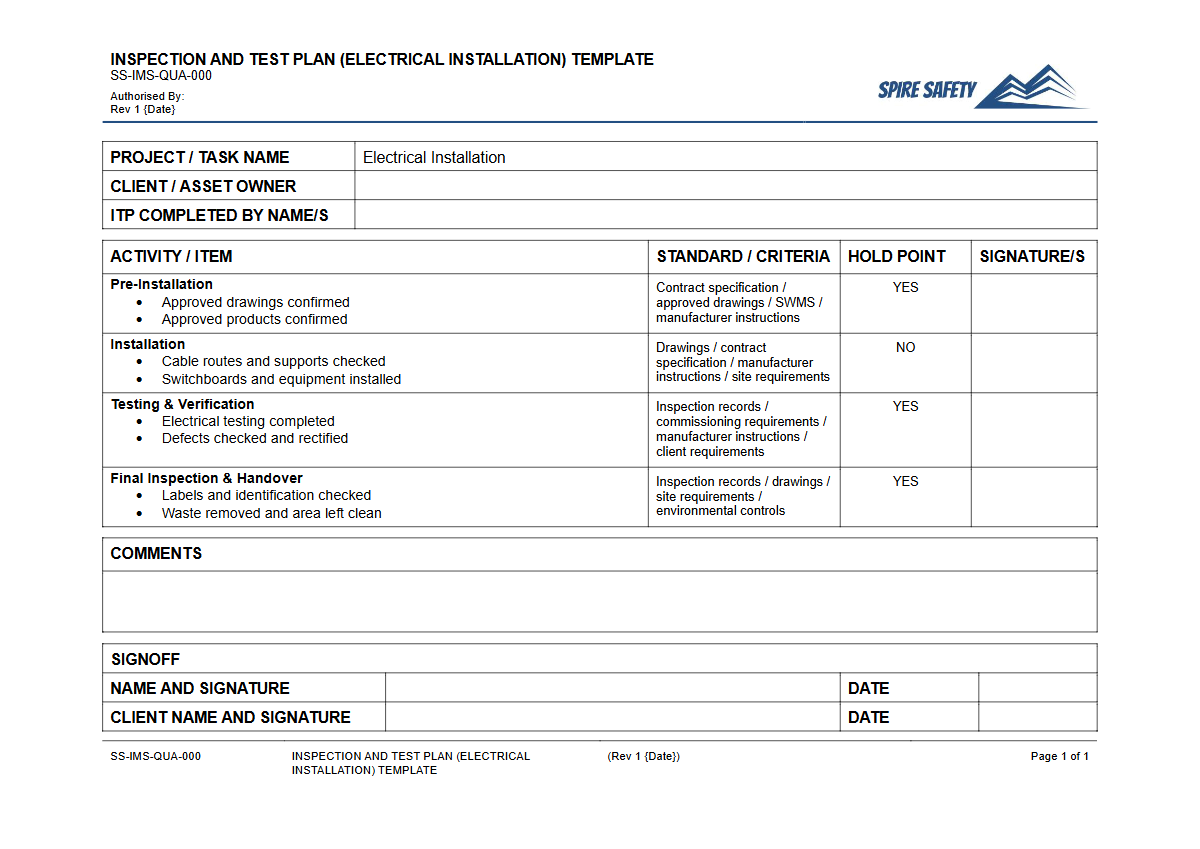
An Inspection and Test Plan (ITP) is a critical quality assurance document used to map out and record the verification activities for a project. This free Inspection & Test Plan (Electrical Installation) Template provides a structured framework to ensure all stages of an electrical installation are progressively checked, tested, and certified against specified requirements.
Using an ITP helps demonstrate due diligence, manage project quality, and create a verifiable record of compliance. It systematically outlines key stages, from pre-start checks to final commissioning, ensuring that no critical step is overlooked. This methodical approach is a cornerstone of robust WHS management systems.
Video walkthrough
How to use the Free Inspection & Test Plan (Electrical Installation) Template
This template is provided in both DOCX and PDF formats for your convenience. To use it effectively, download the DOCX file and open it in a word processor.
You must then adapt the document to the specific context of your project. This includes adding your company branding, project details, and, most importantly, populating the plan with the specific tasks, standards, and acceptance criteria relevant to your electrical installation.
Important: This document is a template and is not a substitute for professional advice. It must be customised to your specific project, workplace, and the relevant state or territory electrical safety regulations.
We cannot be held liable for any issues that arise from the use of this template without proper customisation by a competent person.
Key Components of an Electrical Inspection & Test Plan
- Scope and References: Clearly define the scope of the installation and list all relevant documents, including project drawings, specifications, and Australian Standards (e.g., AS/NZS 3000).
- Inspection & Test Stages: Break down the installation process into logical stages, such as 'Pre-Installation Checks', 'Rough-In', 'Fit-Off', and 'Commissioning'.
- Hold & Witness Points: Designate critical stages as 'Hold Points' (work must stop for inspection) or 'Witness Points' (the client/inspector is invited to witness).
- Acceptance Criteria: For each item, define what 'correct' looks like. This should be a specific, measurable standard (e.g., 'Insulation resistance >1 MΩ'), not just 'Pass/Fail'. Effective criteria are essential for the integrity of the process and are often a focus of WHS compliance audits.
- Records: Specify the record that will be generated to prove the check was completed, such as a test certificate, signed checklist, or photograph.
When to use an Inspection & Test Plan for Electrical Installation
An ITP should be developed during the project planning phase, well before any physical work begins. It is a live document that is used throughout the project lifecycle.
It is particularly crucial for commercial and industrial electrical projects, works involving principal contractors, or any installation with stringent quality or contractual requirements. For projects in unique environments, the ITP must account for site-specific hazards, much like a dedicated WHS inspection template for service stations would address risks from flammable liquids.
Who should use this template
This resource is designed for individuals responsible for the quality, safety, and compliance of electrical installation projects in Australia. This includes:
- Electrical Project Managers
- Electrical Contractors and Supervisors
- Licensed Electricians
- Quality Assurance (QA) and Quality Control (QC) Personnel
- Principal Contractors
- WHS Managers and Advisors
For complex installations or where in-house expertise is limited, engaging external support can provide clarity and ensure robust processes. Many organisations find value in partnering with specialist WHS consulting services to develop and implement effective ITPs.
Whether the job is a large-scale industrial setup or part of a maintenance program in a busy facility, having a formal plan is best practice. To see what other tools are available, you can browse our complete free WHS resources library.
Common mistakes
Common mistakes to avoid
- Failing to customise the template with project-specific details and relevant Australian Standards.
- Using generic 'Pass/Fail' criteria instead of specific, measurable acceptance standards.
- Neglecting to define clear Hold and Witness points, leading to missed verification stages.
- Poor record-keeping, making it difficult to prove inspections and tests were completed correctly.
Legal references
Legal considerations
The following legal requirements may be relevant to this type of work.
- Work Health and Safety Act (Harmonised) — Provides the primary duties for protecting workers and other people from work health and safety risks.
- Work Health and Safety Regulations (Harmonised) — Sets out requirements supporting the management of workplace hazards and risks.
The following codes may be relevant to this type of work.
- Managing WHS Risks Code of Practice — Provides practical guidance on identifying hazards, assessing risks and applying effective controls.
- Work Health and Safety Consultation, Cooperation and Coordination Code of Practice — Provides practical guidance on consulting workers and coordinating with other duty holders.
- Managing the Work Environment and Facilities Code of Practice — Provides practical guidance on safe work environments, workplace facilities and related controls.
Did you know
The Wiring Rules
The primary standard for electrical installations in Australia, AS/NZS 3000, is not legislation itself but is called up by state and territory electrical safety laws, giving it legal force.
RCDs Save Lives
Since 2018, AS/NZS 3000 has required Residual Current Devices (RCDs) on virtually all final sub-circuits in new domestic and similar installations, significantly reducing the risk of fatal electric shock.
FAQ
Frequently asked questions
01What is the difference between a Hold Point and a Witness Point in an ITP?
02Does this electrical ITP template cover AS/NZS 3000 requirements?
03Can I use this template for small residential electrical jobs?
04Is an Inspection and Test Plan a legal requirement in Australia?
Share this resource
Free Inspection & Test Plan (Electrical Installation) Template
Browse Categories
How To Use It
- 1Download and open in Word or PDF.
- 2Replace the placeholders with your business details.
- 3Get it reviewed by a WHS specialist before rollout.
Need it customised?
Our WHS consultants can adapt this template to your site, run a gap analysis, or audit what you already have in place.
Book a Free Consultation WHS consulting servicesor call 1300 156 382
Related templates
- Free Inspection & Test Plan (Electrical Rough-In (First Fix)) Template
- Free Inspection & Test Plan (Electrical Second Fix Fit off) Template
- Free Inspection & Test Plan (Emergency and Exit Lighting) Template
- Free Inspection & Test Plan (Epoxy Resin Floor Coating) Template
- Free Inspection & Test Plan (External Cladding) Template
- Free Inspection & Test Plan (External Insulation and Finish System (EIFS)) Template