
Free Inspection & Test Plan (Emergency and Exit Lighting) Template
Download our free Inspection & Test Plan for emergency and exit lighting. This customisable template helps document testing requirements.
Free Inspection & Test Plan (Emergency and Exit Lighting) Template
DOCX • 143 KB + PDF
Updated Oct 2026
No signup required
Purpose of the Free Inspection & Test Plan (Emergency and Exit Lighting) Template
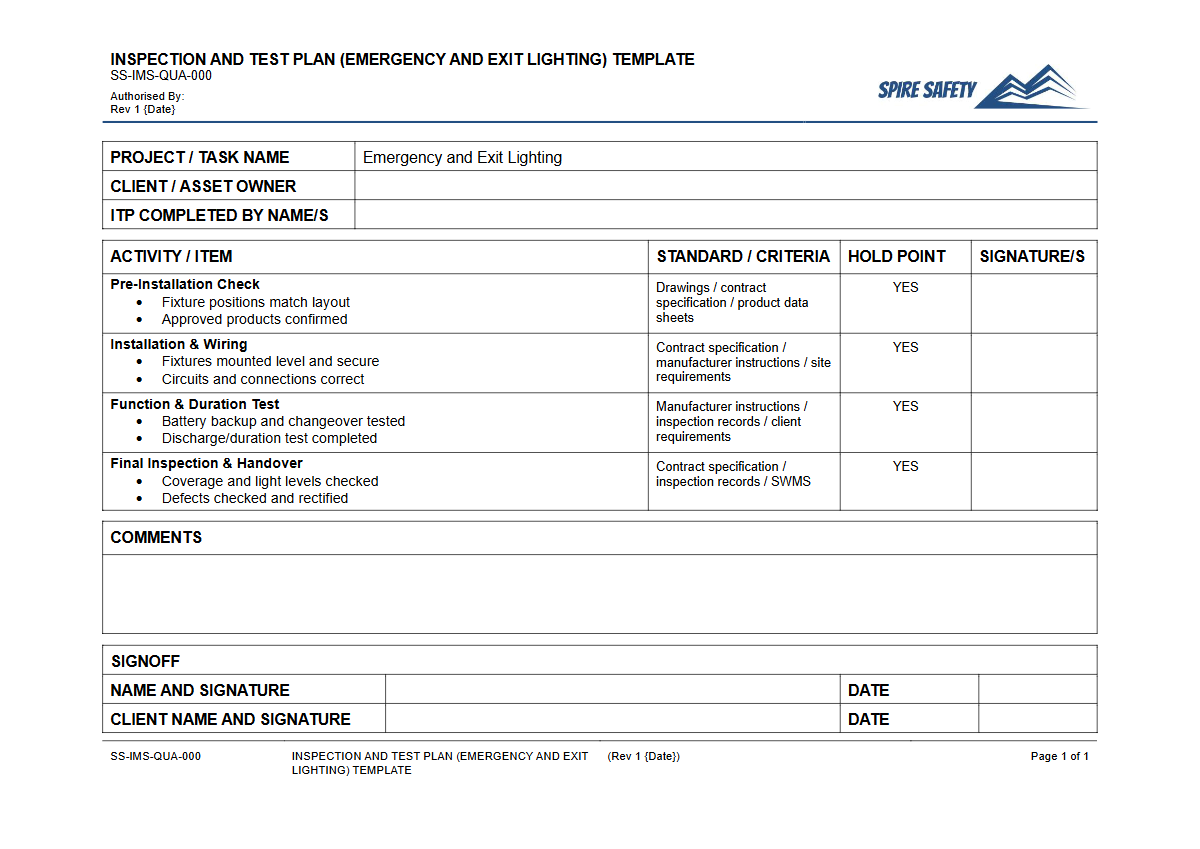
This free Inspection & Test Plan (Emergency and Exit Lighting) Template provides a structured framework for documenting and verifying the routine service and maintenance of your building's emergency lighting system. Properly functioning emergency and exit lights are critical for ensuring personnel can safely evacuate during a power outage or other emergency.
This Inspection & Test Plan (ITP) helps a Person Conducting a Business or Undertaking (PCBU) demonstrate that they are meeting their duty of care under Australian WHS laws by systematically testing these crucial assets.
Using an ITP creates a verifiable record of testing activities, which is essential for demonstrating due diligence. It outlines the specific tests to be performed, the acceptance criteria based on relevant Australian Standards, the frequency of these tests, and a place to record the results. This documentation is a key piece of evidence during any internal or external WHS compliance auditing.
Video walkthrough
How to use the Free Inspection & Test Plan (Emergency and Exit Lighting) Template
Our Inspection & Test Plan template is provided in both DOCX and PDF formats for your convenience. The DOCX file is fully editable, allowing you to tailor it to your specific site requirements.
To use it, simply download the file and add your company details, project information, and the specific makes and models of the emergency lighting units installed at your facility. The template includes columns for test descriptions, acceptance criteria, frequency, responsible persons, and results, aligning with good record-keeping practices.
This document serves as a robust foundation for developing your site-specific procedures. A well-managed ITP is a fundamental component of effective WHS management systems, ensuring that safety-critical equipment is maintained in a state of operational readiness.
Important: We have designed this template as a comprehensive starting point. You must customise it to reflect the specific emergency and exit lighting system, operational risks, and legal requirements of your workplace.
When to use this Inspection & Test Plan
This Inspection & Test Plan should be used to govern all scheduled testing and maintenance activities for emergency and exit lighting. Its use is critical for establishing a consistent and documented routine. Key times to use this ITP include:
- Scheduled Routine Testing: For carrying out the mandatory 6-monthly and annual discharge tests required by Australian Standards.
- After New Installations: To verify that a new or expanded system has been installed correctly and functions as designed.
- Following Repairs or Modifications: To confirm that any maintenance work has restored the system to its required operational state.
- As Part of Broader Safety Audits: The ITP and its completed records can be used as evidence during general site safety reviews, such as those conducted using a Free WHS Inspection (Beverage Plant) Template.
Who should use this Inspection & Test Plan
This template is designed for use by individuals responsible for building maintenance and safety. This typically includes:
- Licensed Electricians: The competent persons who will be physically carrying out the tests and any required repairs.
- Facility Managers: Those responsible for overseeing the maintenance schedule, managing contractors, and ensuring records are kept.
- WHS Officers and Safety Advisors: Professionals who use the ITP to verify that safety procedures are being followed and that the organisation is meeting its compliance obligations.
- Building Owners and PCBUs: The ultimate duty holders who rely on this documentation to demonstrate that safety-critical systems are properly maintained, particularly in high-occupancy settings covered by resources like our Free WHS Inspection (Aged Care Home) Template.
The principles outlined in this ITP are applicable across all industries where emergency lighting is required, from commercial offices and retail spaces to industrial sites that might use a Free WHS Inspection (Vehicle Workshop) Template for other safety checks. For expert assistance in customising and implementing this or other safety documentation, consider engaging professional WHS consulting services.
By implementing this ITP, your organisation can improve the reliability of its emergency systems, ensure consistency in testing, and maintain clear, auditable records. You can find more helpful documents in our free WHS resources library.
Common mistakes
Common mistakes to avoid
- Forgetting to document test results, creating compliance gaps and leaving no auditable trail.
- Using unqualified or inexperienced personnel for testing and maintenance.
- Failing to replace faulty globes, batteries, or entire fittings in a timely manner after a failed test.
- Only testing that lights turn on but failing to check exit signs for damage, correct direction, and visibility.
Legal references
Legal considerations
The following legal requirements may be relevant to this type of work.
- Work Health and Safety Act (Harmonised) — Provides the primary duties for protecting workers and other people from work health and safety risks.
- Work Health and Safety Regulations (Harmonised) — Sets out requirements supporting the management of workplace hazards and risks.
The following codes may be relevant to this type of work.
- Managing WHS Risks Code of Practice — Provides practical guidance on identifying hazards, assessing risks and applying effective controls.
- Work Health and Safety Consultation, Cooperation and Coordination Code of Practice — Provides practical guidance on consulting workers and coordinating with other duty holders.
- Managing the Work Environment and Facilities Code of Practice — Provides practical guidance on safe work environments, workplace facilities and related controls.
Did you know
The 90-Minute Test
The annual 'discharge test' requires every emergency light to remain illuminated under its own battery power for a continuous 90-minute period to pass, simulating a prolonged power failure.
Visibility is Key
In a fire, smoke can reduce visibility to near zero in minutes. Properly maintained emergency lighting is a critical lifeline, illuminating the path of egress and guiding occupants to safety when mains power fails.
FAQ
Frequently asked questions
01What is the required frequency for testing emergency and exit lights in Australia?
02Who is qualified to test emergency lighting systems?
03What records need to be kept for emergency lighting tests?
04Does this template cover all legal requirements?
Share this resource
Free Inspection & Test Plan (Emergency and Exit Lighting) Template
Browse Categories
How To Use It
- 1Download and open in Word or PDF.
- 2Replace the placeholders with your business details.
- 3Get it reviewed by a WHS specialist before rollout.
Need it customised?
Our WHS consultants can adapt this template to your site, run a gap analysis, or audit what you already have in place.
Book a Free Consultation WHS consulting servicesor call 1300 156 382
Related templates
- Free Inspection & Test Plan (Epoxy Resin Floor Coating) Template
- Free Inspection & Test Plan (External Cladding) Template
- Free Inspection & Test Plan (External Insulation and Finish System (EIFS)) Template
- Free Inspection & Test Plan (External Render) Template
- Free Inspection & Test Plan (External Sealing Jointing) Template
- Free Inspection & Test Plan (External Site Lighting) Template