
Free WHS Inspection (Aged Care Home) Template
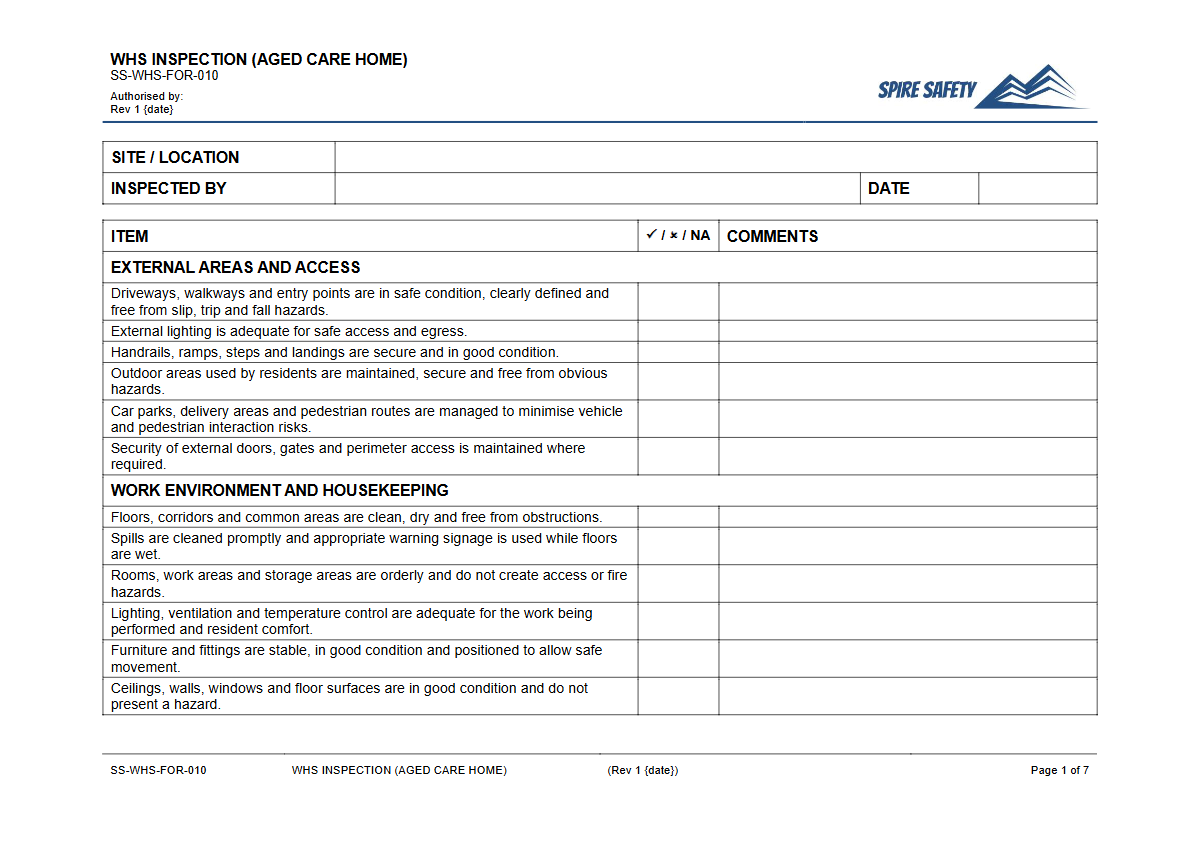
Formalise your safety processes with our Free WHS Inspection (Aged Care Home) Template. Aligned with Australian WHS principles for proactive risk management.
Free WHS Inspection (Aged Care Home) Template
DOCX • 128 KB + PDF
Updated Oct 2026
No signup required
Purpose of the Free WHS Inspection (Aged Care Home) Template
Aged care is a high-risk environment, with unique hazards affecting both residents and workers. This free WHS Inspection (Aged Care Home) Template provides a structured starting point for systematically identifying and controlling these risks.
Regular, documented inspections are a cornerstone of effective safety management, demonstrating proactive hazard identification and a commitment to providing a safe environment for everyone in the facility. By formalising your inspection process, you can move beyond reactive incident response to a more preventative safety culture.
Using this template helps ensure key areas are not overlooked, from resident mobility risks to kitchen hygiene and equipment safety. It provides a framework aligned with Australian W.H.S.
principles for conducting thorough walkthroughs. Integrating these regular checks is a practical way to support your broader WHS management systems and meet your duty of care.
Video walkthrough
How to use the Free WHS Inspection (Aged Care Home) Template
This document is provided in both DOCX and PDF formats for your convenience. The DOCX version is fully editable, allowing you to tailor the checklist to the specific layout, equipment, and operational procedures of your facility. A successful inspection process involves several key steps:
- Customise: Adapt the checklist to include specific rooms, outdoor areas, and equipment unique to your site. Add or remove items to ensure relevance.
- Schedule: Establish a regular schedule for inspections (e.g., weekly for high-traffic areas, monthly for general areas).
- Conduct: Walk through the designated areas, systematically checking each item on the list. Involve relevant workers and Health and Safety Representatives (HSRs) in the process.
- Document: Record all findings, noting any hazards, non-conformances, or areas for improvement. Take photos where appropriate.
- Action: Assign responsibility and set deadlines for any corrective actions required.
- Review: Management should review completed inspections to identify trends, allocate resources, and verify that actions have been completed.
Many identified hazards will relate to specific tasks, such as assisting residents. Findings from your inspection can be used to inform and improve worker training. For example, if you notice recurring issues with resident transfers, it may be time to deliver a targeted safety session using our Aged Care Manual Handling Toolbox Talk Template.
What should an aged care inspection cover?
While you must customise the template, a comprehensive inspection should cover a wide range of areas. Consider including sections for:
- Environment & Facilities: Check for trip hazards (e.g., worn carpets, cables), adequate lighting, clear signage, and functioning handrails in all common areas, corridors, and resident rooms.
- Infection Control: Verify the availability and condition of hand sanitising stations, personal protective equipment (PPE) stocks, and waste disposal systems.
- Kitchen & Food Safety: Inspect for cleanliness, correct food storage temperatures, and the safe operation of kitchen equipment. Our Free Pre-Start Checklist (Freezer) Template can assist with specific equipment checks.
- Plant & Equipment: Assess the condition of essential equipment like mobility aids, beds, and lifting devices. For detailed checks on specific items, use a dedicated form like our Free Pre-Start Checklist (Patient Hoist) Template.
- Emergency Preparedness: Ensure fire exits are clear, extinguishers are serviced and accessible, and emergency plans are visible.
- Outdoor Areas: Check paths, gardens, and car parks for hazards like uneven surfaces, poor lighting, or security issues. For facilities with groundskeeping equipment, our Free Pre-Start Checklist (Lawn Tractor) Template can be a useful tool.
Important Note: This document is a template and serves as a starting point. It is not a complete, out-of-the-box solution.
We recommend you customise this template to address the specific hazards and operational context of your workplace. Its effectiveness is dependent on its correct customisation and implementation.
When to use it
Workplace inspections should be a regular, scheduled activity. The frequency depends on the level of risk associated with the area or activity.
For instance, high-traffic common areas might require weekly checks, while administrative offices may only need a quarterly inspection. This template is also valuable for conducting inspections after an incident has occurred, after changes to the work environment (like new equipment), or when new tasks are introduced.
Periodic, independent reviews of your safety processes can also be beneficial, and our WHS compliance auditing services can provide that external assurance.
Who should use it
This template is designed for anyone responsible for health and safety in an aged care setting. This includes:
- Facility Managers and Site Managers
- Work Health and Safety (WHS) Managers or Advisors
- Health and Safety Representatives (HSRs)
- Supervisors and Team Leaders
- Maintenance and Groundskeeping Staff
A collaborative approach is most effective. Involving workers who perform the day-to-day tasks will provide valuable insights into the real-world hazards they face, making the inspection process more meaningful and effective.
Common mistakes
Common mistakes to avoid
- Using a generic checklist without customising it for the facility's specific layout and equipment.
- Failing to properly document findings and assign clear, time-bound corrective actions.
- Not involving workers or Health and Safety Representatives (HSRs) in the inspection process.
- Completing the inspection but failing to have management review the findings and track actions to completion.
Legal references
Legal considerations
The following legal requirements may be relevant to this type of work.
- Work Health and Safety Act (Harmonised) — Provides the primary duties for protecting workers and other people from work health and safety risks.
- Work Health and Safety Regulations (Harmonised) — Sets out requirements supporting the management of workplace hazards and risks.
The following codes may be relevant to this type of work.
- Managing WHS Risks Code of Practice — Provides practical guidance on identifying hazards, assessing risks and applying effective controls.
- Work Health and Safety Consultation, Cooperation and Coordination Code of Practice — Provides practical guidance on consulting workers and coordinating with other duty holders.
- Managing the Work Environment and Facilities Code of Practice — Provides practical guidance on safe work environments, workplace facilities and related controls.
Did you know
Slips, Trips, and Falls
Slips, trips, and falls are a leading cause of serious injury for both residents and staff in the Australian aged care industry. Most of these incidents are preventable through regular inspections and good housekeeping.
Manual Tasks
According to Safe Work Australia, the healthcare and social assistance industry has one of the highest rates of serious claims for musculoskeletal disorders, with hazardous manual tasks being a primary cause.
FAQ
Frequently asked questions
01How often should we conduct WHS inspections in an aged care home?
02What's the difference between a workplace inspection and an audit?
03Who is responsible for acting on the findings of an inspection?
04Can this template be used for psychosocial hazard inspections?
Share this resource
Free WHS Inspection (Aged Care Home) Template
Browse Categories
How To Use It
- 1Download and open in Word or PDF.
- 2Replace the placeholders with your business details.
- 3Get it reviewed by a WHS specialist before rollout.
Need it customised?
Our WHS consultants can adapt this template to your site, run a gap analysis, or audit what you already have in place.
Book a Free Consultation WHS consulting servicesor call 1300 156 382