
Free WHS Inspection (Airport Facility) Template
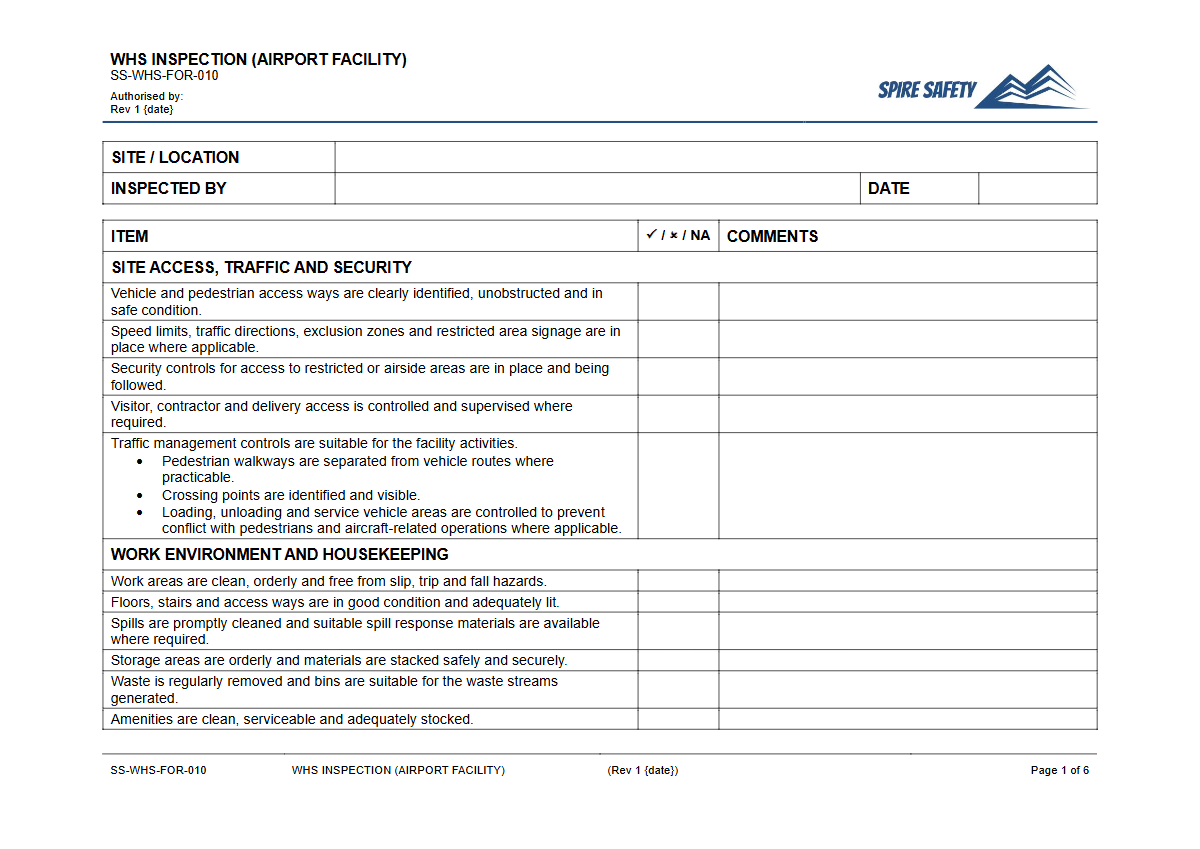
Download our Free WHS Inspection (Airport Facility) Template. A structured starting point for identifying hazards and managing risks in airport environments.
Free WHS Inspection (Airport Facility) Template
DOCX • 128 KB + PDF
Updated Oct 2026
No signup required
Purpose of the Free WHS Inspection (Airport Facility) Template
Airports are complex, high-risk environments with a unique mix of public access areas, secure zones, and heavy industrial activity. This Free WHS Inspection (Airport Facility) Template provides a structured starting point for systematically identifying hazards and assessing controls across your entire facility.
Regular inspections are a cornerstone of effective safety management, helping your organisation meet its duty of care and proactively prevent incidents before they occur. The template is designed to cover a broad range of typical airport hazards, from airside operations like aircraft servicing and ground support equipment movement to landside issues such as passenger traffic, retail spaces, and car park management.
Using this template helps formalise your inspection process, ensuring consistency and providing documented evidence of your safety assurance activities. A proactive inspection program is a key component of building robust WHS management systems, demonstrating a commitment to the health and safety of workers, contractors, and the public.
It prompts a thorough review of physical conditions, work practices, and safety equipment across different operational areas.
Video walkthrough
How to use the Free WHS Inspection (Airport Facility) Template
Our template is provided as a fully editable DOCX file, allowing for complete customisation, along with a ready-to-use PDF. To effectively use this resource, follow these steps:
- Download and Customise: Download the DOCX file and adapt it to the specific layout, equipment, and operations of your airport. Add or remove sections to reflect the unique hazards present in areas like baggage handling systems, security screening points, passenger terminals, and maintenance hangars.
- Schedule the Inspection: Plan the inspection at a time that allows for a thorough assessment. Consider conducting inspections during different operational periods (e.g., peak and off-peak times) to observe a full range of activities and potential risks.
- Conduct the Walk-through: Involve a team including a safety representative, an area manager, and frontline workers. Use the checklist to systematically walk through the designated areas, observing work practices, checking equipment, and identifying non-conformances or potential hazards.
- Document Findings: Record all observations, both positive and negative. For any identified issues, note the location, describe the hazard, and assign a risk rating if applicable. Take photos to provide clear evidence.
- Assign Corrective Actions: For each identified deficiency, assign a responsible person and a due date for rectification. Track these actions to ensure they are completed and that the controls implemented are effective.
Please note: This document is a template and must be customised to suit the specific needs, hazards, and operational context of your airport facility. We recommend consulting with relevant stakeholders, including workers and safety professionals, during this process.
When to use this Inspection Template
Formal workplace inspections in an airport facility should be conducted on a regular, scheduled basis. The frequency will depend on the level of risk in a particular area.
High-traffic or high-risk zones like the tarmac, baggage make-up areas, and security checkpoints may require more frequent inspections than office spaces or low-traffic retail areas.
In addition to routine schedules, an inspection should be triggered by:
- Any significant incident, accident, or near miss.
- Changes to the work environment, such as the introduction of new equipment, procedures, or construction work.
- Following reports of specific hazards or concerns from workers.
- Before major events that may alter traffic flow or operational demands.
For daily checks on specific equipment, a more focused checklist may be appropriate, such as a pre-start checklist for boom gates at vehicle entry points.
Who should use this Inspection Template
This template is designed for use by individuals and teams responsible for overseeing health and safety in an airport environment. This typically includes:
- WHS Managers and Safety Officers: To lead and document formal safety assurance activities.
- Facility and Operations Managers: To ensure the areas under their control are safe and free from hazards.
- Team Leaders and Supervisors: To conduct regular inspections of their specific work areas, such as baggage handling or ground crew operations.
- Health and Safety Representatives (HSRs): To represent their work groups during safety inspections and consultations.
Engaging a mix of management and operational staff ensures a more comprehensive inspection. Combining a manager's overview with a worker's direct experience of tasks and hazards leads to better risk identification and more practical solutions. For a deeper, more independent review of your safety processes, you may consider engaging external help for WHS compliance auditing.
For other equipment that requires daily checks before use, such as maintenance machinery, consider adapting a resource like our pre-start checklist for electric hoists. Likewise, for ground support equipment, a specific vehicle check such as a pre-start checklist for lawn tractors can be modified. You can find more specific templates in our complete free WHS resources library.
Common mistakes
Common mistakes to avoid
- Focusing only on airside hazards while neglecting landside areas like car parks, public terminals, and retail spaces.
- Using a generic checklist without customising it for specific airport zones (e.g., baggage handling vs. catering vs. security).
- Failing to document and track corrective actions, leaving identified hazards unresolved.
- Not involving frontline ground crew, baggage handlers, or retail staff who have direct experience with daily hazards.
Legal references
Legal considerations
The following legal requirements may be relevant to this type of work.
- Work Health and Safety Act (Harmonised) — Provides the primary duties for protecting workers and other people from work health and safety risks.
- Work Health and Safety Regulations (Harmonised) — Sets out requirements supporting the management of workplace hazards and risks.
The following codes may be relevant to this type of work.
- Managing WHS Risks Code of Practice — Provides practical guidance on identifying hazards, assessing risks and applying effective controls.
- Work Health and Safety Consultation, Cooperation and Coordination Code of Practice — Provides practical guidance on consulting workers and coordinating with other duty holders.
- Managing the Work Environment and Facilities Code of Practice — Provides practical guidance on safe work environments, workplace facilities and related controls.
Did you know
Ground Handling Risks
A significant portion of aviation accidents and incidents occur on the ground. These often involve vehicle collisions, manual handling injuries, and slips, trips, and falls on the tarmac and in baggage halls.
FOD Checks
Foreign Object Debris (FOD) walks are a critical type of inspection at airports. A small object like a loose screw on a runway can cause catastrophic engine damage to an aircraft during takeoff.
FAQ
Frequently asked questions
01What is the difference between a WHS inspection and an audit at an airport?
02How often should I conduct a WHS inspection of an airport facility?
03Who should be involved in an airport facility WHS inspection?
04What are the most common hazards found during airport inspections?
Share this resource
Free WHS Inspection (Airport Facility) Template
Browse Categories
How To Use It
- 1Download and open in Word or PDF.
- 2Replace the placeholders with your business details.
- 3Get it reviewed by a WHS specialist before rollout.
Need it customised?
Our WHS consultants can adapt this template to your site, run a gap analysis, or audit what you already have in place.
Book a Free Consultation WHS consulting servicesor call 1300 156 382