
Free WHS Inspection (Asphalt Plant) Template
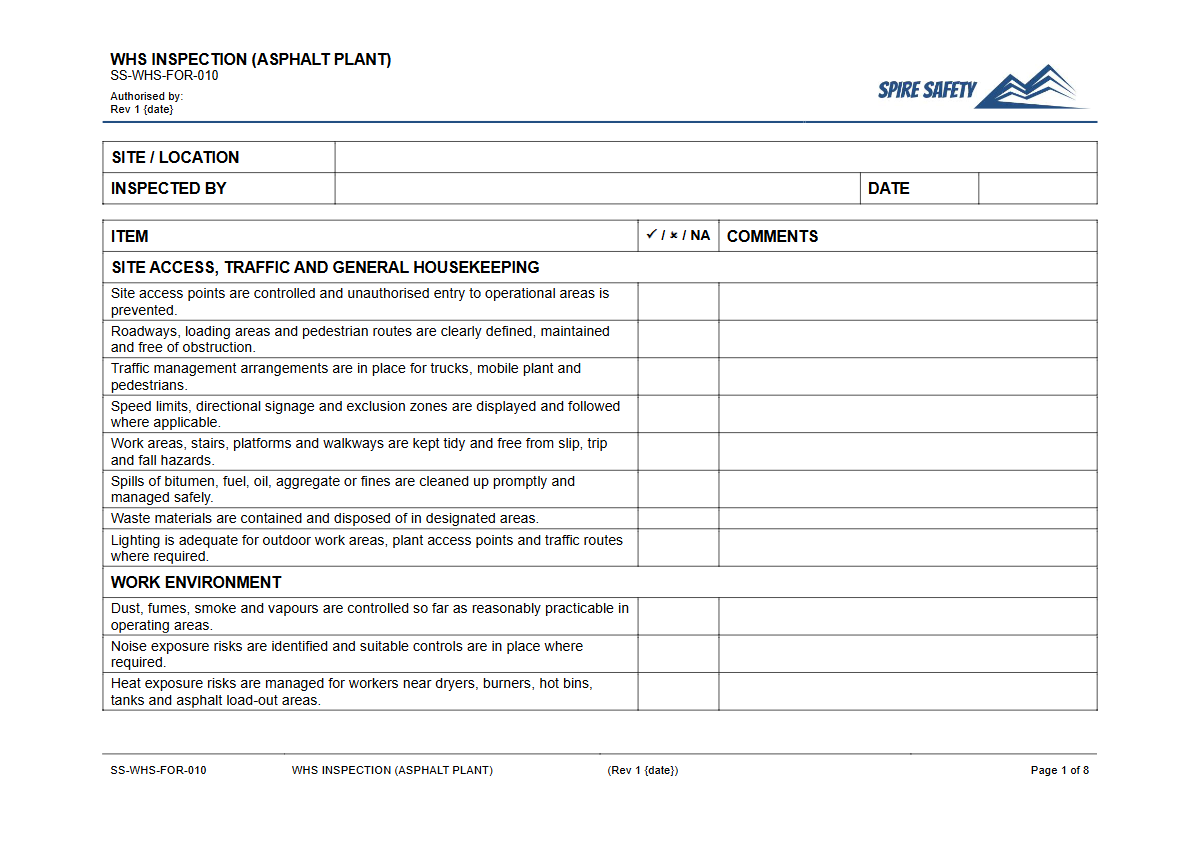
Download our free WHS Inspection (Asphalt Plant) Template to streamline your safety checks.
Free WHS Inspection (Asphalt Plant) Template
DOCX • 129 KB + PDF
Updated Oct 2026
No signup required
Purpose of the Free WHS Inspection (Asphalt Plant) Template
Asphalt plants are complex, high-risk environments involving extreme temperatures, heavy machinery, mobile plant, and hazardous substances. A systematic approach to safety is essential.
Our Free WHS Inspection (Asphalt Plant) Template provides a structured starting point for organisations to formalise their inspection processes, helping to proactively identify and control hazards before they cause harm. This document guides users through key checks, from mechanical integrity and emergency systems to traffic management and chemical handling.
Using this template helps a Person Conducting a Business or Undertaking (PCBU) demonstrate due diligence in managing workplace risks. It encourages a consistent inspection methodology, ensuring that critical safety components are not overlooked.
Regular, documented inspections are a cornerstone of effective safety management, providing valuable records for safety meetings, audits, and continuous improvement. It also supports competency assessments, such as those covered in our Asphalt Paver Verification of Competency (VOC) Template.
Video walkthrough
How to use the Free WHS Inspection (Asphalt Plant) Template
This template is provided in both DOCX and PDF formats for your convenience. The DOCX file is fully editable, allowing you to tailor the checklist to the specific configuration and risks of your asphalt plant.
To get started, download the document and review its sections against your site’s layout, machinery, and operational procedures.
It is vital to remember that this template is a starting point. We have developed it to be customised to your specific site, machinery, local regulations, and organisational procedures. Add, remove, or modify checklist items to ensure the inspection is relevant and comprehensive for your unique context.
For example, your site may have specific protocols for managing hydrocarbons that could be informed by a Spill Prevention and Response Toolbox Talk. Once customised, the inspection should be integrated into your broader safety framework.
Completed inspections should be signed, dated, and filed securely. Any identified defects, hazards, or required actions must be documented and tracked through to completion using your organisation's corrective action or maintenance system.
Integrating this process is a key function of robust WHS management systems, ensuring that identified issues are resolved in a timely manner.
When to use it
The frequency of asphalt plant inspections should be determined by a risk assessment, considering the manufacturer’s recommendations, the age and condition of the plant, the intensity of use, and regulatory requirements. Generally, a combination of checks is recommended:
- Routine Inspections: Conducted at regular intervals, such as weekly or monthly, to perform a thorough check of the entire plant. This template is ideal for these periodic, in-depth reviews.
- Pre-start Checks: While more concise, elements from this inspection can inform daily pre-operational checks carried out by operators.
- Post-Maintenance: Use the checklist to verify that maintenance work has been completed safely and that all guards and safety systems have been reinstated correctly.
- After an Incident: A detailed inspection should form part of any investigation following an incident or significant near miss to identify potential plant-related contributing factors.
The documented outputs are also critical inputs for periodic WHS compliance auditing to verify that processes are being followed and are effective.
Who should use it
This inspection template is designed for use by competent personnel with the knowledge and authority to assess plant safety. This may include:
- Site Supervisors or Managers: Responsible for overseeing day-to-day safety and ensuring inspections are completed.
- WHS Advisors or Officers: Tasked with monitoring compliance and providing safety expertise.
- Maintenance Supervisors or Leading Hands: Who possess a deep technical understanding of the plant’s mechanical and electrical systems.
- Experienced Plant Operators: Who can provide valuable insight into the practical operation and condition of the equipment.
The inspection process often involves collaboration between these roles. It also helps manage risks from adjacent operations, such as those covered in a Skidsteer Bobcat Risk Assessment Template, ensuring a holistic view of site safety. For more ways to formalise your WHS processes, explore our full free WHS resources library.
Common mistakes
Common mistakes to avoid
- Treating the inspection as a "tick-and-flick" exercise without genuine observation.
- Failing to document and follow up on corrective actions for identified defects.
- Not updating the checklist after plant modifications, incidents, or changes in procedure.
- Performing the inspection from ground level only, missing issues on elevated platforms or structures.
Legal references
Legal considerations
The following legal requirements may be relevant to this type of work.
- Work Health and Safety Act (Harmonised) — Provides the primary duties for protecting workers and other people from work health and safety risks.
- Work Health and Safety Regulations (Harmonised) — Sets out requirements supporting the management of workplace hazards and risks.
The following codes may be relevant to this type of work.
- Managing WHS Risks Code of Practice — Provides practical guidance on identifying hazards, assessing risks and applying effective controls.
- Work Health and Safety Consultation, Cooperation and Coordination Code of Practice — Provides practical guidance on consulting workers and coordinating with other duty holders.
- Managing the Work Environment and Facilities Code of Practice — Provides practical guidance on safe work environments, workplace facilities and related controls.
Did you know
Bitumen Fumes
The fumes released from hot asphalt contain polycyclic aromatic hydrocarbons (PAHs). Safe Work Australia sets workplace exposure standards for these substances to minimise health risks for workers.
Thermal Burns
Liquid asphalt is typically handled at temperatures between 150°C and 190°C. Contact at these temperatures causes immediate, severe burns, making splash guards and appropriate PPE critical safety controls.
FAQ
Frequently asked questions
01What are the most significant hazards at an asphalt plant?
02How often should an asphalt plant be inspected for safety?
03Is this WHS inspection template WHS-aligned?
04What is the difference between a plant inspection and a pre-start check?
Share this resource
Free WHS Inspection (Asphalt Plant) Template
Browse Categories
How To Use It
- 1Download and open in Word or PDF.
- 2Replace the placeholders with your business details.
- 3Get it reviewed by a WHS specialist before rollout.
Need it customised?
Our WHS consultants can adapt this template to your site, run a gap analysis, or audit what you already have in place.
Book a Free Consultation WHS consulting servicesor call 1300 156 382