
Free WHS Inspection (Bakery) Template
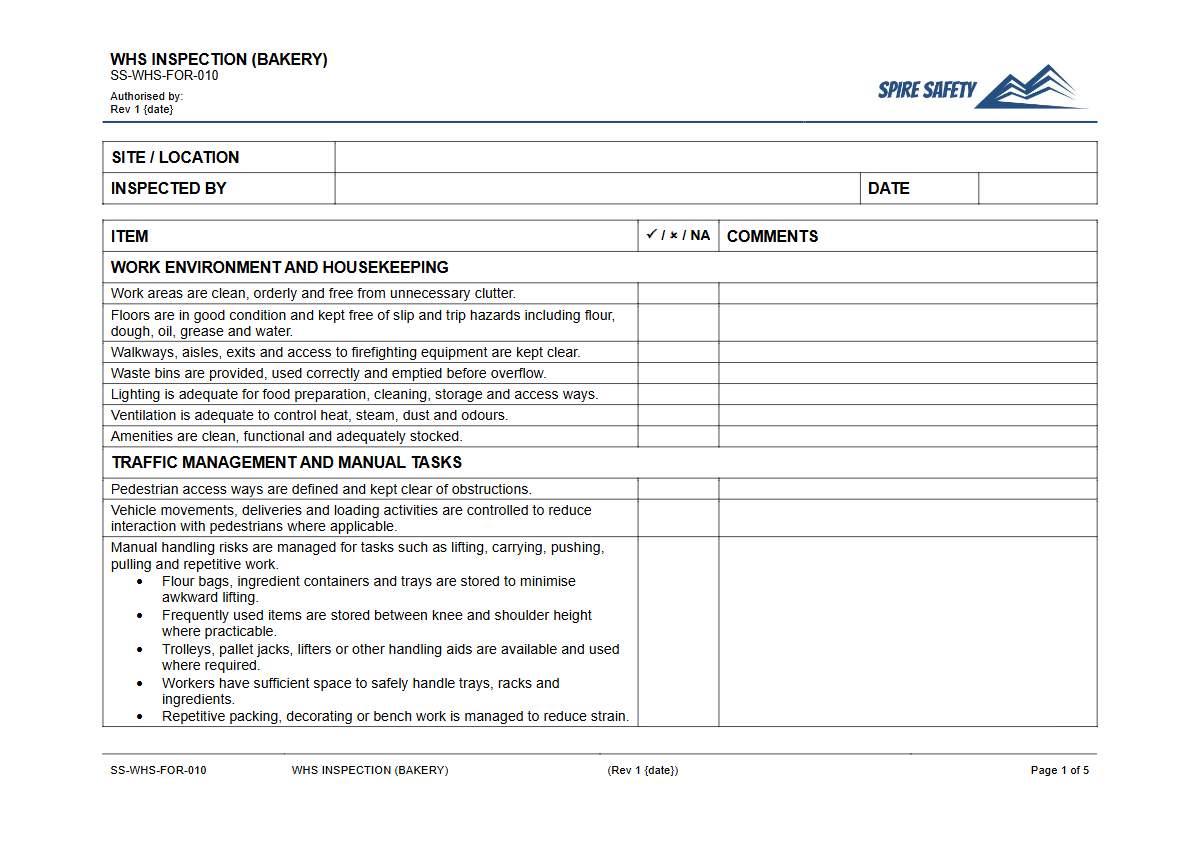
Download our Free WHS Inspection (Bakery) Template to formalise safety checks in your food production environment. A structured DOCX & PDF starting point.
Free WHS Inspection (Bakery) Template
DOCX • 127 KB + PDF
Updated Oct 2026
No signup required
Purpose of the Free WHS Inspection (Bakery) Template
A bakery presents a unique combination of workplace hazards, from hot surfaces and sharp equipment to manual handling and slip-prone floors. Our Free WHS Inspection (Bakery) Template provides a structured starting point for systematically identifying, assessing, and controlling these risks.
Regular, documented inspections are a cornerstone of proactive safety management, helping your business meet its duty of care under Australian WHS legislation.
Using a formal template helps ensure consistency and thoroughness in your safety walks. It prompts you to look beyond the obvious issues and consider all aspects of the work environment, from machinery guarding to staff training and emergency procedures.
This process is a key component of effective WHS management systems, creating a formal record of your risk management activities and demonstrating due diligence.
Video walkthrough
How to use the Free WHS Inspection (Bakery) Template
This template is designed for ease of use. First, download the document in your preferred format (DOCX or PDF).
The DOCX version is fully editable, allowing you to tailor the checklist to the specific layout, equipment, and processes of your bakery. This customisation is crucial for the template's effectiveness.
Once customised, the inspection can be conducted by a supervisor, manager, or Health and Safety Representative (HSR). Walk through the premises, systematically checking each item on the list.
For each point, note whether it is compliant, non-compliant, or not applicable. Any identified issues should be documented with details and assigned a corrective action, including a person responsible and a due date.
This creates a clear action plan for hazard resolution.
It is critical that this document is customised to your specific workplace. We are not familiar with your unique operations, equipment, or environment. You must adapt the template by adding, removing, or modifying checklist items to ensure it accurately reflects the hazards present in your bakery.
For specific equipment, a more detailed check like our Free Pre-Start Checklist (Dough Mixer) Template may be used in conjunction with this broader workplace inspection.
Common Bakery Hazards to Inspect
Your inspection should cover a wide range of potential hazards. Use the following categories as a guide when customising your checklist:
- Slips, Trips, and Falls: Check for flour dust accumulation, water or oil spills, uneven flooring, and obstructions in walkways. Ensure appropriate non-slip flooring is in place and good housekeeping is maintained.
- Manual Handling: Observe how workers lift and move heavy items like flour sacks, mixing bowls, and trays of baked goods. Assess for risks of musculoskeletal injury and the availability of mechanical aids like trolleys or lifters.
- Plant and Equipment: Inspect machinery such as mixers, slicers, rounders, and ovens. Verify that all machine guarding is in place and effective, emergency stops are functional and accessible, and lockout/tagout procedures are followed during cleaning and maintenance. A specific check like our Free Pre-Start Checklist (Bread Proofer) Template can supplement this process for key equipment.
- Burns and Heat: Assess risks from hot surfaces like ovens, trays, and proofers. Check the condition and use of personal protective equipment (PPE) such as heat-resistant gloves. Evaluate controls for managing heat stress in the work environment.
- Hygiene and Contamination: While distinct from WHS, poor hygiene can create safety risks (e.g., pests, slippery floors from food waste). Inspect cleaning schedules, waste disposal systems, and handwashing facilities. For temperature-controlled storage, a Free Pre-Start Checklist (Freezer) Template can ensure equipment is functioning safely.
- Hazardous Substances: Identify all chemicals used (e.g., cleaning agents) and ensure Safety Data Sheets (SDS) are available. Check for correct labelling, storage, and provision of required PPE. Also, consider airborne contaminants like flour dust and the effectiveness of ventilation systems.
When to use it
The frequency of workplace inspections depends on the level of risk. A comprehensive bakery inspection should be conducted regularly, such as monthly or quarterly.
It's also wise to perform an inspection whenever there is a significant change in the workplace, such as the introduction of new equipment, a change in layout, or after an incident or near-miss occurs.
These scheduled inspections supplement, rather than replace, other safety activities like daily pre-start checks on equipment and informal safety observations. For a more in-depth, third-party review of your safety processes, you might consider a formal WHS compliance auditing service.
Who should use it
This inspection template can be used by various personnel within a bakery operation. Typically, it is completed by a shift supervisor, bakery manager, or business owner (PCBU).
To foster a strong safety culture, it is highly recommended to involve workers and their Health and Safety Representatives (HSRs) in the inspection process. Their firsthand experience with the tasks and equipment provides invaluable insight into potential hazards and the practicality of existing controls.
For businesses needing expert guidance on establishing robust inspection programs or managing complex risks, engaging external WHS consulting can provide tailored advice and support. You can find this and many other helpful documents in our free WHS resources library, all designed to assist Australian businesses in managing workplace safety.
Common mistakes
Common mistakes to avoid
- Failing to customise the template for the bakery's specific equipment and layout.
- Conducting the inspection as a paperwork exercise without creating and tracking corrective actions.
- Not involving workers who perform the day-to-day tasks in the inspection process.
- Overlooking less obvious hazards like ergonomic strain, noise levels, or heat stress.
Legal references
Legal considerations
The following legal requirements may be relevant to this type of work.
- Work Health and Safety Act (Harmonised) — Provides the primary duties for protecting workers and other people from work health and safety risks.
- Work Health and Safety Regulations (Harmonised) — Sets out requirements supporting the management of workplace hazards and risks.
The following codes may be relevant to this type of work.
- Managing WHS Risks Code of Practice — Provides practical guidance on identifying hazards, assessing risks and applying effective controls.
- Work Health and Safety Consultation, Cooperation and Coordination Code of Practice — Provides practical guidance on consulting workers and coordinating with other duty holders.
- Managing the Work Environment and Facilities Code of Practice — Provides practical guidance on safe work environments, workplace facilities and related controls.
Did you know
Baker's Asthma
Occupational asthma from exposure to flour dust is one of the most common work-related respiratory diseases globally. It highlights the importance of effective ventilation and respiratory protective equipment in bakeries.
Slip Hazards
According to Safe Work Australia, slips, trips, and falls are a leading cause of serious injury claims in the food and beverage services industry. Common culprits in a bakery include flour dust, water, and oil on floors.
FAQ
Frequently asked questions
01What's the difference between a pre-start check and a workplace inspection?
02How often should I conduct a bakery safety inspection?
03Is this bakery inspection template compliant with Australian WHS law?
04Can flour dust be a serious hazard in a bakery?
Share this resource
Free WHS Inspection (Bakery) Template
Browse Categories
How To Use It
- 1Download and open in Word or PDF.
- 2Replace the placeholders with your business details.
- 3Get it reviewed by a WHS specialist before rollout.
Need it customised?
Our WHS consultants can adapt this template to your site, run a gap analysis, or audit what you already have in place.
Book a Free Consultation WHS consulting servicesor call 1300 156 382