
Free WHS Inspection (Bottling Plant) Template
Download our free WHS Inspection (Bottling Plant) Template. A structured DOCX & PDF checklist to help you identify hazards and control risks in your facility.
Free WHS Inspection (Bottling Plant) Template
DOCX • 129 KB + PDF
Updated Oct 2026
No signup required
Purpose of the Free WHS Inspection (Bottling Plant) Template
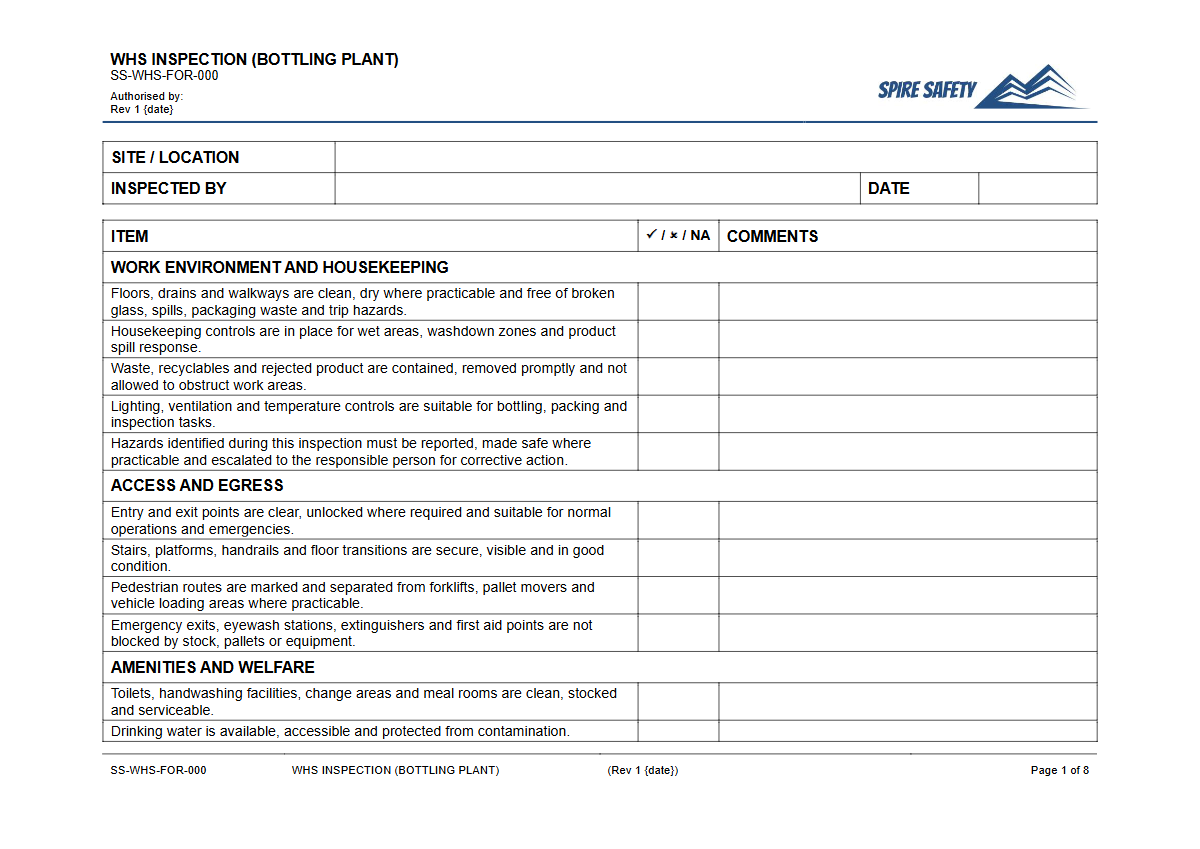
This Free WHS Inspection (Bottling Plant) Template provides a structured starting point for systematically identifying and managing health and safety risks in your bottling facility. Regular inspections are a fundamental part of a proactive safety culture, helping your organisation prevent incidents before they occur.
The checklist guides you through key areas specific to bottling operations, from conveyor systems and filling machines to chemical storage and traffic management, ensuring a thorough review process.
Using a standardised template helps maintain consistency across inspections, creates a formal record of safety activities, and demonstrates due diligence. It prompts a focus on critical hazards like machinery guarding, slip and trip risks on wet floors, and ergonomic strains from manual handling.
The document is designed as a practical tool, aligned with Australian WHS principles, to support your ongoing safety efforts.
Video walkthrough
How to use the Free WHS Inspection (Bottling Plant) Template
Our Free WHS Inspection (Bottling Plant) Template is provided in both DOCX and PDF formats for your convenience. The DOCX file is fully editable, allowing you to tailor the checklist to the unique layout, equipment, and processes of your specific facility.
It is crucial to customise this document to ensure it is relevant and effective for your workplace.
Note: We have created this template as a guide based on common industry practice. You must adapt it to fit the specific hazards and operational realities of your site.
This may involve adding sections for specialised machinery, updating chemical listings, or modifying items to align with your internal safety procedures and the findings of your formal risk assessments.
When conducting the inspection, walk through the entire bottling area. Systematically check each item on the list, marking it as compliant, non-compliant, or not applicable.
For any non-compliant findings, record detailed notes about the issue, its location, and the immediate risk level. This information is vital for developing and prioritising corrective actions.
When to use it
Formal workplace inspections should be conducted at regular, planned intervals. The frequency depends on the level of risk associated with different areas and activities in your bottling plant.
For example, high-traffic zones or areas with high-risk machinery might warrant weekly checks, while a comprehensive, facility-wide inspection could be scheduled monthly or quarterly. The schedule should be part of your overarching WHS management system.
This template is also valuable for ad-hoc inspections. Use it after an incident or near-miss to investigate contributing factors, when new plant or equipment is introduced, or when processes are changed.
It can also be used as a verification tool to ensure that corrective actions from previous inspections have been effectively implemented. Effective management of spills is also crucial; consider holding regular safety discussions using a spill prevention and response toolbox talk to reinforce procedures.
Who should use it
This template is designed for use by anyone responsible for workplace health and safety. This includes WHS Managers, Safety Officers, Supervisors, and members of the Health and Safety Committee (HSC).
To foster a strong safety culture, it is highly beneficial to involve workers who operate the equipment and work in the inspected areas. Their firsthand knowledge is invaluable for identifying subtle or task-specific hazards that a manager might overlook.
Management representatives can also use the completed reports to gain insight into the state of safety performance on the plant floor. The documented findings provide objective data for safety meetings and management reviews. For organisations seeking a higher level of assurance, the data gathered can serve as essential input for periodic WHS compliance audits.
Many bottling facilities have large cold storage areas. For specific equipment within these zones, it is good practice to use targeted checklists, such as a freezer pre-start checklist for daily safety verification.
Similarly, if your process involves mixing ingredients before bottling, a dedicated pre-start checklist for blenders helps manage machinery-specific risks.
This template, along with hundreds of others, can be found in our free WHS resources library, providing a wealth of tools to support your safety management goals.
Common mistakes
Common mistakes to avoid
- Overlooking less obvious hazards like ergonomic risks from repetitive tasks or psychosocial stress.
- Failing to review and update the inspection checklist after new equipment is installed or processes change.
- Simply ticking boxes without thoroughly investigating the 'why' behind a potential hazard.
- Neglecting to assign and track corrective actions for issues identified during the inspection.
Legal references
Legal considerations
The following legal requirements may be relevant to this type of work.
- Work Health and Safety Act (Harmonised) — Provides the primary duties for protecting workers and other people from work health and safety risks.
- Work Health and Safety Regulations (Harmonised) — Sets out requirements supporting the management of workplace hazards and risks.
The following codes may be relevant to this type of work.
- Managing WHS Risks Code of Practice — Provides practical guidance on identifying hazards, assessing risks and applying effective controls.
- Work Health and Safety Consultation, Cooperation and Coordination Code of Practice — Provides practical guidance on consulting workers and coordinating with other duty holders.
- Managing the Work Environment and Facilities Code of Practice — Provides practical guidance on safe work environments, workplace facilities and related controls.
Did you know
Noise-Induced Hearing Loss
The bottling process can generate noise levels exceeding 85 decibels (dB), the exposure standard for noise in Australia. Prolonged exposure without hearing protection can cause permanent hearing damage.
Conveyor Dangers
Conveyor belts are a leading source of serious injuries in manufacturing, often due to entanglement at nip points or impact from falling items. Proper guarding is a critical control measure.
FAQ
Frequently asked questions
01What are the key hazards in a bottling plant?
02How often should bottling plant WHS inspections be conducted?
03Is this bottling plant inspection template enough for WHS compliance?
04Who is responsible for conducting a bottling plant inspection?
Share this resource
Free WHS Inspection (Bottling Plant) Template
Browse Categories
How To Use It
- 1Download and open in Word or PDF.
- 2Replace the placeholders with your business details.
- 3Get it reviewed by a WHS specialist before rollout.
Need it customised?
Our WHS consultants can adapt this template to your site, run a gap analysis, or audit what you already have in place.
Book a Free Consultation WHS consulting servicesor call 1300 156 382