
Free WHS Inspection (Battery Facility) Template
Manage electrical, chemical, and fire risks in battery storage areas with our Free WHS Inspection (Battery Facility) Template. Download your DOCX & PDF.
Free WHS Inspection (Battery Facility) Template
DOCX • 128 KB + PDF
Updated Oct 2026
No signup required
Purpose of the Free WHS Inspection (Battery Facility) Template
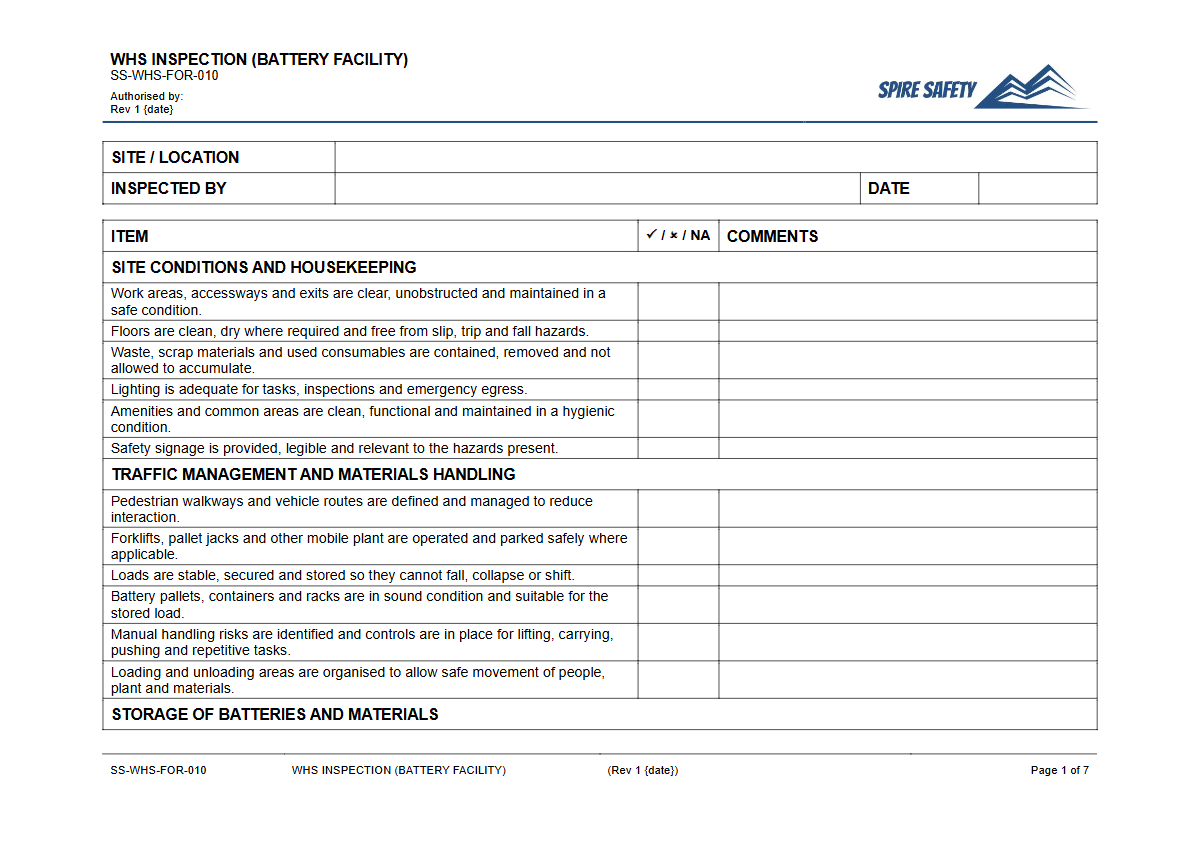
This Free WHS Inspection (Battery Facility) Template provides a structured starting point for conducting regular safety checks in areas where batteries are stored, charged, or maintained. Battery facilities present a unique combination of hazards, including electrical risks, exposure to hazardous chemicals like sulfuric acid, fire from thermal runaway (especially with lithium-ion types), and ergonomic strains from manual handling of heavy units.
Using a formal inspection checklist helps a Person Conducting a Business or Undertaking (PCBU) to systematically identify, assess, and control these risks, contributing to the fulfillment of their primary duty of care under WHS legislation.
Implementing a routine inspection schedule is a practical way to ensure safety controls remain effective and that new hazards are identified promptly. This proactive approach is a cornerstone of a strong safety culture and a key component of an organisation's overall WHS management system. This template helps formalise that process, providing a clear record of safety status, identified issues, and required corrective actions over time.
Video walkthrough
How to use the Free WHS Inspection (Battery Facility) Template
Using this template effectively involves a few key steps. First, download the document in your preferred format (DOCX or PDF).
The DOCX version is fully editable, allowing for extensive customisation to suit your specific operational needs. Once downloaded, you must adapt the checklist to cover the particular battery types (e.g., lead-acid, lithium-ion, NiCad), charging equipment, and storage configurations present in your facility.
Add or remove checklist items to ensure all relevant hazards are addressed, and incorporate any site-specific procedures or requirements.
It is crucial to remember that this document is a template, not a finished safety document. We have designed it as a comprehensive starting point, but you MUST customise it to reflect the specific equipment, layouts, and risks unique to your workplace.
Once customised, train relevant personnel on how to complete the inspection correctly and what to do if they identify a hazard. For businesses that require assistance in adapting the template or conducting the initial risk assessment, our WHS consulting services can provide tailored expert support.
What does this Inspection Template include?
This template is organised into logical sections to guide a thorough inspection. It prompts the user to check and record the status of:
- General facility conditions (e.g., housekeeping, lighting, clear access and egress).
- Ventilation and environmental controls to manage fumes and temperature.
- The condition of charging equipment, including cables, connectors, and power supplies.
- The physical state of batteries (checking for leaks, swelling, corrosion, or damage).
- Emergency preparedness equipment, such as spill kits, fire extinguishers, and eyewash stations.
- Availability and condition of required Personal Protective Equipment (PPE).
- Correct safety signage and labelling.
- A corrective actions section to log and track the resolution of identified issues.
In many facilities, battery handling is just one part of a larger process that may involve other machinery. This inspection should be part of a holistic safety program that includes checks for all equipment, such as a separate electric hoist pre-start checklist if lifting devices are used to move heavy battery packs.
When to use it
The frequency of battery facility inspections should be determined by a risk assessment, considering factors like the types of batteries, the intensity of use, and the nature of the work environment. As a general guide, high-traffic battery charging stations may require daily checks, while a broader facility inspection might be conducted weekly or fortnightly.
A more detailed and comprehensive inspection should be scheduled on a monthly or quarterly basis.
This inspection should also be performed following any incident, such as a chemical spill, fire, or equipment malfunction, to ensure the area is safe before work resumes and to identify any contributing factors. Regularly reviewing the effectiveness of your inspection schedule and findings is also best practice, which can be validated through a formal WHS compliance auditing program.
Who should use it
This template is designed for use by individuals with responsibility for workplace safety and operational management. This includes WHS Managers, Safety Officers, Facility Managers, and department Supervisors.
Competent workers or Health and Safety Representatives (HSRs) who have received appropriate training on battery-related hazards can also be tasked with conducting the inspections. The key requirement is that the inspector understands the risks involved and knows what to look for, from the signs of a failing battery to the correct state of emergency equipment.
Site security and access control are also integral to facility safety, preventing unauthorised personnel from entering potentially hazardous areas. This general inspection can be complemented by more specific checks, such as using a boom gate pre-start checklist to ensure controlled site entry points are functioning correctly.
Systematic safety inspections are a fundamental part of managing WHS risks effectively. This template serves as a robust tool to support your safety processes for battery facilities. For more documents to support your safety management system, browse our complete free WHS resources library.
Common mistakes
Common mistakes to avoid
- Using a generic checklist without customising it for the specific battery types and equipment on site.
- Failing to ensure adequate ventilation in charging areas, allowing for the accumulation of flammable hydrogen gas (with lead-acid batteries).
- Ignoring early warning signs like battery swelling, leaking, or overheating, which can precede a major failure.
- Not training employees on emergency procedures for chemical spills, fires, or electrical incidents.
Legal references
Legal considerations
The following legal requirements may be relevant to this type of work.
- Work Health and Safety Act (Harmonised) — Provides the primary duties for protecting workers and other people from work health and safety risks.
- Work Health and Safety Regulations (Harmonised) — Sets out requirements supporting the management of workplace hazards and risks.
The following codes may be relevant to this type of work.
- Managing WHS Risks Code of Practice — Provides practical guidance on identifying hazards, assessing risks and applying effective controls.
- Work Health and Safety Consultation, Cooperation and Coordination Code of Practice — Provides practical guidance on consulting workers and coordinating with other duty holders.
- Managing the Work Environment and Facilities Code of Practice — Provides practical guidance on safe work environments, workplace facilities and related controls.
Did you know
Thermal Runaway
A damaged or overcharged lithium-ion battery can enter 'thermal runaway', a chain reaction where the internal temperature rises uncontrollably, often leading to a fire that is extremely difficult to extinguish.
Battery Weight
A single forklift battery can weigh over 1,800 kilograms. Improper handling is a major cause of serious musculoskeletal and crushing injuries in workplaces.
FAQ
Frequently asked questions
01What are the main WHS hazards in a battery facility?
02How often should battery charging stations be inspected?
03What PPE is required when working with batteries?
04Can this template be used for both lead-acid and lithium-ion batteries?
Share this resource
Free WHS Inspection (Battery Facility) Template
Browse Categories
How To Use It
- 1Download and open in Word or PDF.
- 2Replace the placeholders with your business details.
- 3Get it reviewed by a WHS specialist before rollout.
Need it customised?
Our WHS consultants can adapt this template to your site, run a gap analysis, or audit what you already have in place.
Book a Free Consultation WHS consulting servicesor call 1300 156 382