
Free WHS Inspection (Beverage Plant) Template
Download our free WHS Inspection (Beverage Plant) Template to identify hazards and manage risks. This structured DOCX & PDF helps streamline your safety audits.
Free WHS Inspection (Beverage Plant) Template
DOCX • 129 KB + PDF
Updated Oct 2026
No signup required
Purpose of the Free WHS Inspection (Beverage Plant) Template
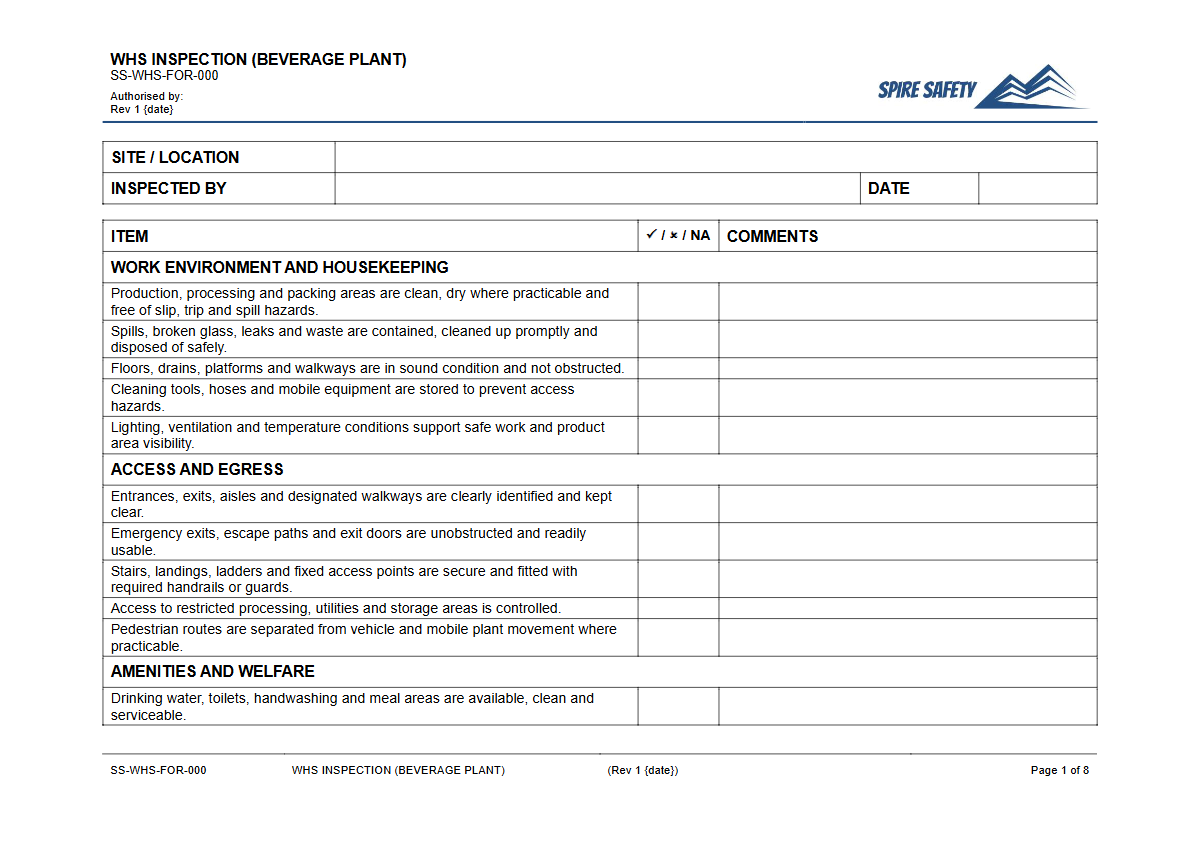
Beverage production facilities present a unique combination of WHS hazards, from wet and slippery floors to complex machinery and chemical handling. This Free WHS Inspection (Beverage Plant) Template provides a structured starting point for systematically identifying, assessing, and controlling these risks.
Regular inspections are fundamental to proactive safety management, helping your organisation prevent incidents, meet its duty of care, and maintain a safe working environment. Using a dedicated template ensures that key risk areas—such as bottling lines, storage, manual tasks, and chemical safety—are consistently reviewed.
The template is designed to guide you through a thorough walkthrough of your plant. It prompts checks on everything from the condition of equipment guards to the accessibility of emergency exits and the management of spills.
Formalising this process helps create a documented record of your safety efforts, which is vital for demonstrating due diligence. For targeted training on spills, our Spill Prevention and Response Toolbox Talk Template is an excellent complementary resource.
Video walkthrough
How to use the Free WHS Inspection (Beverage Plant) Template
To get started, simply download the template in your preferred format (DOCX or PDF). The DOCX file is fully editable, allowing you to tailor the checklist to the specific layout, equipment, and processes of your beverage plant.
Important Note: This document is a template, not a finished safety document. You must customise it to reflect the specific hazards and operational context of your workplace.
We cannot provide a document that is universally compliant because we don't know your specific machinery, chemicals, processes, or environment. Your final inspection checklist should be developed in consultation with workers and other relevant stakeholders.
Key Areas Covered in the Inspection
A comprehensive beverage plant inspection should cover multiple operational zones and hazard types. Our template is organised to address these distinct areas, providing a logical flow for your walkthrough. Key sections include:
- General Work Environment: Assesses housekeeping, lighting, ventilation, and the condition of floors, walkways, and stairs to mitigate slip and trip hazards.
- Plant and Equipment: Covers the safety of production machinery like fillers, labellers, conveyors, pasteurisers, and packaging equipment. This includes checks for machine guarding, emergency stops, and proper lockout/tagout procedures. For specific equipment, a dedicated pre-start is often necessary, such as our Free Pre-Start Checklist (Blender) Template.
- Hazardous Chemicals: Focuses on the storage, handling, labelling, and disposal of cleaning agents, sanitisers, and other chemicals. It prompts checks for Safety Data Sheets (SDS), appropriate personal protective equipment (PPE), and spill response kits.
- Manual Tasks and Ergonomics: Addresses risks associated with lifting, carrying, and repetitive tasks, such as stacking cartons, moving kegs, or working on the production line.
- Storage and Warehousing: Includes checks for pallet racking integrity, safe operation of forklifts, and management of cool rooms and freezers. You can supplement this with our Free Pre-Start Checklist (Freezer) Template for refrigerated areas.
- Emergency Preparedness: Verifies the accessibility and functionality of fire extinguishers, first aid kits, emergency exits, and eyewash stations.
Maintenance tasks in a plant often require working at height. To manage these specific risks, consider using a dedicated Elevated Work Platform Risk Assessment Template.
When to Conduct a Beverage Plant Inspection
The frequency of inspections depends on the level of risk and any specific legislative requirements. A good practice is to establish a regular schedule, such as monthly or quarterly general inspections, supplemented by other checks as needed. Inspections should be conducted:
- At regular, planned intervals as part of your safety calendar.
- After an incident, accident, or near miss to identify contributing factors.
- When new machinery or production lines are introduced.
- When processes or chemicals are changed.
- Following concerns raised by workers or Health and Safety Representatives (HSRs).
For organisations seeking an independent evaluation of their safety processes, Spire Safety offers professional WHS compliance auditing services to provide an external perspective.
Who Should Be Involved in the Inspection
Effective inspections are a consultative process. While a supervisor or safety manager may lead the inspection, involving a range of personnel ensures a more comprehensive and accurate assessment. The inspection team should ideally include:
- Supervisors or Managers: To oversee the process and authorise corrective actions.
- Workers: Operators and floor staff who have hands-on experience with the equipment and processes can identify hazards that others might miss.
- Health and Safety Representatives (HSRs): As elected representatives, HSRs play a crucial role in representing the safety concerns of their work group.
- Maintenance Personnel: To provide technical insight into the condition of plant and equipment.
Involving a diverse team fosters a positive safety culture and is a key component of effective WHS management systems.
Common mistakes
Common mistakes to avoid
- Failing to customise the template for the specific equipment and processes of your plant.
- Not following up on identified hazards to ensure corrective actions are implemented and effective.
- Conducting the inspection without involving workers who operate the equipment daily.
- Treating the inspection as a 'tick-and-flick' exercise rather than a genuine opportunity to identify risks.
Legal references
Legal considerations
The following legal requirements may be relevant to this type of work.
- Work Health and Safety Act (Harmonised) — Provides the primary duties for protecting workers and other people from work health and safety risks.
- Work Health and Safety Regulations (Harmonised) — Sets out requirements supporting the management of workplace hazards and risks.
The following codes may be relevant to this type of work.
- Managing WHS Risks Code of Practice — Provides practical guidance on identifying hazards, assessing risks and applying effective controls.
- Work Health and Safety Consultation, Cooperation and Coordination Code of Practice — Provides practical guidance on consulting workers and coordinating with other duty holders.
- Managing the Work Environment and Facilities Code of Practice — Provides practical guidance on safe work environments, workplace facilities and related controls.
Did you know
Slips, Trips, and Falls
According to Safe Work Australia, slips, trips, and falls are a leading cause of serious injury in the manufacturing industry, with wet and greasy surfaces being a major contributing factor in food and beverage production.
Manual Handling Risks
Body stressing, or manual handling injuries, consistently account for the largest proportion of serious workers' compensation claims across all industries in Australia.
FAQ
Frequently asked questions
01What is the difference between a pre-start check and a full plant inspection?
02How often should a beverage plant be formally inspected for WHS?
03What are the most common hazards in a beverage manufacturing facility?
04Can this template be used for a small-scale microbrewery?
Share this resource
Free WHS Inspection (Beverage Plant) Template
Browse Categories
How To Use It
- 1Download and open in Word or PDF.
- 2Replace the placeholders with your business details.
- 3Get it reviewed by a WHS specialist before rollout.
Need it customised?
Our WHS consultants can adapt this template to your site, run a gap analysis, or audit what you already have in place.
Book a Free Consultation WHS consulting servicesor call 1300 156 382