
Free WHS Inspection (Boat Yard) Template
Download our Free WHS Inspection (Boat Yard) Template to systematically identify and manage hazards in your marine facility.
Free WHS Inspection (Boat Yard) Template
DOCX • 128 KB + PDF
Updated Oct 2026
No signup required
Purpose of the Free WHS Inspection (Boat Yard) Template
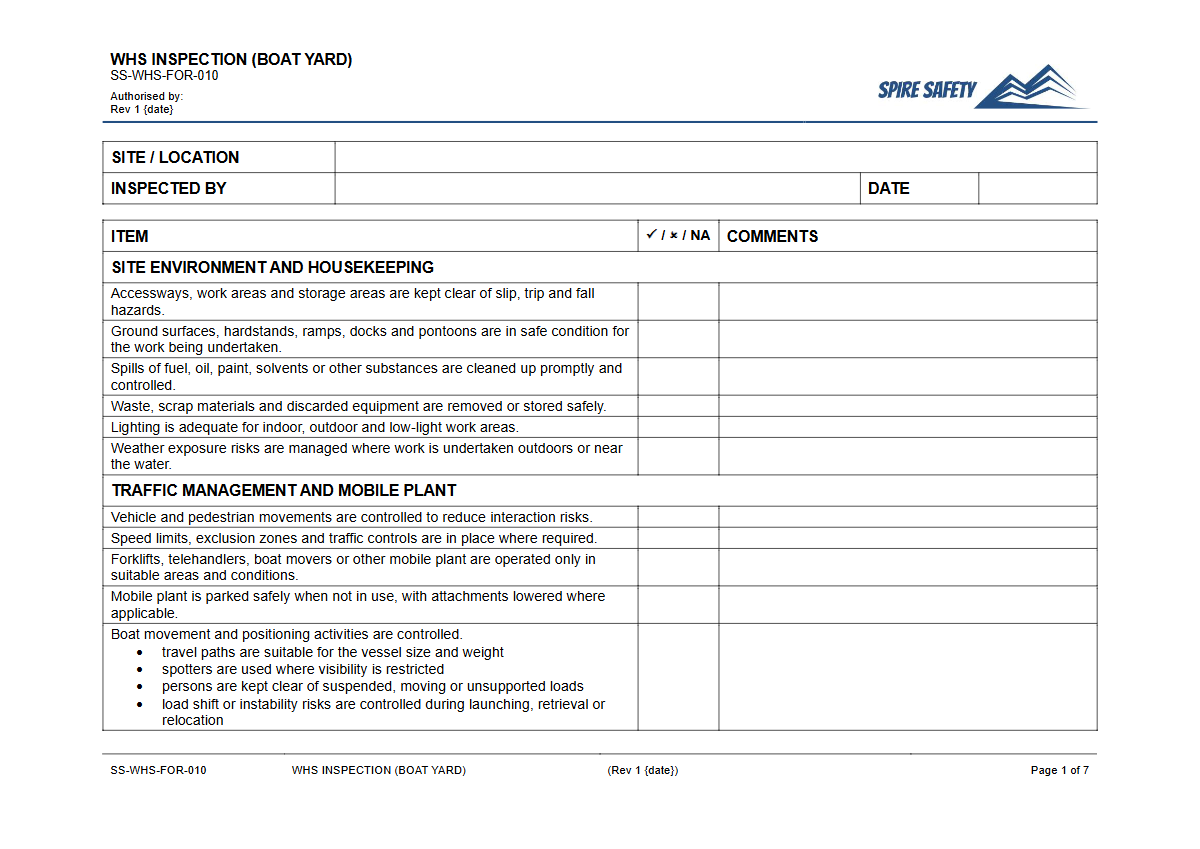
Boat yards and marine facilities present a unique combination of workplace hazards, from wet and slippery surfaces to hazardous chemicals, heavy machinery, and work at heights. This Free WHS Inspection (Boat Yard) Template provides a structured starting point for systematically reviewing your work environment, identifying risks, and documenting necessary corrective actions.
Regular inspections are a fundamental part of a proactive approach to safety, helping your organisation meet its duty of care and prevent incidents before they occur. Using a formal checklist helps ensure no area is overlooked and creates a consistent record of your safety diligence.
Video walkthrough
How to use the Free WHS Inspection (Boat Yard) Template
This template is available in both DOCX and PDF formats. The DOCX file is fully editable, allowing you to add, remove, or modify sections to reflect the specific layout, equipment, and procedures at your facility.
It is crucial to tailor the document to your operational context, as no two boat yards are identical.
Important Note: This document is a template only. It must be customised by a competent person to suit the specific risks and operational requirements of your workplace.
We make no claim that this document is suitable for your workplace as-is.
Once customised, the inspection should be carried out by a designated supervisor, manager, or WHS representative. Walk through the site, carefully checking each item on the list.
For any non-conformances or hazards identified, record the details and assign a corrective action with a clear deadline and responsible person. This process should complement, not replace, specific equipment checks, such as those detailed in our Free Pre-Start Checklist (Boat Lift) Template.
Key Areas Covered
The template is organised to cover common risk areas found in a typical boat yard environment, including:
- General Environment & Housekeeping: Assesses access, egress, lighting, and general tidiness.
- Slips, Trips & Falls: Checks walkways, pontoons, stairs, and work platforms for potential hazards.
- Hazardous Chemicals: Reviews the storage, handling, labelling, and documentation (SDS) for substances like fuels, solvents, resins, and antifouling paints.
- Plant & Equipment: Covers guarding, maintenance, and safe operation of machinery such as cranes, forklifts, and pressure washers.
- Electrical Safety: Inspects power leads, switchboards, and equipment for damage or misuse, especially in wet environments.
- Fire & Emergency: Confirms the accessibility and serviceability of fire extinguishers, alarms, and first aid kits.
- Vessel Storage & Work: Looks at the stability of cradles and stands, access to vessels, and fall prevention measures.
When to use it
The frequency of inspections should be determined by a risk assessment, but a good practice is to conduct a comprehensive site inspection on a regular schedule, such as monthly or quarterly. In addition, inspections should be performed after a significant change, such as the installation of new equipment, or following an incident or near miss.
This scheduled approach should be supported by daily pre-start checks for critical machinery; for example, using a specific tool like our Free Pre-Start Checklist (Electric Hoist) Template for lifting gear.
Who should use it
Workplace inspections should be conducted by personnel with the knowledge and competence to identify hazards specific to a boat yard environment. This typically includes site managers, supervisors, or dedicated WHS officers.
Involving workers in the inspection process can also provide valuable insights from those performing the tasks daily. The findings and corrective action plans should be reviewed by management to ensure accountability and provide necessary resources.
For an independent assessment of your safety processes, engaging external experts for WHS compliance auditing can validate your internal efforts and identify areas for improvement.
Regular inspections are a critical data source for improving your safety practices. The information gathered should feed directly into your overall risk management framework and be a key component of your WHS management systems, driving continuous improvement and demonstrating a commitment to workplace safety.
Effective traffic management is also essential for preventing collisions between vehicles, machinery, and pedestrians. This includes controlling site entry and exit points, which can be formalised using checklists like our Free Pre-Start Checklist (Boom Gate) Template to ensure access controls are functioning correctly.
This boat yard inspection template is just one of many tools designed to help you build a safer workplace. Explore our complete free WHS resources library for more templates, checklists, and guides to support your safety goals.
Common mistakes
Common mistakes to avoid
- Failing to customise the template to address the unique hazards of the specific boat yard.
- Completing the checklist as a paper exercise without physically verifying the items ('pencil-whipping').
- Neglecting to assign and track corrective actions for identified hazards, leaving risks uncontrolled.
- Assigning inspections to personnel who lack the training or experience to recognise specific marine industry hazards.
Legal references
Legal considerations
The following legal requirements may be relevant to this type of work.
- Work Health and Safety Act (Harmonised) — Provides the primary duties for protecting workers and other people from work health and safety risks.
- Work Health and Safety Regulations (Harmonised) — Sets out requirements supporting the management of workplace hazards and risks.
The following codes may be relevant to this type of work.
- Managing WHS Risks Code of Practice — Provides practical guidance on identifying hazards, assessing risks and applying effective controls.
- Work Health and Safety Consultation, Cooperation and Coordination Code of Practice — Provides practical guidance on consulting workers and coordinating with other duty holders.
- Managing the Work Environment and Facilities Code of Practice — Provides practical guidance on safe work environments, workplace facilities and related controls.
Did you know
A High-Risk Industry
The 'Transport, postal and warehousing' industry, which includes many maritime operations, consistently reports one of the highest rates of serious workers' compensation claims in Australia, according to Safe Work Australia data.
Antifouling Hazards
Antifouling paints contain biocides that are highly effective at preventing marine growth, but these same chemicals can be toxic to humans. Proper ventilation, respirators, and skin protection are critical when applying or removing these coatings.
FAQ
Frequently asked questions
01What are the most common hazards in a boat yard?
02How often should a boat yard WHS inspection be conducted?
03Is using this inspection template a legal requirement?
04Who is responsible for fixing issues found during an inspection?
Share this resource
Free WHS Inspection (Boat Yard) Template
Browse Categories
How To Use It
- 1Download and open in Word or PDF.
- 2Replace the placeholders with your business details.
- 3Get it reviewed by a WHS specialist before rollout.
Need it customised?
Our WHS consultants can adapt this template to your site, run a gap analysis, or audit what you already have in place.
Book a Free Consultation WHS consulting servicesor call 1300 156 382