
Free WHS Inspection (Boiler Room) Template
Download our free WHS Inspection (Boiler Room) Template to formalise safety checks for your plant. A structured starting point for Australian workplaces.
Free WHS Inspection (Boiler Room) Template
DOCX • 127 KB + PDF
Updated Oct 2026
No signup required
Purpose of the Free WHS Inspection (Boiler Room) Template
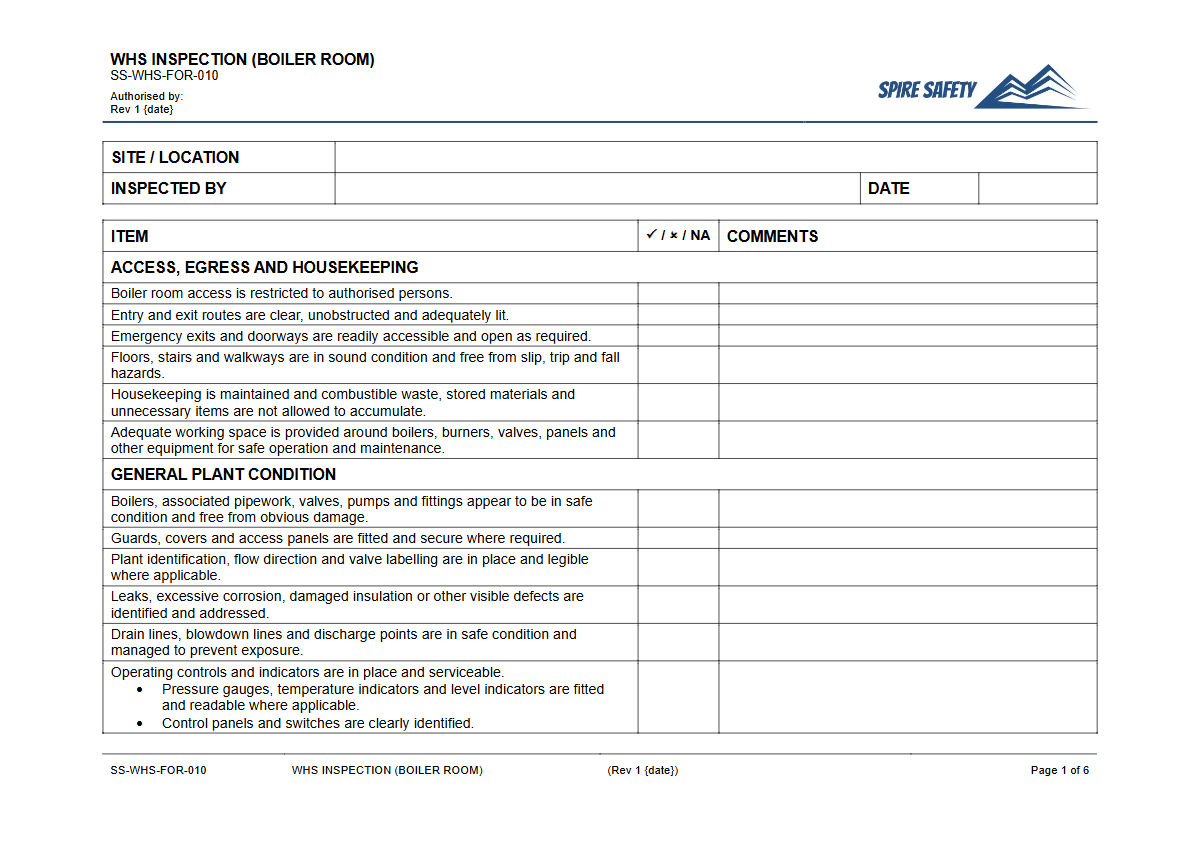
Boiler rooms house high-risk plant that demands rigorous and consistent safety checks. This free WHS Inspection (Boiler Room) Template provides a structured starting point for organisations to formalise their inspection process.
Using this template helps standardise the way your team checks critical components, identifies potential hazards, and documents the condition of the boiler and its surrounding environment. Regular, documented inspections are a fundamental part of managing the significant risks associated with pressure, heat, and fuel systems, forming a key record within your overall safety framework.
A systematic inspection process helps ensure that issues like leaks, pressure gauge inaccuracies, safety valve faults, ventilation blockages, and poor housekeeping are identified and addressed before they can lead to an incident. Integrating these checks is a practical step towards demonstrating due diligence and forms an essential part of effective WHS management systems, providing tangible evidence of proactive risk management.
Video walkthrough
How to use the Free WHS Inspection (Boiler Room) Template
This template is provided as a customisable DOCX file and a ready-to-print PDF. To use it effectively, download the document and adapt it to the specific requirements of your workplace and the particular make and model of your boiler.
Key steps include reviewing the checklist items, adding or removing checks relevant to your equipment, and specifying the acceptable limits or conditions for each point. For example, your boiler's manufacturer may specify a very narrow pressure range that should be included on the form.
Once customised, ensure all relevant personnel are trained on how to use the checklist properly. This includes understanding what each item means, what to look for, and the procedure for reporting any non-conformances or defects.
The process of inspecting high-risk plant must be taken seriously, similar to how an operator would use a pre-start checklist for an electric hoist to verify its safety before lifting a load. Completed inspections should be signed, dated, and filed according to your organisation's record-keeping procedures.
Please Note
This document is a template and not a complete, out-of-the-box solution. We cannot guarantee it covers every hazard or control measure applicable to your specific situation.
You must customise this document by consulting the manufacturer's instructions, relevant Australian Standards, codes of practice, and undertaking a site-specific risk assessment.
When to use this Inspection Template
The frequency of boiler room inspections depends on several factors, including the type of boiler, its age and condition, the intensity of use, and regulatory requirements. This template can be adapted for various inspection schedules, such as pre-start checks at the beginning of a shift, more detailed daily or weekly checks, and post-maintenance inspections to ensure the equipment is safe to return to service.
Establishing a consistent rhythm for these checks helps create a safety-first culture and ensures that potential issues are caught early. This approach of formalising routine checks is valuable across all types of fixed plant, much like the process for using our Free Pre-Start Checklist (Cool Room) Template for refrigerated spaces.
Who should use it
Boiler room inspections should only be conducted by a 'competent person'. This is someone who has the requisite training, knowledge, and experience to identify hazards associated with the equipment.
Depending on the complexity and risk level of the boiler (e.g., high-pressure vs. low-pressure), this may range from a trained operator for daily checks to a specially certified technician or engineer for more in-depth inspections.
Supervisors and managers should use the completed checklists to oversee operations, track corrective actions, and verify that the inspection process is being followed correctly. If your organisation lacks the internal expertise for managing high-risk plant, seeking external support through WHS consulting can provide the necessary guidance and assurance.
Ultimately, the inspection program's success is a shared responsibility, from the operator performing the check to the management team that resources and enforces the system. The records generated are also critical inputs for higher-level reviews and can be examined during a formal WHS compliance auditing process to verify the effectiveness of your safety protocols. For more templates and safety documents, you can browse our complete free WHS resources library.
Common mistakes
Common mistakes to avoid
- Using a generic checklist without customising it for the specific boiler model and its environment.
- Failing to adequately train personnel on what to look for and the correct procedure for reporting faults.
- Ignoring 'minor' issues like small leaks, damaged insulation, or clutter, which can hide or lead to serious hazards.
- Completing the checklist as a 'tick and flick' exercise without genuine inspection or follow-up on corrective actions.
Legal references
Legal considerations
The following legal requirements may be relevant to this type of work.
- Work Health and Safety Act (Harmonised) — Provides the primary duties for protecting workers and other people from work health and safety risks.
- Work Health and Safety Regulations (Harmonised) — Sets out requirements supporting the management of workplace hazards and risks.
The following codes may be relevant to this type of work.
- Managing WHS Risks Code of Practice — Provides practical guidance on identifying hazards, assessing risks and applying effective controls.
- Work Health and Safety Consultation, Cooperation and Coordination Code of Practice — Provides practical guidance on consulting workers and coordinating with other duty holders.
- Managing the Work Environment and Facilities Code of Practice — Provides practical guidance on safe work environments, workplace facilities and related controls.
Did you know
Pressure Risks
A boiler explosion is often a rapid depressurisation event where superheated water flashes into steam, expanding to over 1,600 times its original volume almost instantly.
Silent Danger
Incomplete combustion in fuel-fired boilers can produce lethal carbon monoxide (CO) gas, making proper ventilation and gas detection systems critical safety measures in a boiler room.
FAQ
Frequently asked questions
01What should be included in a boiler room inspection?
02How often should a boiler room be inspected?
03Who is a 'competent person' to inspect a boiler?
04Is this template sufficient for legal compliance?
Share this resource
Free WHS Inspection (Boiler Room) Template
Browse Categories
How To Use It
- 1Download and open in Word or PDF.
- 2Replace the placeholders with your business details.
- 3Get it reviewed by a WHS specialist before rollout.
Need it customised?
Our WHS consultants can adapt this template to your site, run a gap analysis, or audit what you already have in place.
Book a Free Consultation WHS consulting servicesor call 1300 156 382