
Free Pre-Start Checklist (Cool Room) Template
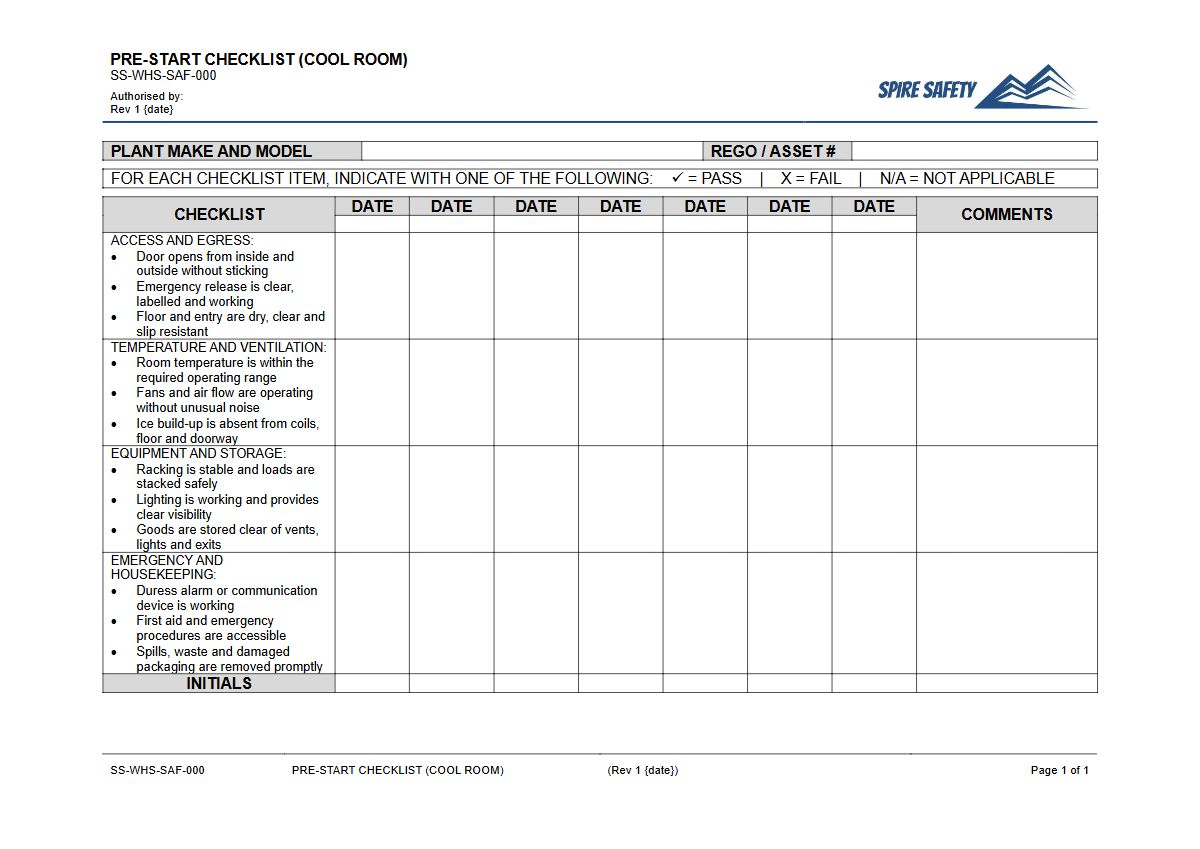
Formalise your cool room inspections with our free Pre-Start Checklist (Cool Room) Template. Download the DOCX and PDF to improve safety and maintenance.
Free Pre-Start Checklist (Cool Room) Template
DOCX • 125 KB + PDF
Updated Oct 2026
No signup required
Purpose of the Free Pre-Start Checklist (Cool Room) Template
Regularly inspecting cool rooms and walk-in freezers is a critical WHS and operational task in many industries, including hospitality, food processing, and healthcare. This free Pre-Start Checklist (Cool Room) Template provides a structured starting point for formalising these daily checks.
Using a checklist helps your organisation systematically identify hazards before they cause harm, such as slips from condensation, electrical faults from moisture ingress, or ergonomic injuries from poorly maintained doors. Proactive checks also minimise the business risk of equipment failure, which can lead to costly food spoilage and operational downtime.
A documented pre-start process demonstrates a commitment to workplace health and safety. It helps meet the primary duty of care for a Person Conducting a Business or Undertaking (PCBU) to provide and maintain a work environment that is without risks to health and safety, so far as is reasonably practicable.
Integrating this check into daily routines encourages a positive safety culture where potential issues are reported and rectified promptly. To reinforce this behaviour across all equipment, consider using a Pre-Start Checks and Plant Maintenance Toolbox Talk to brief your team.
Video walkthrough
How to use the Free Pre-Start Checklist (Cool Room) Template
This resource is available as a DOCX file, allowing for full customisation, and a PDF for immediate use. The template prompts users to inspect critical safety and operational components of a cool room, including door seals, internal emergency release mechanisms, lighting, fan guards, temperature displays, and floor conditions.
Your goal is to create a checklist that accurately reflects the specific equipment and risks present in your workplace.
IMPORTANT: This is a template only. We have not tailored it to your specific cool room, workplace, or operational context.
You MUST customise this document, consulting with your workers and other stakeholders to ensure it is fit for your specific purpose. This checklist should form part of your broader WHS management systems, linking pre-start inspections to your fault reporting and maintenance procedures.
When to use it
A cool room pre-start checklist should be completed before the start of each work shift or, at a minimum, once every 24 hours. The ideal frequency depends on how heavily the cool room is used and the specific risks involved.
For high-traffic commercial kitchens, a pre-shift check is essential. For less frequently accessed units, a daily check may be sufficient.
The goal is to identify any faults or developing issues before they create a hazard or lead to equipment failure. Consistency is key to an effective pre-start inspection program.
Who should use it
The checklist is designed to be used by the workers who interact with the cool room daily, such as chefs, kitchen hands, or warehouse staff. They are best placed to notice subtle changes in equipment performance or condition.
A supervisor or manager should be designated to review the completed checklists, sign off, and ensure that any reported defects are actioned through the organisation's maintenance and repair procedures. Training should be provided to all relevant personnel on how to properly conduct the inspection and what to do if they identify a 'fail' item.
The process is similar for other specific equipment, such as when using a Pre-Start Checklist for a coffee grinder in a cafe environment.
What happens when a fault is found?
Finding a fault is the primary purpose of the check. The checklist is not just a tick-and-flick exercise.
Your procedure must clearly define the steps to take when a non-conformance is identified. This typically involves immediately reporting the issue to a supervisor, tagging the equipment out of service if the hazard is severe (e.g., an exposed live wire or a person trapped inside), and initiating a maintenance request.
Keeping a record of these checks and the subsequent corrective actions is vital for demonstrating due diligence and can be reviewed during a WHS compliance auditing process.
Integrating with other safety procedures
Working in and around cool rooms often involves more than just checking the equipment. Staff frequently move heavy boxes and trolleys in confined, cold spaces.
The principles of safe lifting and movement are crucial to prevent musculoskeletal injuries. You can support your team's safety by supplementing equipment checks with procedural training, such as by adapting an Aged Care Manual Handling Toolbox Talk to focus on the specific items and environment of your workplace.
A holistic approach ensures all related hazards are considered and managed. For a wider selection of safety documents, explore our complete free WHS resources library.
Common mistakes
Common mistakes to avoid
- Using a generic template without customising it for the specific cool room model and workplace risks.
- Workers 'pencil-whipping' the form without physically performing the checks.
- Failing to have a clear procedure for reporting and actioning faults found during the inspection.
- Poor record-keeping, making it impossible to track recurring faults or prove due diligence.
Legal references
Legal considerations
The following legal requirements may be relevant to this type of work.
- Work Health and Safety Act (Harmonised) — Provides the primary duties for protecting workers and other people from work health and safety risks.
- Work Health and Safety Regulations (Harmonised) — Sets out requirements supporting the management of workplace hazards and risks.
The following codes may be relevant to this type of work.
- Managing WHS Risks Code of Practice — Provides practical guidance on identifying hazards, assessing risks and applying effective controls.
- Work Health and Safety Consultation, Cooperation and Coordination Code of Practice — Provides practical guidance on consulting workers and coordinating with other duty holders.
- Managing the Work Environment and Facilities Code of Practice — Provides practical guidance on safe work environments, workplace facilities and related controls.
Did you know
Energy Hogs
A cool room with a faulty door seal can increase its energy consumption by over 20%, significantly raising electricity costs and placing extra strain on the refrigeration unit.
Slip Hazards
Slips, trips, and falls are a leading causes of injury in the hospitality industry. Leaking condensation from cool rooms is a common and often overlooked contributor to these incidents.
FAQ
Frequently asked questions
01Why is a pre-start check important for a cool room?
02What should be included in a cool room pre-start checklist?
03Who is responsible for completing a cool room pre-start check?
04How often should cool room pre-start checks be done?
Share this resource
Free Pre-Start Checklist (Cool Room) Template
Browse Categories
How To Use It
- 1Download and open in Word or PDF.
- 2Replace the placeholders with your business details.
- 3Get it reviewed by a WHS specialist before rollout.
Need it customised?
Our WHS consultants can adapt this template to your site, run a gap analysis, or audit what you already have in place.
Book a Free Consultation WHS consulting servicesor call 1300 156 382