
Free WHS Inspection (Assembly Plant) Template
Streamline your safety processes with our Free WHS Inspection (Assembly Plant) Template. This structured document helps identify and control hazards.
Free WHS Inspection (Assembly Plant) Template
DOCX • 128 KB + PDF
Updated Oct 2026
No signup required
Purpose of the Free WHS Inspection (Assembly Plant) Template
Maintaining a safe and productive assembly plant requires consistent, thorough oversight. Our Free WHS Inspection (Assembly Plant) Template provides a structured starting point for systematically reviewing your work areas, equipment, and procedures to identify hazards before they cause harm.
This document is designed to guide you through a comprehensive check of common risk areas found in assembly and manufacturing environments, from machinery safety to traffic management and ergonomics.
Using this template helps an organisation formalise its safety walk-throughs, creating a consistent record of observations and required actions. Regular inspections are a cornerstone of proactive safety management, demonstrating due diligence and fostering a positive safety culture.
The findings from these inspections provide valuable data that feeds into broader effective WHS management systems, helping to prioritise resources and guide continuous improvement efforts.
Video walkthrough
How to Use the Free WHS Inspection (Assembly Plant) Template
This template is provided in both DOCX and PDF formats for your convenience. The DOCX file is fully editable, allowing you to tailor it to the specific conditions of your workplace. Follow these steps to get the most out of the resource:
- Customise the Checklist: It is crucial to remember that this template is a starting point. We have designed it to be comprehensive, but you must customise it to reflect the specific machinery, production lines, chemicals, and inherent risks present in your unique workplace. Add, remove, or modify sections to ensure all relevant hazards are covered.
- Schedule the Inspection: Determine an appropriate frequency for inspections. This could be monthly, quarterly, or as determined by your risk assessment process.
- Conduct the Inspection: Walk through the assembly plant with the checklist, methodically observing conditions and work practices. Engage with workers and supervisors to gather insights and understand how tasks are actually performed.
- Document Findings: Clearly record any hazards identified, noting their location and the potential risk they pose. Use photos to supplement your written descriptions where appropriate.
- Assign Corrective Actions: For each identified hazard, specify the corrective action required, assign responsibility to a specific person, and set a realistic completion date.
The template includes sections on general work environment, hazardous substances, and emergency preparedness. If your plant has specific high-risk processes, such as extensive chemical handling, you may wish to supplement this inspection with targeted training, like that covered in our Spill Prevention and Response Toolbox Talk Template.
What this Inspection Template Covers
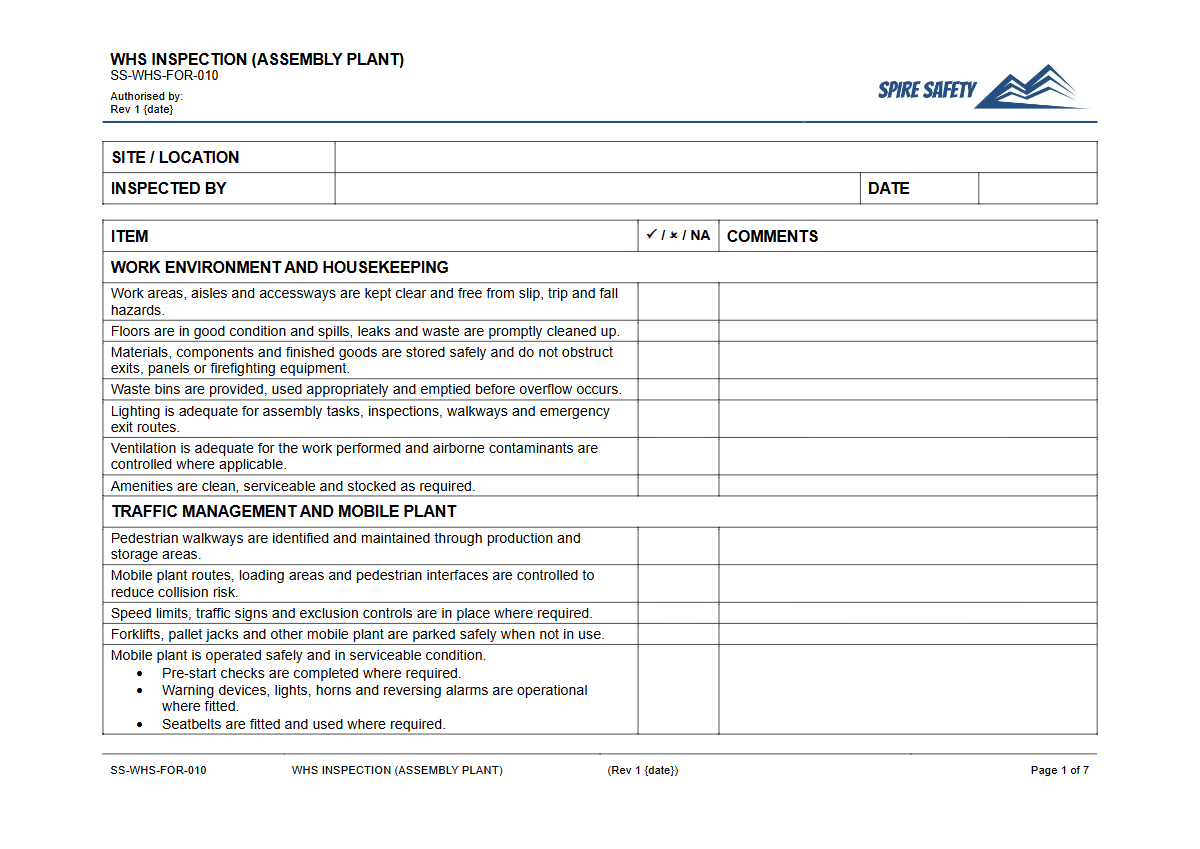
Our template provides a framework to assess key WHS areas in an assembly plant, including:
- Work Environment: Housekeeping, lighting, ventilation, and noise levels.
- Machinery and Equipment: Guarding, operator controls, maintenance, and emergency stops.
- Ergonomics: Manual tasks, workstation design, and repetitive movements.
- Hazardous Substances: Storage, labelling, safety data sheets (SDS), and spill containment.
- Traffic Management: Pedestrian walkways, forklift operating areas, and signage.
- Emergency Preparedness: Fire equipment, first aid facilities, and clear egress paths.
For more granular daily checks on specific pieces of plant, you can adapt this inspection framework or use dedicated pre-start checklists. For an example of a machine-specific checklist, see our Free Pre-Start Checklist (Feed Mixer) Template.
When to Use It
Formal workplace inspections should be a scheduled part of your safety calendar. Beyond regular checks, this template is useful in several other situations:
- After an incident, accident, or near miss to identify contributing factors.
- When introducing new machinery, equipment, or substances.
- When a work process or production layout changes.
- In response to concerns raised by workers or Health and Safety Representatives (HSRs).
While this template facilitates routine internal checks, it does not replace the need for more intensive reviews. Complex machinery like scissor lifts or boom lifts used for maintenance require their own specific assessments, such as those outlined in a Free Elevated Work Platform Risk Assessment Template.
Who Should Use It
This inspection template can be used by various personnel within an organisation. The most effective inspections are often conducted by a team to bring diverse perspectives. Key users include:
- WHS Managers and Advisors: To oversee the workplace inspection program and analyse trends from the findings.
- Supervisors and Line Managers: To conduct regular checks of their specific work areas and take ownership of safety performance.
- Health and Safety Representatives (HSRs): As part of their legislated role in monitoring workplace safety and representing their work group.
- Workers: Competent workers can be involved in inspections, bringing valuable operational knowledge to the process.
While this template is a powerful tool for internal use, some situations may benefit from an independent, external review to identify systemic gaps you might miss. This is where services like professional WHS compliance auditing can provide significant value. For other useful documents, please browse our complete free WHS resources library.
Common mistakes
Common mistakes to avoid
- Failing to customise the template to the specific hazards of the workplace.
- Treating the inspection as a 'tick-and-flick' exercise without genuine observation.
- Neglecting to assign clear corrective actions with deadlines and responsible persons.
- Not following up to ensure that identified corrective actions have been completed effectively.
Legal references
Legal considerations
The following legal requirements may be relevant to this type of work.
- Work Health and Safety Act (Harmonised) — Provides the primary duties for protecting workers and other people from work health and safety risks.
- Work Health and Safety Regulations (Harmonised) — Sets out requirements supporting the management of workplace hazards and risks.
The following codes may be relevant to this type of work.
- Managing WHS Risks Code of Practice — Provides practical guidance on identifying hazards, assessing risks and applying effective controls.
- Work Health and Safety Consultation, Cooperation and Coordination Code of Practice — Provides practical guidance on consulting workers and coordinating with other duty holders.
- Managing the Work Environment and Facilities Code of Practice — Provides practical guidance on safe work environments, workplace facilities and related controls.
Did you know
Hierarchy of Controls
The most effective way to manage risks is by using the hierarchy of controls. Eliminating the hazard altogether is most effective, while relying on personal protective equipment (PPE) is the least effective measure.
Manufacturing as a Priority Industry
In Australia, the manufacturing industry is identified as a national priority for work health and safety improvement due to the high rates of serious injuries and fatalities compared to other sectors.
FAQ
Frequently asked questions
01What is the difference between a WHS inspection and an audit?
02How often should we inspect our assembly plant?
03Who is qualified to conduct a WHS inspection in an assembly plant?
04Can this template be used for other types of manufacturing?
Share this resource
Free WHS Inspection (Assembly Plant) Template
Browse Categories
How To Use It
- 1Download and open in Word or PDF.
- 2Replace the placeholders with your business details.
- 3Get it reviewed by a WHS specialist before rollout.
Need it customised?
Our WHS consultants can adapt this template to your site, run a gap analysis, or audit what you already have in place.
Book a Free Consultation WHS consulting servicesor call 1300 156 382