
Free WHS Inspection (Art Gallery) Template
Download our free WHS Inspection Template for Art Galleries.
Free WHS Inspection (Art Gallery) Template
DOCX • 129 KB + PDF
Updated Oct 2026
No signup required
Purpose of the Free WHS Inspection (Art Gallery) Template
Art galleries present unique work health and safety challenges, blending public spaces with active workplaces. This Free WHS Inspection (Art Gallery) Template provides a structured starting point for systematically identifying, assessing, and controlling hazards specific to this environment.
It helps organisations formalise their safety processes, from exhibition floors and storage areas to workshops and public amenities. Using a checklist helps ensure key risk areas such as public access, manual handling of artworks, lighting, and emergency procedures are regularly reviewed.
This document is designed to support your broader safety management framework by promoting consistent and thorough workplace inspections.
Video walkthrough
How to use the Free WHS Inspection (Art Gallery) Template
This template is a comprehensive starting point, but it must be adapted to the specific layout, activities, and risks of your gallery. It is provided in both DOCX and PDF formats for your convenience.
Download the DOCX file to add, remove, or modify checklist items to reflect your unique operational environment, including permanent collections, temporary exhibitions, and back-of-house activities. It is essential that you consult with your team—including curators, technicians, front-of-house staff, and volunteers—to ensure the inspection covers all relevant hazards.
Important: This is a template only. We cannot guarantee it will be suitable for your specific circumstances.
You must customise it by consulting with workers and other stakeholders to ensure it addresses all risks present in your workplace. Its effectiveness depends on its correct customisation and implementation.
What this Inspection includes:
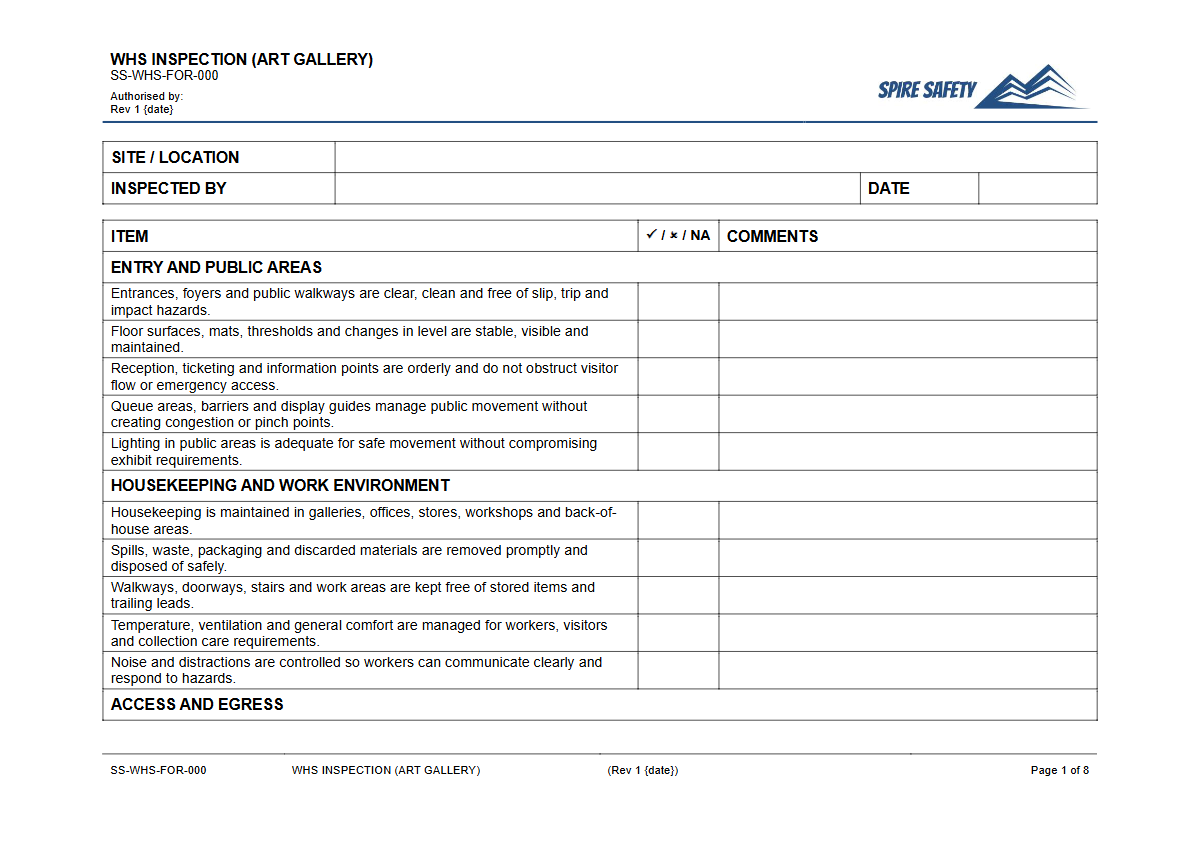
- A section for recording inspection details, including the date, location, and personnel involved.
- Checklist items covering common art gallery hazards like public liability, exhibition setup, electrical safety, and hazardous substances.
- Columns to record observations, assess risk levels, and note required corrective actions.
- A sign-off area to ensure accountability for closing out identified issues.
When to conduct Art Gallery Inspections
Regular inspections are fundamental to proactive safety management. The frequency should be determined by your risk assessment, but a good practice is to conduct them:
- Before the opening of a new exhibition or major installation.
- After any significant incident or near miss to prevent recurrence.
- On a routine schedule (e.g., monthly or quarterly) for general areas.
- Whenever changes are made to the gallery layout, lighting, or public pathways.
Integrating these checks into your operational schedule helps maintain ongoing vigilance. These formal inspections supplement the daily checks staff might perform on specific equipment, such as using a pre-start checklist for an electric hoist before lifting a heavy sculpture.
Who should be involved
A successful inspection involves a team effort. The person conducting the inspection should be competent and familiar with the gallery's operations. Ideally, this includes a combination of individuals such as:
- The Health and Safety Representative (HSR) or committee member.
- A department manager or supervisor responsible for the area.
- A worker or technician who performs tasks in the area being inspected.
Involving different people brings diverse perspectives, helping to identify hazards that might otherwise be missed. This collaborative approach also fosters a positive safety culture and is a core component of effective WHS management systems.
Beyond the Checklist
An inspection is more than just ticking boxes; it's about meaningful action. Once hazards are identified, they must be assessed and controlled using the hierarchy of controls.
This means prioritising actions that eliminate or substitute risks over those that rely on administrative controls or personal protective equipment (PPE). Documenting these actions and assigning responsibility ensures follow-through. For complex issues or to verify the effectiveness of your overall safety program, you might consider engaging professionals for formal WHS compliance audits.
Maintaining equipment in public amenity areas is also critical. For instance, facilities with a parents' room should ensure items are safe, perhaps using a dedicated pre-start checklist for a bottle warmer. Similarly, if the gallery cafe has kitchen equipment, checks like a pre-start checklist for a kitchen blender are vital. Even external assets like car park entries need attention, which can be managed with a free Pre-Start Checklist for boom gates. You can find more templates like these in our free WHS resources library to support every aspect of your gallery's operations.
Common mistakes
Common mistakes to avoid
- Forgetting to inspect 'back-of-house' areas like workshops, loading docks, and conservation labs.
- Failing to involve staff, technicians, and volunteers who have hands-on knowledge of the daily risks.
- Not documenting corrective actions or assigning clear responsibility and deadlines for fixing hazards.
- Overlooking risks associated with temporary exhibitions, events, and bump-in/bump-out procedures.
Legal references
Legal considerations
The following legal requirements may be relevant to this type of work.
- Work Health and Safety Act (Harmonised) — Provides the primary duties for protecting workers and other people from work health and safety risks.
- Work Health and Safety Regulations (Harmonised) — Sets out requirements supporting the management of workplace hazards and risks.
The following codes may be relevant to this type of work.
- Managing WHS Risks Code of Practice — Provides practical guidance on identifying hazards, assessing risks and applying effective controls.
- Work Health and Safety Consultation, Cooperation and Coordination Code of Practice — Provides practical guidance on consulting workers and coordinating with other duty holders.
- Managing the Work Environment and Facilities Code of Practice — Provides practical guidance on safe work environments, workplace facilities and related controls.
Did you know
Slips, Trips, and Falls
Slips, trips, and falls are a leading cause of serious injuries in Australian workplaces, and public venues like galleries are high-risk areas due to varied floor surfaces and visitor traffic.
Installation Risks
The installation of large-scale sculptures and artworks often requires specialised rigging and engineering assessments to ensure structural stability and prevent catastrophic failure, a risk unique to the arts sector.
FAQ
Frequently asked questions
01What are the most common WHS hazards in an art gallery?
02How often should I conduct a WHS inspection in my gallery?
03Who is responsible for WHS in an art gallery?
04Can this template be used for temporary exhibitions or pop-up galleries?
Share this resource
Free WHS Inspection (Art Gallery) Template
Browse Categories
How To Use It
- 1Download and open in Word or PDF.
- 2Replace the placeholders with your business details.
- 3Get it reviewed by a WHS specialist before rollout.
Need it customised?
Our WHS consultants can adapt this template to your site, run a gap analysis, or audit what you already have in place.
Book a Free Consultation WHS consulting servicesor call 1300 156 382