
Free WHS Inspection (Agricultural Site) Template
Download our Free WHS Inspection (Agricultural Site) Template to streamline safety audits on your farm. This DOCX & PDF template helps identify hazards.
Free WHS Inspection (Agricultural Site) Template
DOCX • 128 KB + PDF
Updated Oct 2026
No signup required
Purpose of the Free WHS Inspection (Agricultural Site) Template
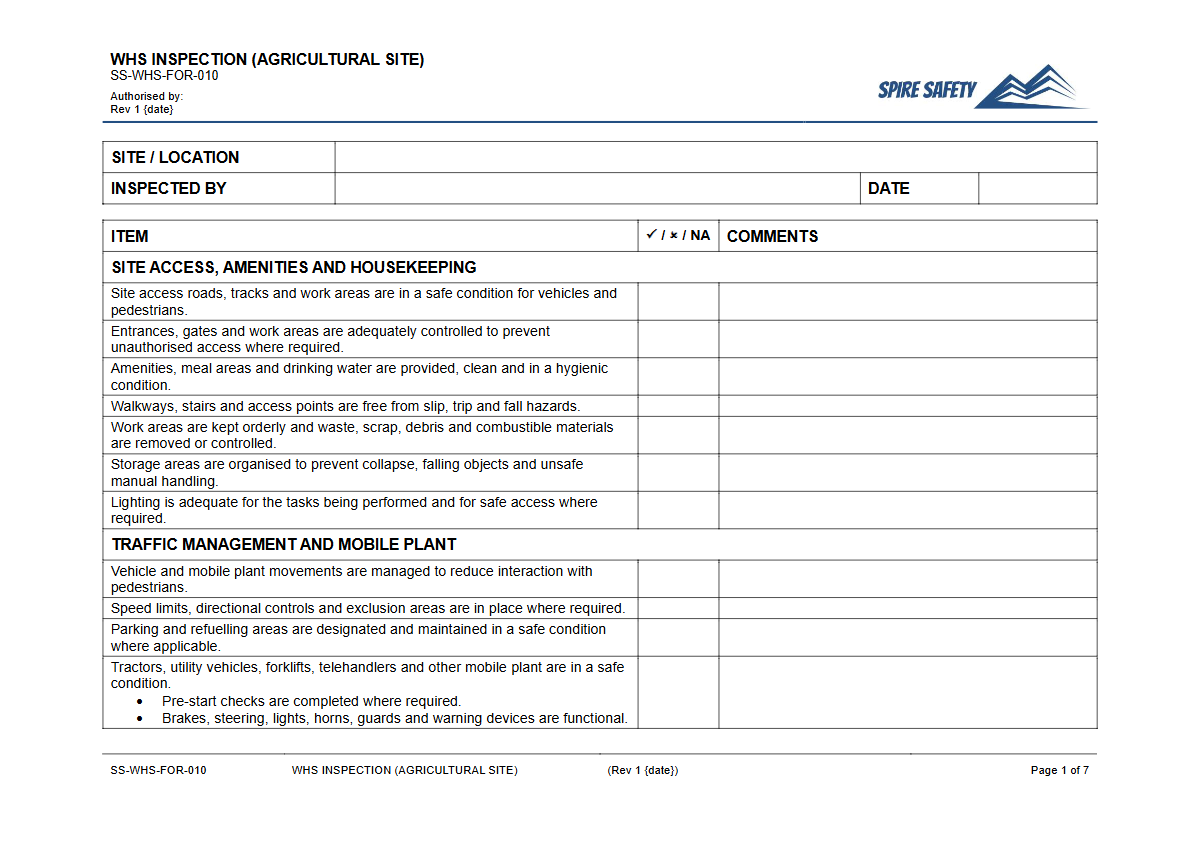
Proactively managing health and safety on agricultural sites is essential for preventing incidents and injuries. This Free WHS Inspection (Agricultural Site) Template provides a structured starting point for systematically identifying hazards across your property.
The template is designed to guide you through a comprehensive check of common risk areas on farms, from machinery and equipment to chemical storage and general working environments. By formalising your inspection process, you create a reliable record of your safety efforts and a clear action plan for controlling identified risks.
This aligns with the principles of a robust WHS management system, helping you build a stronger safety culture.
Video walkthrough
How to use the Free WHS Inspection (Agricultural Site) Template
Download the template in your preferred format (DOCX or PDF) to get started. The DOCX version is fully editable, allowing you to tailor the checklist to the specific layout, equipment, and operations of your farm.
It is crucial that you customise this document. Important Note: We have provided a comprehensive starting point based on common agricultural hazards, but every workplace is unique.
You must add, remove, or modify checklist items to ensure they accurately reflect the specific risks present at your site. A generic checklist is not sufficient; a site-specific one is a key part of your safety due diligence. For equipment-specific checks, you can supplement this site-wide inspection with documents like our Free Pre-Start Checklist (Disc Plough) Template.
Key Areas Covered in the Inspection Template
This inspection checklist prompts a review of various high-risk areas and activities common in an agricultural setting. The goal is to provide a comprehensive framework that you can adapt for your specific needs. Key sections include:
- Machinery and Equipment: Checks for guarding, maintenance records, emergency stops, and operator competency.
- Chemicals and Hazardous Substances: Assesses storage, labelling, Safety Data Sheets (SDS), and availability of personal protective equipment (PPE).
- Structures and Access: Covers the condition of sheds, silos, yards, fences, and access roads. It also addresses risks related to site security and unauthorised access.
- Electrical Safety: Inspects wiring, power points, RCDs (safety switches), and overhead powerline safety.
- Emergency Preparedness: Reviews first aid facilities, fire extinguishers, emergency communication methods, and evacuation plans.
- Worker Amenities and Environment: Checks for clean drinking water, sanitation facilities, and protection from environmental hazards like sun and heat.
When to use it
Regular site inspections are a cornerstone of proactive WHS management. The frequency of these inspections can depend on several factors, including the size and complexity of your operation, the types of activities performed, and any recent changes to equipment or processes.
As a general guideline, a comprehensive site inspection should be conducted at least quarterly. However, you may need to conduct them more frequently, such as monthly, if your site has high-risk activities or has experienced recent incidents.
Inspections should also be triggered by specific events, such as after severe weather, before seasonal high-risk activities like harvesting, or when introducing new plant or machinery. These scheduled checks complement but do not replace the need for daily pre-start equipment checks, like those outlined in our Free Pre-Start Checklist (Lawn Tractor) Template.
Who should use it
This inspection template is designed for anyone with responsibility for safety on an agricultural site. This includes farm owners, site managers, supervisors, and dedicated WHS officers or representatives.
To be effective, the inspection should be conducted by a person who is competent to identify the hazards specific to agriculture. Involving workers in the inspection process can also be highly beneficial, as they have hands-on experience with the tasks and equipment and can offer valuable insights.
For broader safety reviews and to verify the effectiveness of your internal processes, engaging external professionals for a formal WHS compliance audit can provide an objective assessment of your safety systems.
By integrating this inspection template into your regular safety routines, you take a significant step towards mitigating risks on your property. Remember to review and update your customised template regularly to ensure it remains relevant to your operations.
Explore our full free WHS resources library for more templates and guides to support your safety efforts.
Common mistakes
Common mistakes to avoid
- Using a generic checklist without customising it for the specific farm's equipment, layout, and operations.
- 'Pencil-whipping' the inspection by ticking boxes without physically verifying the items.
- Failing to assign and follow up on corrective actions for hazards identified during the inspection.
- Not keeping records of completed inspections and the actions taken to control risks.
Legal references
Legal considerations
The following legal requirements may be relevant to this type of work.
- Work Health and Safety Act (Harmonised) — Provides the primary duties for protecting workers and other people from work health and safety risks.
- Work Health and Safety Regulations (Harmonised) — Sets out requirements supporting the management of workplace hazards and risks.
The following codes may be relevant to this type of work.
- Managing WHS Risks Code of Practice — Provides practical guidance on identifying hazards, assessing risks and applying effective controls.
- Work Health and Safety Consultation, Cooperation and Coordination Code of Practice — Provides practical guidance on consulting workers and coordinating with other duty holders.
- Managing the Work Environment and Facilities Code of Practice — Provides practical guidance on safe work environments, workplace facilities and related controls.
Did you know
Agriculture's Risk Profile
Despite employing less than 3% of the workforce, the agriculture, forestry, and fishing industry accounts for a disproportionately high number of worker fatalities in Australia.
Tractor Danger
Tractor-related incidents remain one of the leading causes of death on Australian farms. Over half of these involve rollovers, highlighting the importance of Roll-Over Protective Structures (ROPS).
FAQ
Frequently asked questions
01What are the most common hazards on an Australian farm?
02How often should I conduct a WHS inspection on my farm?
03Can I use a digital app for my farm safety inspections?
04What's the difference between a pre-start check and a site inspection?
Share this resource
Free WHS Inspection (Agricultural Site) Template
Browse Categories
How To Use It
- 1Download and open in Word or PDF.
- 2Replace the placeholders with your business details.
- 3Get it reviewed by a WHS specialist before rollout.
Need it customised?
Our WHS consultants can adapt this template to your site, run a gap analysis, or audit what you already have in place.
Book a Free Consultation WHS consulting servicesor call 1300 156 382