
Free WHS Inspection (Aircraft Hangar) Template
Download our Free WHS Inspection (Aircraft Hangar) Template to streamline your safety checks.
Free WHS Inspection (Aircraft Hangar) Template
DOCX • 127 KB + PDF
Updated Oct 2026
No signup required
Purpose of the Free WHS Inspection (Aircraft Hangar) Template
Aircraft hangars are complex and high-risk work environments, combining heavy machinery, hazardous substances, work at heights, and complex manual tasks. A systematic approach to safety is essential to prevent incidents and ensure the wellbeing of maintenance crews and personnel.
This Free WHS Inspection (Aircraft Hangar) Template provides a structured starting point for formalising your safety checks and managing workplace risks effectively.
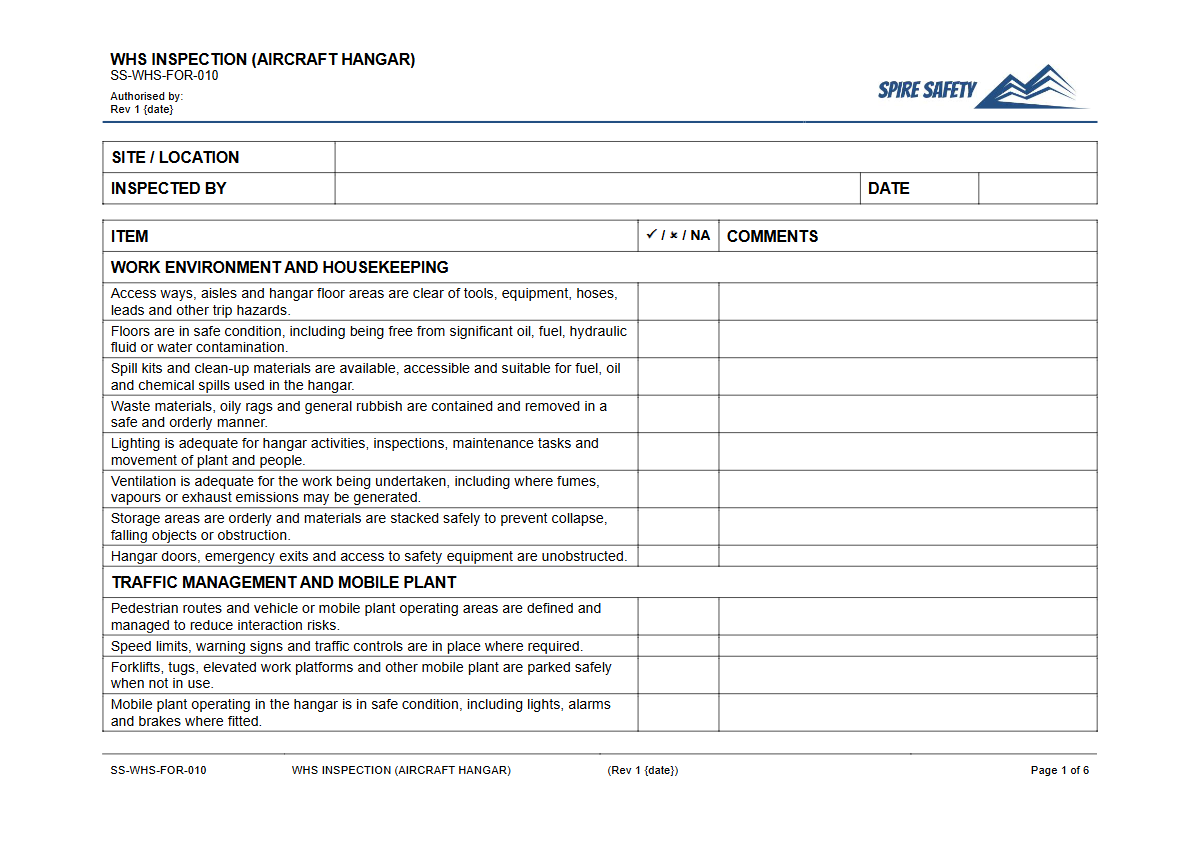
Regularly inspecting your hangar helps identify potential hazards before they cause harm. The template prompts checks for common risks such as fluid spills (fuels, hydraulic oils, solvents), trip hazards from tools and cables, fire safety equipment status, and the condition of structural elements.
By using a consistent checklist, you can create a documented record of your safety efforts, track corrective actions, and demonstrate due diligence. It is a fundamental component of any effective safety management system, helping your organisation meet its duties under WHS legislation.
Video walkthrough
How to use the Free WHS Inspection (Aircraft Hangar) Template
This template is designed to be a flexible foundation for your specific operational needs. To get started, download the file in your preferred format (DOCX for easy editing or PDF).
The checklist covers key areas common to most aircraft hangars, including general housekeeping, structures and access, fire prevention, hazardous materials storage, and plant and equipment safety. A comprehensive inspection process involves more than just ticking boxes; it requires careful observation and engagement.
Walk through the hangar, completing each section of the checklist. For any identified hazards or non-conformances, record the details, assess the level of risk, and assign a corrective action with a responsible person and a due date.
This creates a clear action plan for risk mitigation. For example, if an inspection reveals faulty lifting chains, you might use an electric hoist pre-start checklist to formalise daily checks on that specific piece of equipment going forward.
Important: This is a generic template that must be customised. We don't know your specific site, equipment, or procedures.
To make it effective, you must consult with your workers and adapt the checklist to include hazards unique to your hangar, the types of aircraft you service, and the specific tasks your teams perform.
When to use it
The frequency of hangar inspections should be determined by a risk assessment. As a general guide, a comprehensive workplace inspection is often conducted monthly or quarterly.
However, inspections should also be triggered by specific events. These include after an incident or near miss, before commencing a major or non-routine maintenance project, or when introducing new equipment, substances, or work procedures.
Regular, scheduled inspections ensure that safety standards do not degrade over time and that new hazards are identified promptly. For access points to your site, a daily check using a boom gate pre-start checklist can also be integrated into your overall inspection schedule.
Who should use it
This inspection template is designed for use by anyone with responsibility for workplace health and safety in an aviation maintenance setting. This includes Hangar Managers, WHS Advisors, Safety Officers, and supervisors.
To ensure inspections are thorough and practical, they should be conducted by a person competent in identifying hangar-specific hazards. Best practice involves conducting inspections collaboratively with Health and Safety Representatives (HSRs) and members of the maintenance crew, as their hands-on experience is invaluable for spotting less obvious risks. The findings are a critical input for leadership and PCBUs (Persons Conducting a Business or Undertaking) when reviewing the effectiveness of their safety protocols and considering formal WHS compliance auditing.
Integrating this inspection into your operational rhythm is a key part of developing a complete WHS management system. It provides the data needed to make informed decisions about risk control. It also fosters a positive safety culture by demonstrating a visible commitment to a safe and healthy workplace.
If you store specific materials that require refrigeration, such as composites or chemicals, you can supplement your main inspection with a dedicated freezer pre-start checklist to ensure temperature integrity and safety.
You can find a wide range of similar documents in our free WHS resources library, covering various equipment and safety procedures to help you build out your safety toolkit.
Common mistakes
Common mistakes to avoid
- Ignoring gradual clutter and poor housekeeping until it becomes a major hazard.
- Failing to check the condition and certification of specialised lifting and access equipment.
- Overlooking inadequate ventilation when working with solvents, paints, or sealants.
- Not following up on identified hazards with documented corrective actions and deadlines.
Legal references
Legal considerations
The following legal requirements may be relevant to this type of work.
- Work Health and Safety Act (Harmonised) — Provides the primary duties for protecting workers and other people from work health and safety risks.
- Work Health and Safety Regulations (Harmonised) — Sets out requirements supporting the management of workplace hazards and risks.
The following codes may be relevant to this type of work.
- Managing WHS Risks Code of Practice — Provides practical guidance on identifying hazards, assessing risks and applying effective controls.
- Work Health and Safety Consultation, Cooperation and Coordination Code of Practice — Provides practical guidance on consulting workers and coordinating with other duty holders.
- Managing the Work Environment and Facilities Code of Practice — Provides practical guidance on safe work environments, workplace facilities and related controls.
Did you know
Slips, Trips, and Falls
According to Safe Work Australia, slips, trips and falls are a leading cause of serious injuries in Australian workplaces. This risk is amplified in hangars by fluid spills, trailing hoses, and scattered tools.
Hearing Loss Risk
Noise from aircraft engines, power tools, and pneumatic equipment can easily exceed 85 dB(A), the exposure standard where hearing protection becomes mandatory. Prolonged exposure without adequate protection can cause permanent, irreversible hearing loss.
FAQ
Frequently asked questions
01What's the difference between a pre-start check and a hangar inspection?
02How often should we conduct an aircraft hangar inspection?
03Who is qualified to perform a WHS inspection in an aircraft hangar?
04Does this template cover CASA requirements?
Share this resource
Free WHS Inspection (Aircraft Hangar) Template
Browse Categories
How To Use It
- 1Download and open in Word or PDF.
- 2Replace the placeholders with your business details.
- 3Get it reviewed by a WHS specialist before rollout.
Need it customised?
Our WHS consultants can adapt this template to your site, run a gap analysis, or audit what you already have in place.
Book a Free Consultation WHS consulting servicesor call 1300 156 382