
Free Inspection & Test Plan (External Sealing Jointing) Template
Ensure quality and safety on your project with our Free Inspection & Test Plan (ITP) for External Sealing & Jointing. Download your DOCX & PDF template.
Free Inspection & Test Plan (External Sealing Jointing) Template
DOCX • 135 KB + PDF
Updated Oct 2026
No signup required
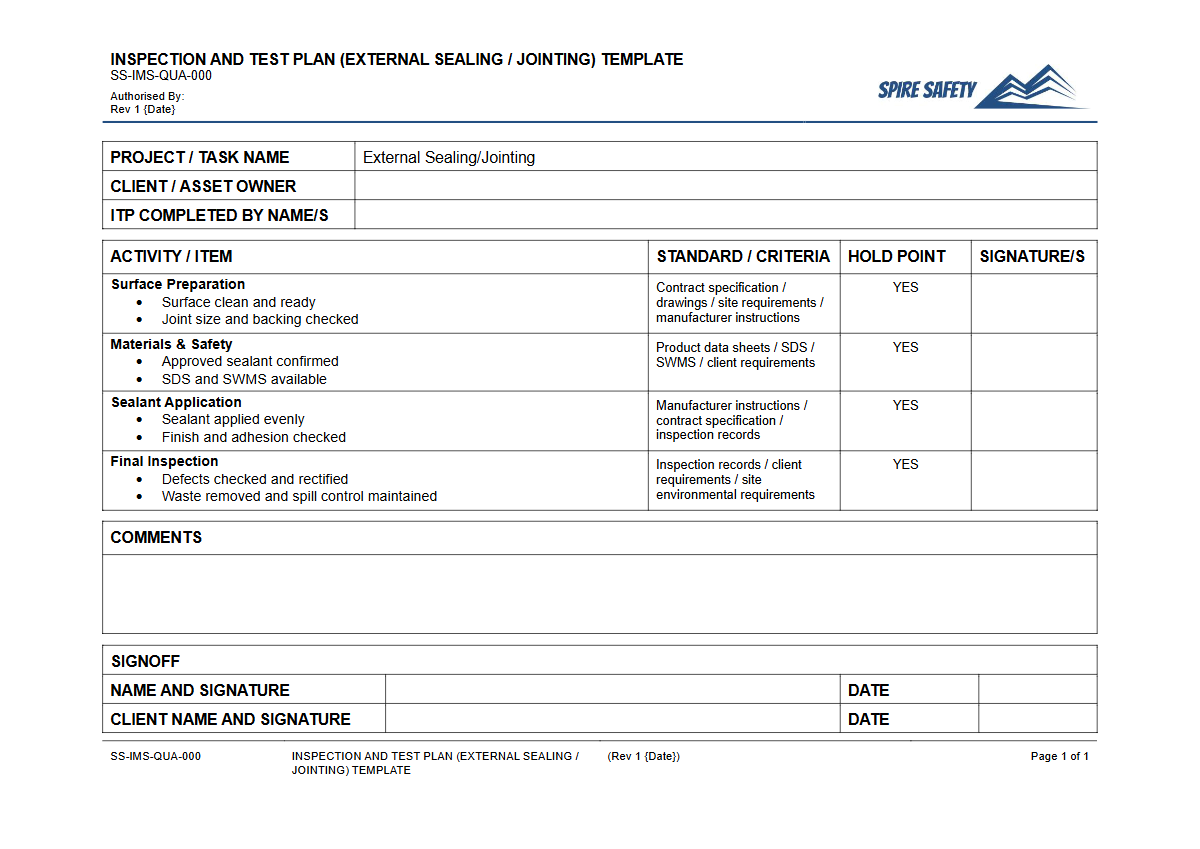
Purpose of the Free Inspection & Test Plan (External Sealing Jointing) Template
This Free Inspection & Test Plan (External Sealing Jointing) Template provides a structured framework for documenting and verifying quality control activities throughout the sealing and jointing process. An effective Inspection & Test Plan (ITP) is crucial for ensuring that external sealants are applied correctly, meet project specifications, and perform as intended to prevent water ingress, air leakage, and premature failure.
It establishes a clear sequence of inspections, tests, and verifications required at critical stages of the work, from material delivery to final sign-off.
Using this template helps formalise your quality assurance process, ensuring all activities are planned, executed, and recorded systematically. It outlines the specific checks, acceptance criteria, and responsibilities for each task, such as surface preparation, primer application, sealant installation, and curing.
This methodical approach is a fundamental part of more comprehensive WHS management systems, helping to minimise defects, avoid costly rework, and demonstrate due diligence to clients and regulators.
Video walkthrough
How to use the Free Inspection & Test Plan (External Sealing Jointing) Template
This Inspection & Test Plan template is designed for ease of use. It is broken down into logical sections that follow a typical construction workflow.
You will find columns for detailing the specific activity or process, the type of check required (e.g., survey, visual inspection, material test), the acceptance criteria based on project specifications or Australian Standards, and the records to be maintained. It also includes designated 'Hold Points' (work cannot proceed without verification) and 'Witness Points' (work may proceed but an inspection must be attended).
IMPORTANT: This is a template only. We have designed it to be a comprehensive starting point, but it must be customised to your specific project requirements, sealant manufacturer's technical data sheets, site conditions, and relevant legal or contractual obligations.
Review every line item and adapt it to reflect the unique risks and quality standards of your workplace.
When to use an Inspection & Test Plan
An ITP for external sealing and jointing should be developed before work commences and implemented throughout the project lifecycle. It is essential for any construction, remedial, or maintenance project involving the application of sealants to building facades, expansion joints, window perimeters, precast panels, pavements, and other external structures.
The plan is a live document that guides supervisors and workers on the required quality standards at each step.
For large-scale or complex projects, the principles of structured verification found in an ITP are similar to those used in developing Principal Mining Hazard Management Plans, where critical controls are identified and verified to manage significant risks. The ITP serves as the primary tool for proactive quality management, rather than relying on reactive defect identification after the work is complete.
Who should use this Inspection & Test Plan
This template is intended for use by a range of personnel involved in managing and executing construction projects. This includes:
- Project Managers and Site Engineers: For planning, scheduling, and overseeing quality control activities.
- Quality Assurance / Quality Control (QA/QC) Managers: For establishing and monitoring project quality standards.
- Construction Supervisors and Forepersons: For directing work crews and conducting day-to-day inspections on site.
- Specialist Contractors: Waterproofing and sealing applicators can use this to demonstrate their quality processes to principal contractors.
- Asset Owners and Facility Managers: For verifying the quality of remedial and maintenance works.
The completed records from this ITP are valuable evidence of compliance and can be reviewed during internal or third-party WHS compliance audits. They provide a transparent and auditable trail demonstrating that work was completed to the required standard. For other specific site checks, such as those in operational areas, a dedicated checklist like a WHS inspection for a vehicle workshop might be more appropriate.
This document is just one of many tools designed to improve workplace safety and quality. For more templates and guides, browse our complete free WHS resources library.
Common mistakes
Common mistakes to avoid
- Failing to customise the ITP for specific project materials and conditions.
- Skipping or inadequately documenting mandatory hold point inspections.
- Using incorrect acceptance criteria that don't align with Australian Standards or manufacturer's specifications.
- Inadequate surface preparation and cleaning before sealant application, leading to adhesion failure.
Legal references
Legal considerations
The following legal requirements may be relevant to this type of work.
- Work Health and Safety Act (Harmonised) — Provides the primary duties for protecting workers and other people from work health and safety risks.
- Work Health and Safety Regulations (Harmonised) — Sets out requirements supporting the management of workplace hazards and risks.
The following codes may be relevant to this type of work.
- Managing WHS Risks Code of Practice — Provides practical guidance on identifying hazards, assessing risks and applying effective controls.
- Work Health and Safety Consultation, Cooperation and Coordination Code of Practice — Provides practical guidance on consulting workers and coordinating with other duty holders.
- Managing the Work Environment and Facilities Code of Practice — Provides practical guidance on safe work environments, workplace facilities and related controls.
Did you know
Water Ingress
Water ingress is consistently ranked as one of the most common and costly building defects in Australia, with failed sealant joints being a primary contributor.
Surface Preparation is Key
According to sealant manufacturers, over 75% of sealant failures are attributable to improper surface preparation or incorrect joint design, not the sealant material itself.
FAQ
Frequently asked questions
01What is the purpose of an ITP for external sealing?
02Who is responsible for signing off hold points in an ITP?
03How does an Inspection & Test Plan differ from a Safe Work Method Statement (SWMS)?
04Can this template be used for internal waterproofing as well?
Share this resource
Free Inspection & Test Plan (External Sealing Jointing) Template
Browse Categories
How To Use It
- 1Download and open in Word or PDF.
- 2Replace the placeholders with your business details.
- 3Get it reviewed by a WHS specialist before rollout.
Need it customised?
Our WHS consultants can adapt this template to your site, run a gap analysis, or audit what you already have in place.
Book a Free Consultation WHS consulting servicesor call 1300 156 382
Related templates
- Free Inspection & Test Plan (External Site Lighting) Template
- Free Inspection & Test Plan (Fibre Cement Cladding) Template
- Free Inspection & Test Plan (Final Handover Defects Inspection) Template
- Free Inspection & Test Plan (Fire Detection and Alarm System) Template
- Free Inspection & Test Plan (Fire Doors and Hardware) Template
- Free Inspection & Test Plan (Fire Hydrant Hose Reel System) Template