
Free Inspection & Test Plan (Fibre Cement Cladding) Template
Download our Free Inspection & Test Plan (Fibre Cement Cladding) Template to ensure quality and safety.
Free Inspection & Test Plan (Fibre Cement Cladding) Template
DOCX • 135 KB + PDF
Updated Oct 2026
No signup required
Purpose of the Free Inspection & Test Plan (Fibre Cement Cladding) Template
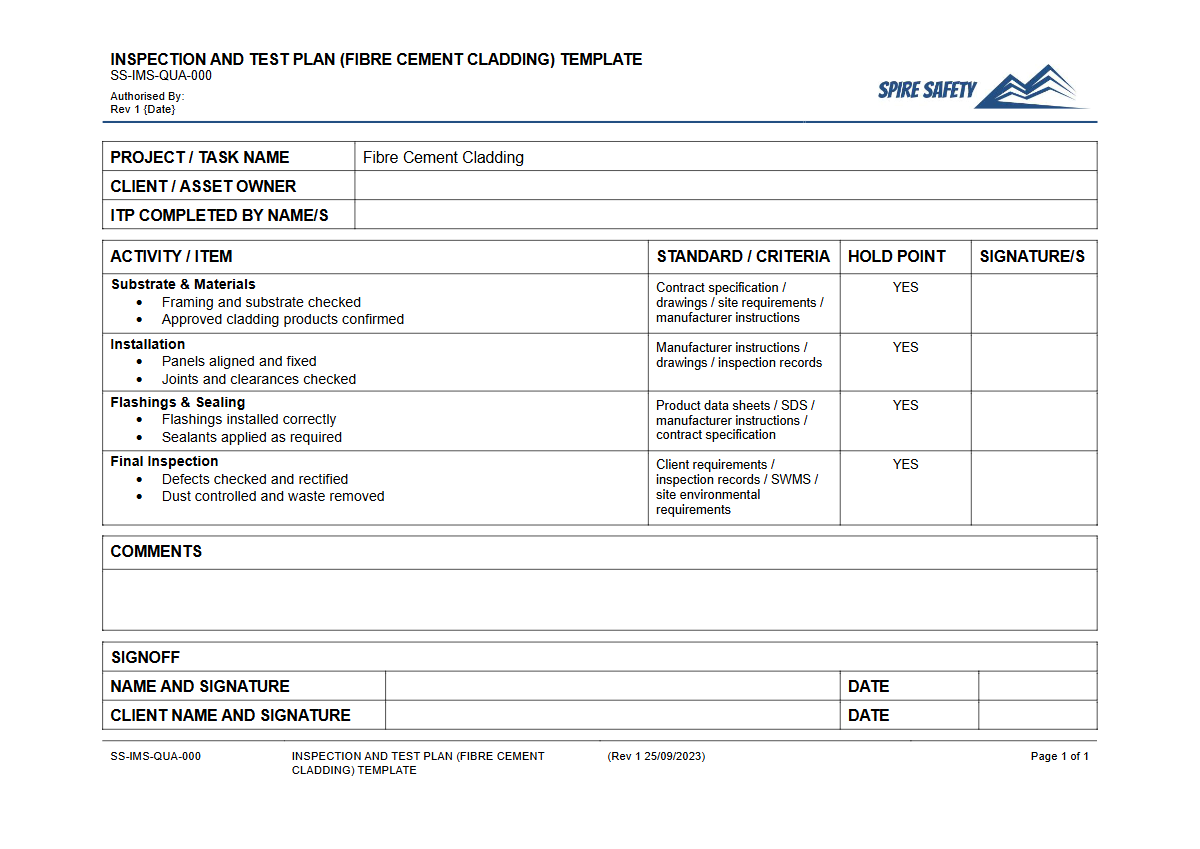
This Free Inspection & Test Plan (Fibre Cement Cladding) Template provides a structured framework for ensuring all installation work meets the required quality standards, design specifications, and safety benchmarks. An Inspection and Test Plan (ITP) is a crucial quality assurance document that outlines the critical checkpoints in a process, from material receival to final handover.
Using this template helps create a formal record of verification, demonstrating that each stage of the cladding installation has been inspected, tested, and approved. This systematic approach not only promotes compliance with the manufacturer's installation requirements, which is often essential for warranty, but also supports the broader objectives of your site's WHS management systems by integrating quality control directly into the construction workflow.
Video walkthrough
How to use the Free Inspection & Test Plan (Fibre Cement Cladding) Template
To effectively implement this template, you should first download the DOCX or PDF file and thoroughly review its contents. It is designed as a comprehensive starting point, listing typical activities and checkpoints relevant to fibre cement cladding projects.
The plan is organised into columns detailing the activity/process, the specific check or test required, acceptance criteria (e.g., manufacturer's tolerance, Australian Standard), inspection frequency, the record to be kept, and a section for sign-off.
Important: This document is a template and is not a substitute for professional advice. It must be customised to your specific project, including the exact brand and type of fibre cement product, architectural details, engineering requirements, site conditions, and relevant state or territory regulations.
We are not liable for any issues that may arise from the use of this template.
Key Customisation Steps
- Review and Edit Activities: Add, remove, or modify the inspection points to align with your project's scope of works and the specific manufacturer's installation guide.
- Define Acceptance Criteria: Clearly state the standards for a 'pass' at each checkpoint. This should reference specific clauses from the National Construction Code (NCC), Australian Standards, or the product supplier's technical data sheets.
- Assign Responsibilities: Nominate who is responsible for carrying out the inspection (e.g., Site Supervisor, Cladding Subcontractor) and who is responsible for verification or sign-off (e.g., Project Manager, Third-Party Inspector).
- Establish Hold and Witness Points: Identify critical stages ('hold points') where work cannot proceed without formal approval, and 'witness points' where observation by a supervisor or client representative is required.
When to use an Inspection & Test Plan
An ITP for fibre cement cladding is a live document used throughout the entire installation lifecycle. It begins before any cladding is fixed, with checks for material delivery, storage, and substrate readiness.
It is then used intensively during the installation phase to verify fastener patterns, joint details, and the correct placement of flashings and waterproofing. Finally, it guides the pre-completion inspection to identify and manage any defects before final handover.
The completed ITP serves as a permanent quality record, providing valuable evidence during any future WHS compliance auditing or quality assessments.
Who should use this template
This template is designed for use by a range of personnel involved in construction and project management. Key users include:
- Project Managers: To oversee quality assurance and ensure contractual requirements are being met.
- Site Supervisors and Forepersons: To manage the day-to-day installation process and conduct routine checks on the ground.
- Quality Assurance (QA) Managers: To implement and monitor the project's quality management plan.
- Leading Hand Installers: To guide their teams and perform self-inspections as work progresses.
- Principal Contractors: To ensure subcontractors are adhering to the specified standards of quality and safety.
For organisations looking to integrate such processes into their wider safety framework, our expert team can provide tailored WHS consulting services to ensure your systems are robust and practical for your specific operational needs.
Key Inspection Stages for Fibre Cement Cladding
A comprehensive ITP will typically cover several critical stages. These include checks on the structural framing to ensure it is plumb and true, verification of building wrap or sarking installation, and thorough inspection of all flashings around windows, doors, and penetrations.
One of the most significant hazards associated with this work is the generation of respirable crystalline silica (RCS) when cutting sheets. Your ITP can and should include a checkpoint to verify that specified dust control measures (e.g., on-tool dust extraction, wet cutting) are in use, which is a key part of managing high-risk activities similar to those detailed in principal hazard management plans.
Subsequent stages involve confirming the cladding sheets are fixed correctly according to the specified fastener type and layout, checking that expansion and control joints are correctly detailed, and inspecting the application of sealants and decorative finishes. This Inspection & Test Plan is just one of many useful documents available in our free WHS resources library to help you manage your projects effectively.
Common mistakes
Common mistakes to avoid
- Failing to check the substrate for straightness and flatness before starting installation.
- Ignoring manufacturer specifications for fastener type, spacing, and edge distances.
- Improper installation of sarking, flashings, and waterproofing, leading to water ingress.
- Neglecting dust control measures when cutting sheets, creating a significant silica dust hazard.
Legal references
Legal considerations
The following legal requirements may be relevant to this type of work.
- Work Health and Safety Act (Harmonised) — Provides the primary duties for protecting workers and other people from work health and safety risks.
- Work Health and Safety Regulations (Harmonised) — Sets out requirements supporting the management of workplace hazards and risks.
The following codes may be relevant to this type of work.
- Managing WHS Risks Code of Practice — Provides practical guidance on identifying hazards, assessing risks and applying effective controls.
- Work Health and Safety Consultation, Cooperation and Coordination Code of Practice — Provides practical guidance on consulting workers and coordinating with other duty holders.
- Managing the Work Environment and Facilities Code of Practice — Provides practical guidance on safe work environments, workplace facilities and related controls.
Did you know
Crystalline Silica Risk
Cutting, grinding, or drilling fibre cement products can release respirable crystalline silica (RCS), a hazardous dust. Uncontrolled exposure can lead to serious diseases like silicosis, so dust suppression methods are critical.
Manufacturer's Warranty
Failing to follow the manufacturer's installation guide, which an ITP helps you document, can void the product warranty, potentially leading to costly rectification work at your own expense.
FAQ
Frequently asked questions
01Is an Inspection & Test Plan mandatory for fibre cement cladding?
02What is the difference between an ITP and a Safe Work Method Statement (SWMS)?
03Can I use this template for other types of cladding systems?
04What are the most critical checks for fibre cement installation?
Share this resource
Free Inspection & Test Plan (Fibre Cement Cladding) Template
Browse Categories
How To Use It
- 1Download and open in Word or PDF.
- 2Replace the placeholders with your business details.
- 3Get it reviewed by a WHS specialist before rollout.
Need it customised?
Our WHS consultants can adapt this template to your site, run a gap analysis, or audit what you already have in place.
Book a Free Consultation WHS consulting servicesor call 1300 156 382
Related templates
- Free Inspection & Test Plan (Final Handover Defects Inspection) Template
- Free Inspection & Test Plan (Fire Detection and Alarm System) Template
- Free Inspection & Test Plan (Fire Doors and Hardware) Template
- Free Inspection & Test Plan (Fire Hydrant Hose Reel System) Template
- Free Inspection & Test Plan (Fire Services Installation) Template
- Free Inspection & Test Plan (Fire Sprinkler System) Template