
Free Inspection & Test Plan (Fire Services Installation) Template
Download our free Inspection & Test Plan (Fire Services Installation) template.
Free Inspection & Test Plan (Fire Services Installation) Template
DOCX • 138 KB + PDF
Updated Oct 2026
No signup required
Purpose of the Free Inspection & Test Plan (Fire Services Installation) Template
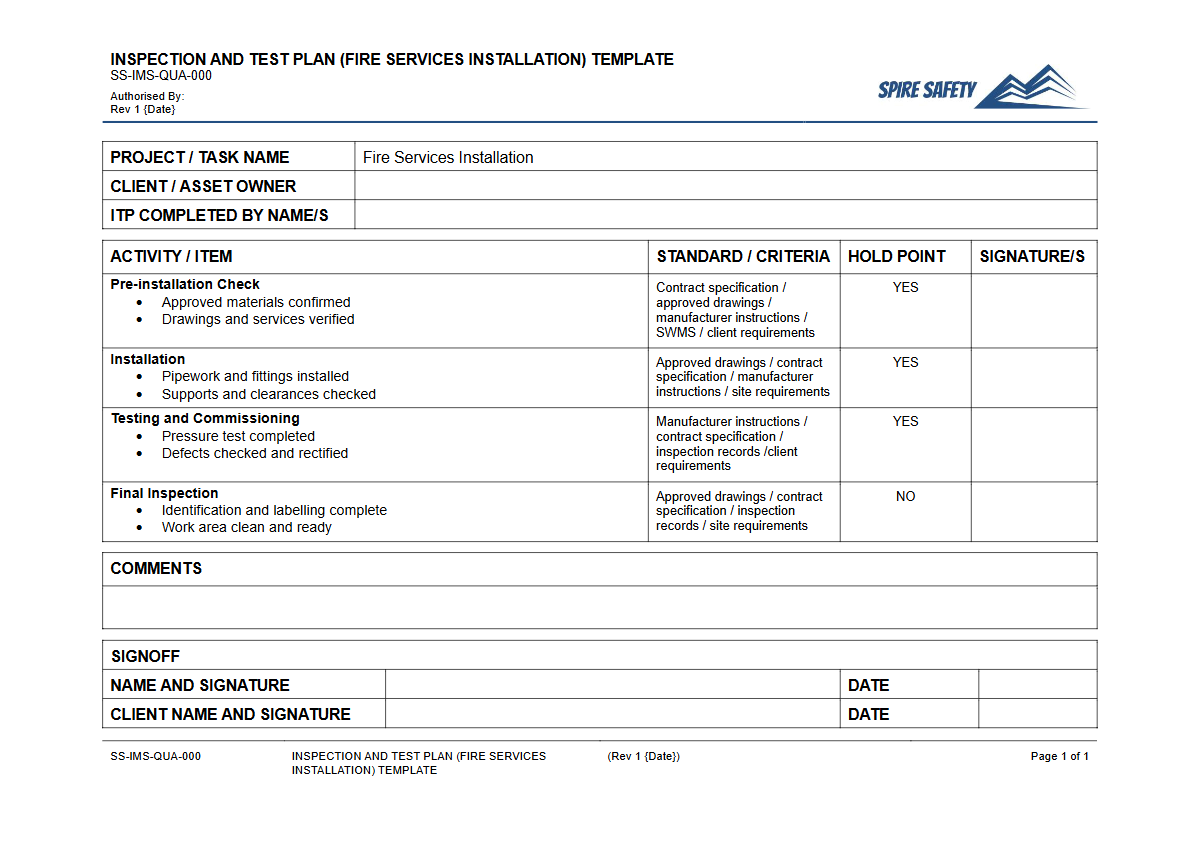
An Inspection and Test Plan (ITP) is a crucial quality assurance document that outlines the plan for managing verifications and checks throughout a project. This Free Inspection & Test Plan (Fire Services Installation) Template provides a structured framework to ensure all critical stages of a fire system installation meet the required quality, safety, and compliance benchmarks.
It serves as a formal record, detailing every inspection, test, and verification activity from design review through to final commissioning. Implementing a robust ITP is a fundamental component of broader WHS management systems, providing tangible evidence that work is being completed to specification.
Using this template helps formalise the quality control process, ensuring that all components and installation work comply with project specifications, Australian Standards, and the National Construction Code (NCC). It establishes clear hold and witness points, which prevents work from proceeding until critical checks are completed and signed off.
This systematic approach minimises the risk of defects, rework, and non-compliance, ultimately safeguarding the building's occupants and assets by ensuring the fire protection systems function as intended.
Video walkthrough
How to use the Free Inspection & Test Plan (Fire Services Installation) Template
This Inspection & Test Plan is available as a fully editable DOCX file and a ready-to-use PDF. The DOCX format allows for complete customisation to align with your specific project's scope, standards, and terminology.
The goal is to provide a comprehensive yet flexible starting point for your quality and compliance documentation.
It is crucial to remember that this template is a starting point. We have designed it to be adapted to your specific project's requirements, including the types of fire systems being installed (e.g., sprinklers, detectors, alarms, suppression systems), relevant Australian Standards, and your site-specific risks.
You must review and customise every section to ensure it is fit for purpose for your operations.
The template is structured to guide you through defining key stages, inspection types (e.g., visual, dimensional, functional), acceptance criteria, and responsible personnel. It includes columns for recording results, verifying documentation, and obtaining sign-offs.
For more granular, task-specific checks before operating equipment, you can integrate procedures from documents like our free pre-start checklist for fire panels into your overall safety process.
When to use an Inspection & Test Plan
An ITP for fire services installation should be developed and approved during the project's planning and design phase, well before any physical installation work commences. It forms a key part of the project quality plan.
Once established, the ITP becomes a live document that is actively used and updated throughout the entire project lifecycle. This includes the procurement and receiving of materials, all stages of installation and assembly, pre-commissioning checks, and final system testing and handover.
The completed ITP, with all its signatures and attached records, serves as a permanent quality record. It provides the objective evidence required during handover and can be a critical document during subsequent maintenance activities or any formal WHS compliance auditing. Maintaining this record demonstrates due diligence and commitment to quality and safety standards.
Who should use this Inspection & Test Plan
This template is designed for use by various personnel involved in construction and building services projects where fire systems are being installed. Key users include:
- Project Managers: To oversee project quality and supports your compliance efforts milestones are being met.
- Quality Assurance/Quality Control (QA/QC) Managers: To manage, implement, and document the project's quality verification activities.
- Site Supervisors and Foremen: To manage the day-to-day execution of inspections and tests on site and ensure hold points are respected.
- Specialist Fire Services Contractors: To define their work's compliance and quality checks and provide evidence to the principal contractor or client.
- Consulting Engineers and Client Representatives: To review and approve the quality plan and witness critical tests.
The ITP also functions as a vital communication tool, clearly defining responsibilities and expectations for all stakeholders. It ensures everyone understands what needs to be checked, when, and by whom, which is a core component of effective WHS consultation processes. For companies seeking to enhance their safety documentation, our free WHS resources library offers a wide range of additional templates and guides.
Common mistakes
Common mistakes to avoid
- Using a generic ITP template without customising it for the specific project, standards, and materials.
- Proceeding past a designated 'hold point' without obtaining the required inspection and signature.
- Failing to maintain accurate and complete records, including attaching test certificates and reports to the ITP.
- Not referencing the correct and most current versions of Australian Standards or the National Construction Code.
Legal references
Legal considerations
The following legal requirements may be relevant to this type of work.
- Work Health and Safety Act (Harmonised) — Provides the primary duties for protecting workers and other people from work health and safety risks.
- Work Health and Safety Regulations (Harmonised) — Sets out requirements supporting the management of workplace hazards and risks.
The following codes may be relevant to this type of work.
- Managing WHS Risks Code of Practice — Provides practical guidance on identifying hazards, assessing risks and applying effective controls.
- Work Health and Safety Consultation, Cooperation and Coordination Code of Practice — Provides practical guidance on consulting workers and coordinating with other duty holders.
- Managing the Work Environment and Facilities Code of Practice — Provides practical guidance on safe work environments, workplace facilities and related controls.
Did you know
Maintenance Standard
Australian Standard AS 1851, 'Routine service of fire protection systems and equipment', sets the requirements for the inspection, testing, and maintenance of fire systems *after* they are installed, forming a critical part of a building's ongoing safety management.
FAQ
Frequently asked questions
01What is the difference between an Inspection & Test Plan (ITP) and a Safe Work Method Statement (SWMS)?
02Does this ITP template cover all types of fire systems?
03Are Inspection and Test Plans a legal requirement in Australia?
04What are 'hold points' and 'witness points' in an ITP?
Share this resource
Free Inspection & Test Plan (Fire Services Installation) Template
Browse Categories
How To Use It
- 1Download and open in Word or PDF.
- 2Replace the placeholders with your business details.
- 3Get it reviewed by a WHS specialist before rollout.
Need it customised?
Our WHS consultants can adapt this template to your site, run a gap analysis, or audit what you already have in place.
Book a Free Consultation WHS consulting servicesor call 1300 156 382
Related templates
- Free Inspection & Test Plan (Fire Sprinkler System) Template
- Free Inspection & Test Plan (Floor Levelling Screeding) Template
- Free Inspection & Test Plan (Floor Tiling) Template
- Free Inspection & Test Plan (Format) Template
- Free Inspection & Test Plan (Formwork) Template
- Free Inspection & Test Plan (Glazing) Template