
Free Inspection & Test Plan (Glazing) Template
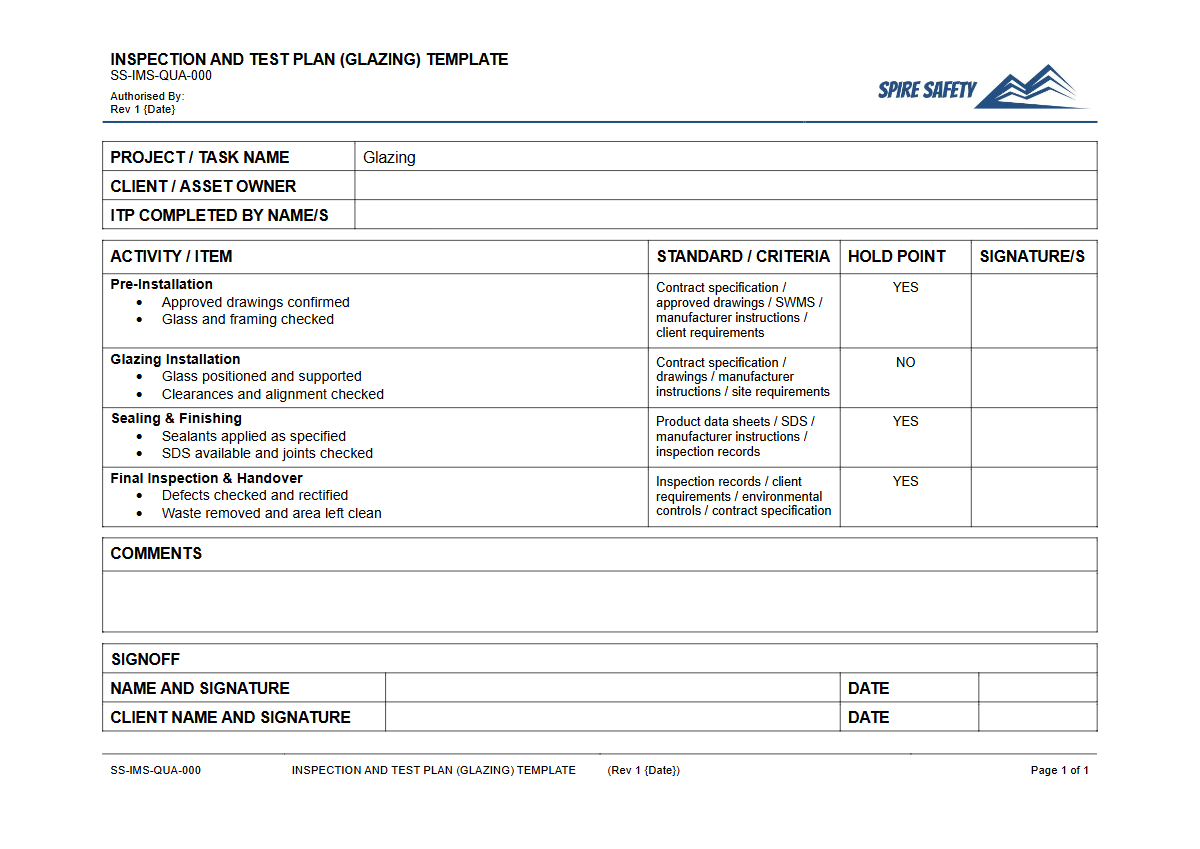
Download our free Inspection & Test Plan (Glazing) Template. This structured DOCX & PDF helps you define quality and safety checks for glazing projects.
Free Inspection & Test Plan (Glazing) Template
DOCX • 140 KB + PDF
Updated Oct 2026
No signup required
Purpose of the Free Inspection & Test Plan (Glazing) Template
This Free Inspection & Test Plan (Glazing) Template provides a structured framework for defining the quality control and verification activities for glazing installation projects. An ITP is a critical document that outlines key stages, inspection points, responsibilities, and acceptance criteria to ensure work complies with project specifications, Australian Standards, and safety requirements.
Using an ITP helps formalise quality assurance, manage non-conformances, and provide clear evidence of compliance for clients and regulators. It systematically addresses risks associated with glass handling, installation methods, and structural integrity.
Implementing a robust ITP is a cornerstone of effective project management and demonstrates a proactive approach to safety and quality. It forms an integral part of broader WHS management systems, ensuring that processes are not just planned but are also consistently verified and documented.
This systematic approach reduces the likelihood of costly rework, material wastage, and safety incidents on site.
Video walkthrough
How to use the Free Inspection & Test Plan (Glazing) Template
Our free ITP template for glazing is designed as a comprehensive starting point. To use it effectively, download the DOCX file and adapt it to the unique demands of your project.
This involves reviewing each section and customising the hold points, witness points, inspections, and tests to align with your specific scope of works, client requirements, and the types of glass systems being installed.
Important: This template is a starting point. We have designed it to be customised to reflect the specific hazards, risks, control measures, and project requirements of your workplace and operations.
You must reference relevant documents, such as architectural drawings, engineering specifications, supplier data sheets, and Australian Standard AS 1288. Ensure all personnel involved understand their roles and responsibilities as defined in the plan.
Integrating with other safety processes
An ITP works alongside other key safety documents. While the ITP focuses on quality and verification checkpoints, a Safe Work Method Statement (SWMS) details the step-by-step process for performing high-risk construction work safely.
The findings from inspections documented in your ITP can also inform broader site safety reviews. For related activities, you might also use our free WHS Inspection (Vehicle Workshop) Template if your glazing work includes vehicle fleet maintenance or pre-fabrication in a workshop environment.
When to use an Inspection & Test Plan
An ITP should be developed and approved during the project planning phase, well before any physical work commences. It is a live document used throughout the project lifecycle, from material receival to final handover.
It is particularly critical for commercial, industrial, and high-rise residential construction where quality and compliance requirements are stringent. The plan serves as a roadmap for supervisors and installation crews, guiding them on when and how to conduct required checks.
Completed ITP records are also essential during project close-out and may be required as part of handover documentation. They provide a verifiable audit trail of quality control, which is invaluable during any future WHS compliance auditing or if defects are identified post-completion.
An ITP is a proactive tool for managing quality, not just a reactive one for finding faults.
Who should use this template
This Inspection & Test Plan template is intended for use by various personnel involved in construction and glazing projects. Key users include:
- Project Managers: To oversee project quality, ensure contractual obligations are met, and manage project milestones.
- Site Supervisors & Forepersons: For day-to-day management of quality on site, directing crews, and signing off on inspection points.
- Quality Managers & Advisors: To establish and monitor the project's quality framework and ensure procedural adherence.
- WHS Advisors: To ensure safety requirements are integrated into quality checkpoints, particularly for high-risk tasks like working at heights or manual handling of large glass panels. Seeking external expertise from WHS consulting professionals can help integrate complex safety and quality requirements.
- Leading Hand Glaziers: To conduct inspections and tests at critical stages of the installation process.
While glazing involves specific risks, the principles of planning and verification are universal in high-risk industries. The structured approach of an ITP is a fundamental tool for managing operational risks, similar to how specialised sectors use documents like Principal Mining Hazard Management Plans to control major hazards. For more document templates to support your operations, explore our complete free WHS resources library.
Common mistakes
Common mistakes to avoid
- Using a generic template without customising it for project-specific materials and standards.
- Failing to reference the correct version of Australian Standard AS 1288 and other relevant specifications.
- Not properly training supervisors and installers on their responsibilities within the ITP.
- Poor record-keeping, with missed sign-offs for critical hold and witness points.
Legal references
Legal considerations
The following legal requirements may be relevant to this type of work.
- Work Health and Safety Act (Harmonised) — Provides the primary duties for protecting workers and other people from work health and safety risks.
- Work Health and Safety Regulations (Harmonised) — Sets out requirements supporting the management of workplace hazards and risks.
The following codes may be relevant to this type of work.
- Managing WHS Risks Code of Practice — Provides practical guidance on identifying hazards, assessing risks and applying effective controls.
- Work Health and Safety Consultation, Cooperation and Coordination Code of Practice — Provides practical guidance on consulting workers and coordinating with other duty holders.
- Managing the Work Environment and Facilities Code of Practice — Provides practical guidance on safe work environments, workplace facilities and related controls.
Did you know
Safety Glass Standards
In Australia, AS 1288 mandates the use of Grade A safety glass (laminated or toughened) in high-risk areas like doors, side panels, and low-level glazing to minimise the risk of cutting or piercing injuries if the glass breaks.
Hold vs. Witness Points
An ITP uses 'Hold Points', where work must stop until a formal inspection is completed, and 'Witness Points', where an inspection must be observed but work does not need to stop, allowing for more flexible project flow.
FAQ
Frequently asked questions
01What is the difference between an Inspection & Test Plan (ITP) and a Safe Work Method Statement (SWMS)?
02Does this ITP template cover specific types of glazing like structural or fire-rated glass?
03How often should an Inspection and Test Plan be reviewed?
04Is an ITP a mandatory WHS document in Australia?
Share this resource
Free Inspection & Test Plan (Glazing) Template
Browse Categories
How To Use It
- 1Download and open in Word or PDF.
- 2Replace the placeholders with your business details.
- 3Get it reviewed by a WHS specialist before rollout.
Need it customised?
Our WHS consultants can adapt this template to your site, run a gap analysis, or audit what you already have in place.
Book a Free Consultation WHS consulting servicesor call 1300 156 382
Related templates
- Free Inspection & Test Plan (Grease Trap Installation) Template
- Free Inspection & Test Plan (Green Flat Roof System) Template
- Free Inspection & Test Plan (Guttering and Downpipes) Template
- Free Inspection & Test Plan (Hot Water System Installation) Template
- Free Inspection & Test Plan (HVAC Installation) Template
- Free Inspection & Test Plan (Hydraulic Balancing) Template