
Free Inspection & Test Plan (Hot Water System Installation) Template
Download our free Inspection & Test Plan (Hot Water System Installation) Template.
Free Inspection & Test Plan (Hot Water System Installation) Template
DOCX • 139 KB + PDF
Updated Oct 2026
No signup required
Purpose of the Free Inspection & Test Plan (Hot Water System Installation) Template
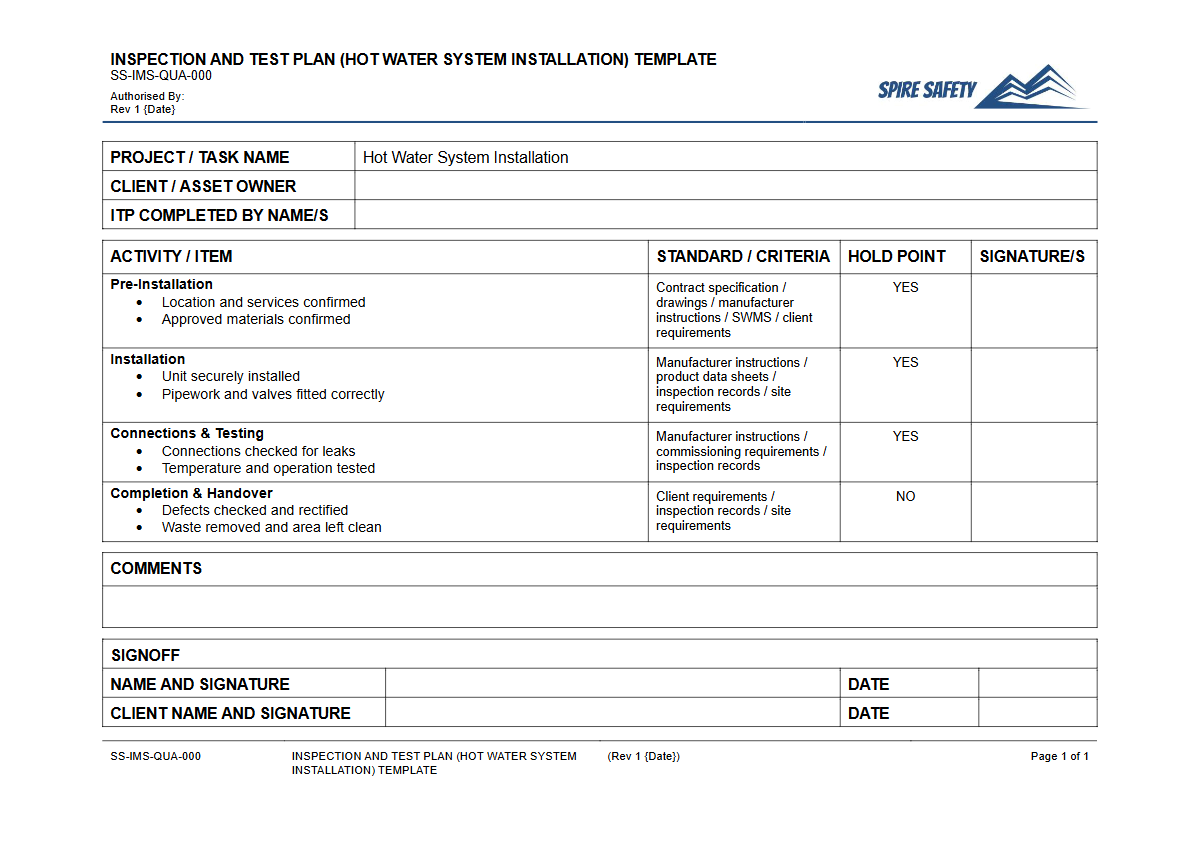
Ensure every hot water system installation meets quality standards and safety requirements with our free Inspection & Test Plan (Hot Water System Installation) Template. This downloadable document provides a structured framework for plumbers, project managers, and safety professionals to plan, verify, and record all critical inspection and testing activities.
Available in DOCX and PDF, it is designed to be adapted to your specific project needs, aligning with good work health and safety practices.
An Inspection and Test Plan (ITP) is a crucial quality assurance document that outlines the sequence of inspections and tests for a specific task. For hot water system installations, this includes verifying correct materials, ensuring compliance with Australian Standards, and testing the final system's performance and safety.
It provides clear hold and witness points, ensuring that critical stages are not missed and that work is verified by the appropriate personnel. Using a structured ITP helps prevent costly re-work, ensures client satisfaction, and provides documented evidence of a professional and safe installation.
It also serves as a key input for broader safety documentation, often working alongside a free Water Pump Risk Assessment Template to manage associated hazards.
Video walkthrough
How to use the Free Inspection & Test Plan (Hot Water System Installation) Template
This template is provided as a comprehensive starting point. After downloading the DOCX file, you can edit it to suit the unique requirements of your project, including the type of hot water system (e.g., storage, instantaneous, heat pump, solar), site conditions, and client specifications.
The PDF version is also included for easy printing and distribution.
To make this document effective, you must customise it for your specific project, equipment, and regulatory environment. We have provided a comprehensive starting point, but it is not a substitute for a site-specific risk assessment and quality plan.
Add your company branding, project details, and list the specific Australian Standards and codes of practice you are working to. A well-maintained ITP forms a core part of integrated WHS management systems, demonstrating a systematic approach to quality and safety.
When to use this Inspection & Test Plan
The ITP should be developed during the planning phase of a project, before any physical installation work begins. It serves as a roadmap for the entire installation process.
It is a live document used throughout the project lifecycle to guide and record quality checks. Key stages for its use include pre-commencement planning, verification during each installation step, and final commissioning and handover.
It should be used in conjunction with other key safety documents, such as a Water Cart Operation Safe Work Method Statement for related site activities that involve plant and water management.
Who should use this template
This template is designed for use by competent and qualified individuals involved in the installation and supervision of hot water systems. This typically includes:
- Licensed Plumbers and Gasfitters: The primary users who perform the installation and conduct the specified tests.
- Project Managers and Site Supervisors: Responsible for overseeing the project, ensuring quality control, and managing hold and witness points.
- WHS and Quality Assurance Personnel: Use the ITP to verify that processes are being followed and that compliance documentation is being completed correctly.
The competency of personnel is paramount for ensuring a safe and compliant installation. Verifying the skills and knowledge of individuals performing high-risk work is a critical safety control.
A formal process, such as implementing a Verification of Competency for water cart operators, is an example of how organisations can ensure their teams are appropriately skilled for specific tasks.
Key Components of a Hot Water System ITP
A robust ITP contains several key elements to guide the quality control process effectively. This template is structured to capture these components, ensuring a thorough approach to verification.
Verification Activities
This is the core of the ITP, listing each task or item to be inspected. For a hot water system, this includes checking the slab or base, verifying pipe material and size, confirming valve locations (isolation, tempering, pressure limiting), and ensuring correct electrical or gas connections.
Acceptance Criteria
For each activity, clear acceptance criteria must be defined. This is usually a reference to a specific clause in an Australian Standard (e.g., AS/NZS 3500), the manufacturer's installation instructions, or the project specifications.
It removes ambiguity and sets a clear standard for what is 'correct'. Independent verification of these criteria is often a component of formal WHS compliance auditing.
Records and Responsibilities
The ITP must specify what record is generated to prove the inspection was completed (e.g., a signature, a test certificate, a photograph) and who is responsible for performing the check, witnessing it, and signing it off. This creates a clear chain of accountability. You can find many more templates to support your processes in our free WHS resources library.
Common mistakes
Common mistakes to avoid
- Failing to customise the template for the specific system (e.g., solar vs. gas instantaneous).
- Not clearly defining or referencing the acceptance criteria (e.g., 'as per AS/NZS 3500.4 Clause 5.3').
- Skipping or 'pencil-whipping' hold points without the required authority's sign-off.
- Neglecting to record serial numbers of major components like the unit, tempering valve, or relief valves.
Legal references
Legal considerations
The following legal requirements may be relevant to this type of work.
- Work Health and Safety Act (Harmonised) — Provides the primary duties for protecting workers and other people from work health and safety risks.
- Work Health and Safety Regulations (Harmonised) — Sets out requirements supporting the management of workplace hazards and risks.
The following codes may be relevant to this type of work.
- Managing WHS Risks Code of Practice — Provides practical guidance on identifying hazards, assessing risks and applying effective controls.
- Work Health and Safety Consultation, Cooperation and Coordination Code of Practice — Provides practical guidance on consulting workers and coordinating with other duty holders.
- Managing the Work Environment and Facilities Code of Practice — Provides practical guidance on safe work environments, workplace facilities and related controls.
Did you know
Tempering Valve Requirements
In Australia, heated water delivered to sanitary fixtures used for personal hygiene (like showers and basins) must be tempered to a maximum of 50°C to prevent serious scald injuries. This is a critical safety check in any hot water system installation ITP.
The Plumbing Code
The Plumbing Code of Australia (PCA) is part of the National Construction Code and sets the mandatory technical requirements for all plumbing and drainage work in Australia. An ITP helps provide evidence that these requirements have been met.
FAQ
Frequently asked questions
01What is an Inspection and Test Plan (ITP) for a hot water system?
02Is this template compliant with Australian Standards?
03What are the key tests for a new hot water system installation?
04Who is responsible for signing off on an ITP?
Share this resource
Free Inspection & Test Plan (Hot Water System Installation) Template
Browse Categories
How To Use It
- 1Download and open in Word or PDF.
- 2Replace the placeholders with your business details.
- 3Get it reviewed by a WHS specialist before rollout.
Need it customised?
Our WHS consultants can adapt this template to your site, run a gap analysis, or audit what you already have in place.
Book a Free Consultation WHS consulting servicesor call 1300 156 382
Related templates
- Free Inspection & Test Plan (HVAC Installation) Template
- Free Inspection & Test Plan (Hydraulic Balancing) Template
- Free Inspection & Test Plan (Hydraulic Lift Pit) Template
- Free Inspection & Test Plan (Hydraulic Services) Template
- Free Inspection & Test Plan (Internal Door Installation) Template
- Free Inspection & Test Plan (Internal Wall Framing) Template