
Free Inspection & Test Plan (Hydraulic Balancing) Template
Download our free Inspection & Test Plan (Hydraulic Balancing) template to formalise quality control for HVAC and fluid systems. Customise this DOCX & PDF.
Free Inspection & Test Plan (Hydraulic Balancing) Template
DOCX • 138 KB + PDF
Updated Oct 2026
No signup required
Purpose of the Free Inspection & Test Plan (Hydraulic Balancing) Template
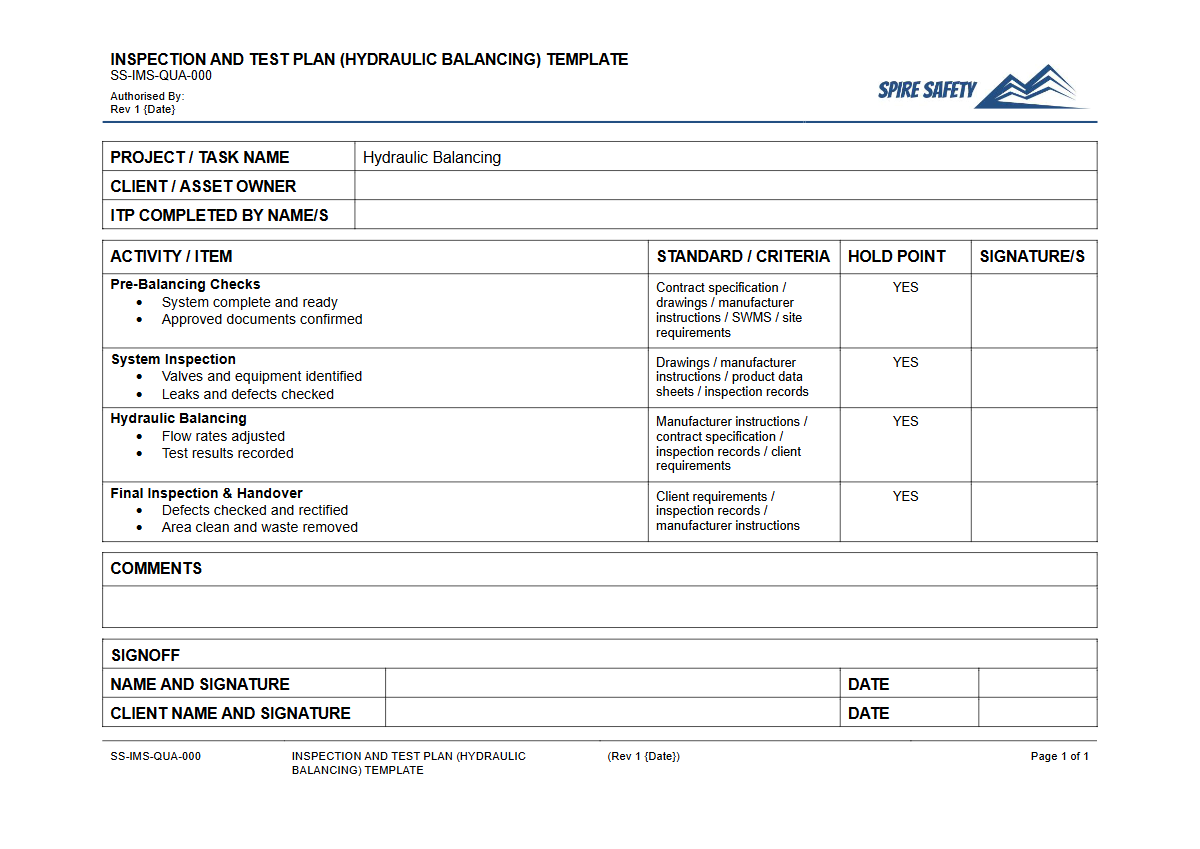
An Inspection & Test Plan (ITP) is a critical quality assurance document that provides a structured framework for managing and documenting the hydraulic balancing process. Our Free Inspection & Test Plan (Hydraulic Balancing) Template is designed to help you verify that HVAC, plumbing, and other fluid distribution systems are commissioned correctly and perform according to their design specifications.
It outlines the sequence of inspections, tests, and verifications required at each stage, ensuring every step is completed and signed off.
Using a formal ITP helps prevent common performance issues such as inadequate heating or cooling, noisy operation, and excessive energy consumption. It provides a clear record of compliance and quality, serving as objective evidence that the system meets project requirements and industry standards.
This process forms a vital component of robust WHS management systems by ensuring plant and equipment are installed and commissioned safely.
Video walkthrough
How to use the Free Inspection & Test Plan (Hydraulic Balancing) Template
This template provides a comprehensive starting point for your hydraulic balancing projects. It is available in DOCX format, allowing for full customisation to meet your specific needs.
The plan is structured to guide you through defining tasks, setting acceptance criteria, identifying verification methods (such as witness, review, or hold points), and recording outcomes. You can add or remove checkpoints based on the complexity of your system, client specifications, and relevant Australian Standards.
Please note: This template is a guide and starting point only. We have provided a solid foundation, but you must customise it to suit the specific requirements of your project, the type of hydraulic equipment, and your site-specific safety procedures and risk assessments.
When to Use This Inspection & Test Plan
This ITP is essential during the commissioning phase of new building constructions and mechanical system installations. It should be implemented after the system has been installed and flushed, but before the final handover to the client or facility manager. It is also highly valuable for:
- Major retrofits or upgrades to existing hydraulic systems.
- Re-commissioning systems after significant maintenance or modifications.
- Troubleshooting and diagnosing performance issues in existing buildings.
- Serving as a quality control tool within a broader project management framework, often verified through a WHS compliance auditing process.
Who Should Use This Template
This resource is designed for professionals responsible for the quality, performance, and safety of mechanical and fluid systems. Key users include:
- Mechanical Contractors and HVAC Technicians: For executing and documenting balancing procedures on site.
- Commissioning Agents and Engineers: To manage and verify the entire commissioning process from a technical oversight perspective.
- Project Managers: To track progress and ensure quality milestones are met before project handover.
- Facility Managers: To understand the baseline performance of their systems and use as a reference for future maintenance.
- WHS Advisors: To ensure that the commissioning process for plant is managed safely and that workers carrying out the tasks are competent. A formal Verification of Competency for a hydraulic impact wrench is one example of how specific competencies can be confirmed.
Whether you're working on a commercial high-rise, a hospital, or an industrial processing plant, this ITP provides the structure needed to deliver a perfectly balanced system. Similar principles of staged checks apply in many environments, from complex industrial sites to a vehicle workshop inspection where hydraulic hoists are tested.
For more templates covering a wide range of tasks and equipment, browse our complete free WHS resources library.
Common mistakes
Common mistakes to avoid
- Failing to properly flush and clean the system before starting balancing procedures.
- Using uncalibrated gauges and manometers, leading to inaccurate readings.
- Adjusting one circuit without considering its impact on the rest of the system.
- Poor record-keeping, making it impossible to verify work or troubleshoot issues later.
Legal references
Legal considerations
The following legal requirements may be relevant to this type of work.
- Work Health and Safety Act (Harmonised) — Provides the primary duties for protecting workers and other people from work health and safety risks.
- Work Health and Safety Regulations (Harmonised) — Sets out requirements supporting the management of workplace hazards and risks.
The following codes may be relevant to this type of work.
- Managing WHS Risks Code of Practice — Provides practical guidance on identifying hazards, assessing risks and applying effective controls.
- Work Health and Safety Consultation, Cooperation and Coordination Code of Practice — Provides practical guidance on consulting workers and coordinating with other duty holders.
- Managing the Work Environment and Facilities Code of Practice — Provides practical guidance on safe work environments, workplace facilities and related controls.
Did you know
The 20% Rule
An improperly balanced hydronic system can increase a building's energy consumption by up to 20% due to pumps working harder than necessary and inefficient heat transfer.
Pascal's Principle
All modern hydraulic systems operate on Pascal's Principle, a concept described by French mathematician Blaise Pascal in 1647. It states that pressure applied to an enclosed fluid is transmitted undiminished to every portion of the fluid and the walls of the containing vessel.
FAQ
Frequently asked questions
01What is hydraulic balancing?
02Are 'witness points' and 'hold points' the same thing in an ITP?
03Is an Inspection & Test Plan mandatory for hydraulic balancing in Australia?
04Can I use this template for both small residential and large commercial projects?
Share this resource
Free Inspection & Test Plan (Hydraulic Balancing) Template
Browse Categories
How To Use It
- 1Download and open in Word or PDF.
- 2Replace the placeholders with your business details.
- 3Get it reviewed by a WHS specialist before rollout.
Need it customised?
Our WHS consultants can adapt this template to your site, run a gap analysis, or audit what you already have in place.
Book a Free Consultation WHS consulting servicesor call 1300 156 382
Related templates
- Free Inspection & Test Plan (Hydraulic Lift Pit) Template
- Free Inspection & Test Plan (Hydraulic Services) Template
- Free Inspection & Test Plan (Internal Door Installation) Template
- Free Inspection & Test Plan (Internal Wall Framing) Template
- Free Inspection & Test Plan (Kitchen Cabinetry Installation) Template
- Free Inspection & Test Plan (Landscaping Civil Works) Template